










Is your service orchestration layer ready for autonomous operations?
- The service orchestration challenge is real. And it is solvable. Networks have evolved from predictable physical assets to dynamic software-defined environments.
- Communication service providers (CSPs) have not made the same leap, resulting in a widening gap between how fast the network can change and how quickly operations can respond. The operations layer needs to evolve just as fundamentally as the network itself.

Senior Solution architect
Senior Solution architect
Senior Solution architect
5G has changed what networks can do. Network slicing, virtualization, and cloud-native deployments have introduced a level of operational complexity that did not exist a generation ago. Services now span multiple domains simultaneously, each governed by distinct Service Level Objectives (SLOs) that collectively underpin the end-to-end Service Level Agreements (SLAs) committed to the customer.
None of this is surprising. It is the nature of a generational shift. If you are managing a multi-domain network today, you already feel this. The orchestration challenge is not a future concern. It is a present one. The good news is that the path to solving it is well understood, the technology is mature, and the architecture is proven. The challenges we face are:
- Operationalizing the translation of business intent into automated service orchestration and assurance.
- Enabling self-healing, self-configuring, and self-optimizing networks by supporting higher levels of operational autonomy through real-time inventory management, closed-loop assurance, intent-based control, and AI-driven decision making.
The first challenge is fundamentally about how orchestration layers interpret intent and act on it. The second is about visibility. Real-time, unified insight across your service and network inventory is what makes closed loop automation work, without someone having to step in at every decision point. Both are solvable. And both lead back to the same foundational architectural choices.
Why agentic AI changes everything
The first wave of AI in network operations focused on giving people better information faster. Anomaly detection, predictive alerts and intelligent dashboards are valuable capabilities, but fundamentally passive. The AI informs. You decide. The system acts.
The next wave is agentic AI. AI that does not just surface insights but autonomously acts on them. AI that can take a complex operational goal, decompose it into tasks, execute those tasks across multiple systems, and adapt when conditions change.
As TM Forum's IT with Intent: The interconnected future of telco operations report makes clear, this shift toward intent-driven, autonomous operations is not theoretical. It is the direction the industry is actively building toward. Watch discussions around this report in a webinar featuring Ericsson, TM Forum and Telstra. The future of telco IT operating models: the road to intent-based operations.
For service orchestration, this is a defining moment. If agentic AI is going to operate in a live network environment, making real-time decisions about service routing, fault remediation, slice management, and configuration, then the orchestration layer underneath needs to support that level of autonomous operation. It needs to receive intent from an AI agent, translate it into specific network actions, execute reliably, and feed results back so the agent can learn and adapt. This is not a distant aspiration. It is an architectural decision you can start making now.
The architecture that works is attainable
The TM Forum's Open Digital Architecture (ODA) framework provides the most mature blueprint for what this environment/system/solution looks like in practice. Three principles stand out, and each one maps directly to what agentic AI demands from an orchestration layer.
1. Composability Replace tightly coupled OSS systems with independently deployable components, each responsible for a discrete capability, each exposing standardized APIs. When every OSS function is a composable component with a clean interface, an AI agent can orchestrate across them dynamically. It combines capabilities in response to real-time demands rather than following pre-scripted workflows.
This modular, API-first design is what enables the flexibility that autonomous operations require. Without it, your orchestration layer will always be one step behind what your network and your AI models need from it.
2. A shared data layer Intelligence locked inside individual applications is one of the most persistent obstacles to automation. Your fault management system knows things your performance management system does not. Your inventory holds data your orchestration layer cannot easily access.
The answer is not a single monolithic data store; it is a unified data fabric. A logical layer that provides consistent, real-time access to data across distributed systems, regardless of where that data physically lives. When all components can observe and act on a coherent, federated view of the network, AI models have the contextual foundation they need to make reliable decisions. Without this unified data access layer, intelligent orchestration remains out of reach regardless of how capable your AI models are.
3. Intent-based operation. Rather than telling the network exactly how to achieve a desired state, intent-based systems express what state to achieve, and the orchestration layer works out the how. This is architecturally aligned with how agentic AI operates.
An AI agent receiving a service quality objective can express it as intent, and the orchestration layer translates it into specific actions across the relevant network functions. You do not need AI that understands every low-level detail of every network element. You need an orchestration layer that translates intent into action safely and consistently.
Your path to autonomous operations starts here and now
The journey toward autonomous operations has four practical stages. The key is to build each layer properly before adding the next.
Stage 1: Connected. The foundational plumbing is in place. Systems expose APIs. Data flows between domains. Manual processes are digitized. If you are still building this consistently across your full OSS landscape, that is the right work to be doing. Getting the foundations right matters more than moving fast.
Stage 2: Automated. Specific workflows run end to end without human intervention. Fault resolution for known patterns, provisioning for standard service types, performance threshold management. You are still in the loop for exceptions and novel situations, but routine operations no longer require someone at a terminal.
Stage 3: Orchestrated. The orchestration layer becomes intelligent and dynamic. Pre-defined closed-loop workflows handle known fault patterns and service conditions without human intervention. Intent-based interfaces allow AI models to express desired outcomes, and the system executes against those outcomes within established policy boundaries. Human oversight remains necessary for novel situations or scenarios that fall outside pre-modelled patterns.
Stage 4: Autonomous. This is where agentic AI changes the model fundamentally. Rather than executing pre-scripted workflows, agentic AI reasons across real-time context, decomposes complex operational goals into dynamic task sequences, and acts across the full-service lifecycle, including situations it has never encountered before. You are no longer governing individual operational decisions. You set the intent, define the operational boundaries, and review outcomes. The AI operates and adapts within those boundaries independently.
Each stage builds on the last. The gap between where you are today and where autonomous operations require you to be is real. But we can close it together with a phased approach and the right architectural choices at each step.
Open standards are the foundation
Your network environment spans multiple vendors, multiple technology generations, and multiple domains. The orchestration layer you build needs to reflect that reality from the start.
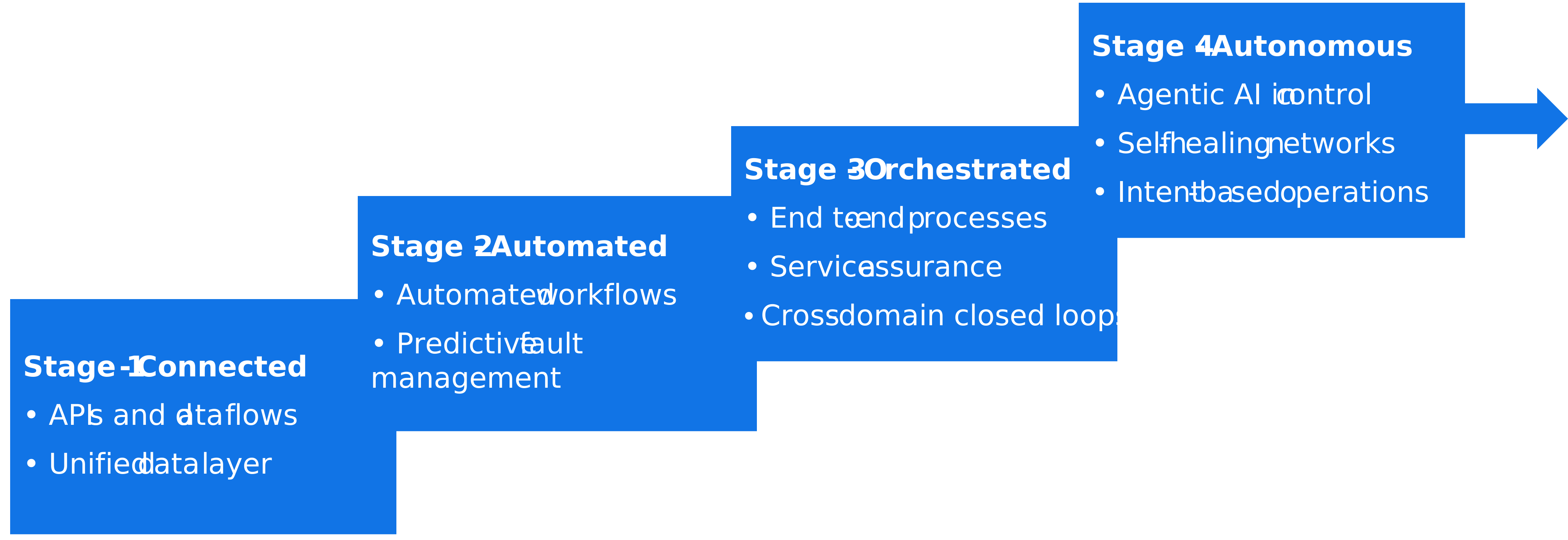
Figure 1. CSPs route to autonomous operations based on intent and Agentic AI
TM Forum's open APIs, ETSI's cloud-native network function specifications, and O-RAN's open interfaces are the connective tissue that allows best-of-breed capabilities to work together without custom integration for every combination. Design your orchestration layer to be heterogeneous by default, able to work with components across your full technology landscape.
This is architecturally demanding. It requires rigorous API governance, robust data modelling, and careful management of interoperability. But it is the only approach that gives you the flexibility to innovate at the pace of your market demands.
The service orchestration layer is where it gets decided
The future of autonomous networks will not be decided by radio technology or the AI model alone. It will be decided by how well orchestration capabilities are embedded across every layer of the network, from domain-level intent management functions that translate AI-driven goals into specific network actions, to the service orchestration layer that coordinates outcomes across domains. Whether centralized or distributed, these orchestration functions are the connective tissue between intelligence and action. Getting this layer architecturally, technically, and operationally right, is what determines whether autonomous operations deliver on their promise.
The architecture is proven. The technology is ready. The path is clear.
The final point that matters as much as the architecture itself is that this is not purely a technology journey. The path to autonomous operations requires equal investment in people and processes. Operating models need to evolve alongside the technical architecture. Teams who have managed networks through manual processes for years will need new skills, new tools, and new ways of working. Governance frameworks need to define clearly where AI operates autonomously and where human judgment remains essential. The organizations that succeed will be those that treat cultural and operational transformation with the same rigor they apply to their architectural choices.
The organizations who make these choices now will be the ones setting the benchmark for everyone else in three years.
Read this TM Forum report on the future of telco operations: IT with Intent: The interconnected future of telco operations
View this TM Forum webinar: The future of telco IT operating models: the road to intent-based operations featuring Ericsson and Telstra
Read more
- How passive infrastructure will be managed in the era of autonomous networks
- Autonomous Operations: The path to resilient IT
- Autonomous networks: Use real-time inventory to unravel the challenge
- Service orchestration solutions
- OSS/BSS solutions - continuous evolution for continuous innovation
- Autonomous networks