










6G without the complexity: a simpler, single path from 5G
- What if we could introduce 6G without the complexity of multiple deployment paths? A single architecture would align the ecosystem, reduce market fragmentation and accelerate time-to-value for operators.
- Building on existing 5G investments enables a smooth evolution to 6G – supporting faster rollout, more efficient use of spectrum and earlier access to new services and revenue opportunities.

Master Researcher, Radio networks for machine type communication

Senior Expert, Core network architecture

Expert, Mobile networks architecture and signaling
Master Researcher, Radio networks for machine type communication
Senior Expert, Core network architecture
Expert, Mobile networks architecture and signaling
Master Researcher, Radio networks for machine type communication
Senior Expert, Core network architecture
Expert, Mobile networks architecture and signaling
The mobile communication industry has now entered the 6G study phase in 3GPP, with Release 20 underway and the first specifications expected toward the end of 2028. As work on the next generation accelerates, the key question is how to introduce 6G in a way that minimizes complexity while fully leveraging the scale and investments already built with 5G.
The introduction of 5G came with two deployment options: non-standalone (NSA) and standalone (SA). While NSA deployments enabled early rollouts, the coexistence of NSA and SA options also introduced parallel and sometimes diverging development paths, uneven feature availability and a slower path to monetization. With 6G, we have the opportunity to take a more focused approach from the outset.
At Ericsson, we believe that the most effective way to enable a fast, scalable and commercially successful introduction of 6G is to design a standalone system with a 6G RAN connected to a 6G core network (CN). This approach minimizes complexity, aligns the ecosystem and helps ensure that the full capabilities of 6G can be made available as early as possible.
What 5G deployment data shows
Recent deployment data reinforces this picture. According to a GSA report published in December 2025, 28 percent of operators known to be investing in 5G have invested in public 5G SA networks, corresponding to 181 operators worldwide, with an 18 percent increase compared to Q4 2024.
As operators transition from NSA to SA, they are beginning to realize the benefits of features such as network slicing, enabling new offerings like differentiated connectivity. At the same time, operators that introduced 5G SA early are now scaling these offerings more broadly.
Taken together, this highlights a dual reality: while 5G SA is delivering clear business value, the transition from NSA to SA has been more complex and gradual than initially expected. In hindsight it is clear that supporting multiple deployment options has led to market fragmentation. Network and device vendors have needed to support different roadmaps for NSA and SA features, resulting in uneven feature availability and performance. In addition, operators that chose to launch 5G NSA first had no ability to monetize new SA capabilities from the outset.
What this means for 6G architecture
In light of the 5G deployment experience, the 6G ecosystem is converging on the standardization of a single architecture in 3GPP: a standalone model in which 6G RAN connects to the 6G CN – based on an evolved 5G Core (5GC) – without dependencies on legacy radio access technologies (RATs). 3GPP studies on a 6G RAN architecture that supports standalone deployment are already underway.
Ericsson is a strong advocate of this approach. A standalone design will ensure a single primary control framework for device connection, avoiding the need to split control across multiple RATs and reducing system complexity. This approach is also the best way to achieve a fast rollout and enable operators and users alike to realize the full potential of 6G as quickly as possible.
By standardizing a single 6G architecture we can:
- Align industry focus, driving scale and faster time to market.
- Avoid phased deployments, enabling earlier and more predictable monetization.
- Streamline the architecture, reducing complexity in devices and networks.
- Reduce integration and testing efforts, lowering deployment costs.
All of these benefits are relevant both for early adopters launching new services and for operators evolving existing networks over time.
Key enablers of the standalone 6G architecture
From a system perspective, two of the most important enablers for a smooth introduction of a standalone 6G architecture are efficient use of spectrum and a seamless evolution of core network capabilities from 5G.
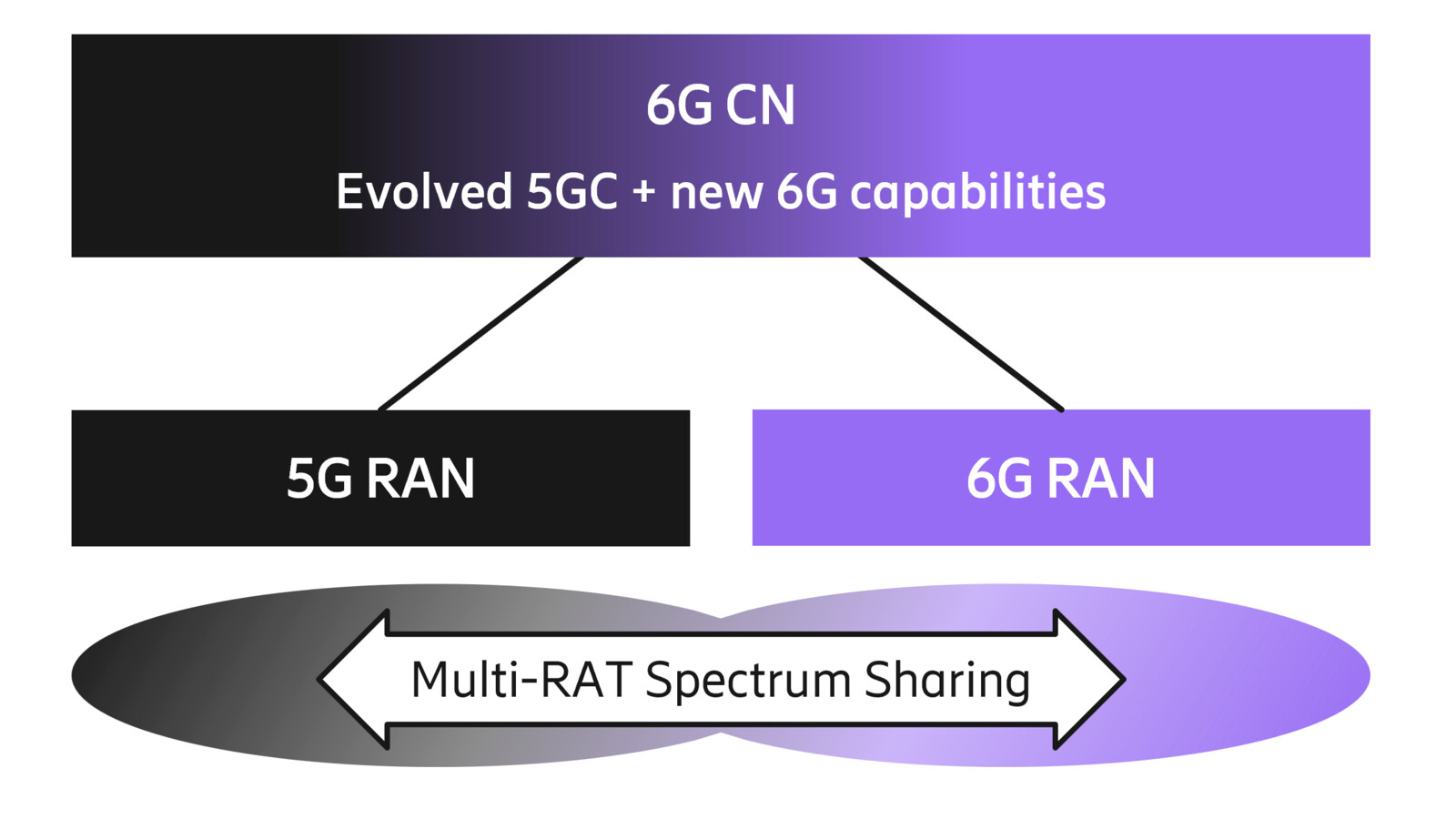
Key enablers of the standalone 6G architecture
Multi-RAT spectrum sharing
Multi-RAT spectrum sharing (MRSS) is a highly efficient approach to enable the smooth introduction of 6G in existing spectrum. It allows 5G and 6G to dynamically share spectrum resources based on traffic load and channel conditions – something that will be essential as 6G operates in both new spectrum and in spectrum already used by previous generations.
In particular, low- and mid-band spectrum is essential for wide-area coverage and will be shared between 5G and 6G at the time of 6G introduction. This is supported by the lean design of the 5G radio interface (reducing always-on signaling overhead). While 4G relied on always-on cell-specific reference signals, 5G reduced persistent broadcasting and introduced more flexible resource configurations. This enables efficient spectrum sharing mechanisms, including time- and frequency-domain multiplexing, between 5G and 6G.
At Mobile World Congress 2026, we demonstrated MRSS with very low overhead and the ability to dynamically adapt resource sharing. For example, resources can be adjusted between 5G and 6G depending on traffic demand, maintaining performance while ensuring high spectrum utilization.
Alternative approaches to spectrum sharing, such as those based on dual connectivity (DC), have significant drawbacks compared with MRSS. First, DC-based approaches introduce additional complexity by requiring that control of the device connection is split across multiple RATs and dividing device transmission power, both of which negatively impact uplink performance in realistic scenarios. Second, support for 6G-5G dual connectivity would lead to divergence in the ecosystem and would fundamentally undermine the concept of a single architecture, with all of its benefits.
A 6G core network based on the 5GC
At Ericsson, we think that the 6G CN should be based on an evolution of the 5GC, rather than defining a completely new system. Why? Because the 5GC has already proven to be extensible and future-proof, supporting capabilities such as network slicing, granular quality-of-service frameworks and exposure of network capabilities to applications. These capabilities are now enabling new service offerings and revenue opportunities.
A 5GC-based approach delivers several benefits:
- Operators can extend rather than rebuild existing service capabilities.
- Monetization enablers deployed with 5GC can be reused and evolved.
- A common user-plane anchor can be maintained, enabling service continuity.
- Standardization and development efforts can focus on enhancing capabilities, rather than replacing them.
In addition, this approach simplifies interworking with 4G and 5G by leveraging existing mechanisms, including established roaming interfaces.
Evolving the network architecture in 6G
In our view, the 6G core network should be designed based on four principles:
- Avoid unnecessary disruption.
- Reuse proven designs (such as 5GC).
- Enhance where needed.
- Leverage new business and technology enablers.
The first three are closely connected and reinforce each other. The fourth breaks down into two categories: introducing new capabilities and focusing on business-relevant interfaces.
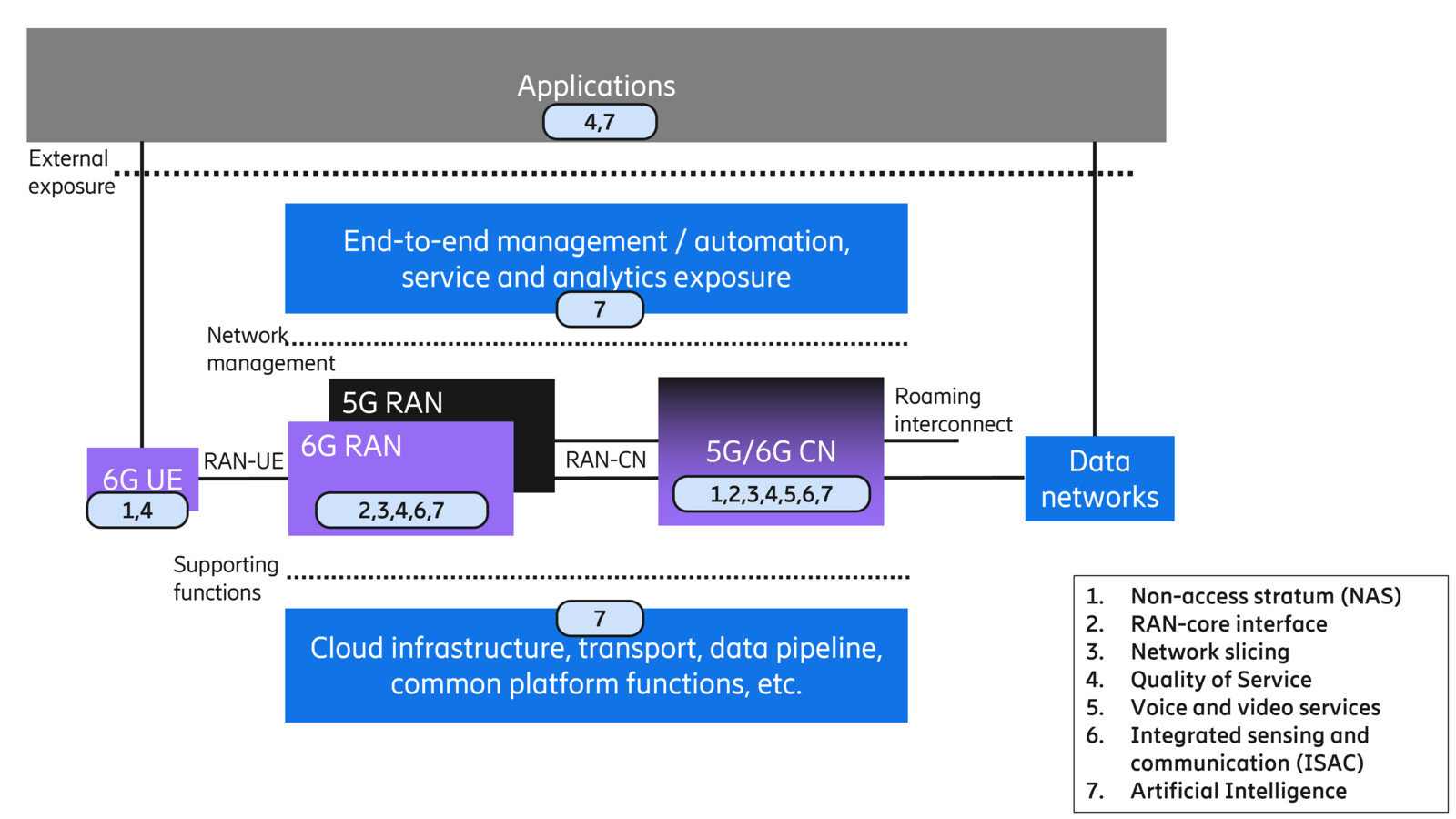
6G network architecture overview, showing impact to the different domains of the discussed evolution aspects
Minimizing disruption by reusing and enhancing proven designs
- Several key design aspects of 5G have proven effective and should be carried forward into 6G. For example, non-access stratum (NAS) signaling, with a single anchor point in the core network, has provided a clear separation between RAN and core network functions. Maintaining this principle avoids increased signaling complexity and supports efficient coordination.
- The RAN-core interface, a widely deployed multi-vendor interface, can be further evolved to a better support in cloud environments. Enhancements such as more flexible routing of signaling messages can improve robustness and scalability in dynamic cloud deployments.
- Network slicing will continue to evolve, for example by reducing dependencies on device implementation, enabling faster introduction of new slice-based services.
-
Similarly, the quality-of-service framework can be extended to support closer interaction between applications and the network, for example by allowing applications to adapt to network-provided performance information.
- For voice and video services, IP Multimedia Subsystem (IMS)-based solutions are expected to remain important, including for regulatory requirements. Reusing and evolving these capabilities simplifies the introduction of 6G.
Introducing new capabilities
- 6G will introduce a variety of new capabilities including integrated sensing and communication (ISAC). Unlike traditional communication services, sensing is not directly tied to individual users. A suitable architectural approach is to separate radio resource handling and radio-near sensing processing, located in the RAN, from higher-level sensing processing and exposure, located in the core network. This enables efficient resource usage while supporting flexible development of sensing services.
- Artificial intelligence is going to play a key role in future networks by enabling autonomous networks and AI-driven performance, among other things. 6G networks will also be optimized to support the emerging range of AI-driven applications and devices. Given the rapid evolution of AI technologies, standardization should focus on enablers such as data collection and exposure and avoid defining specific AI methods. This will allow networks to continuously benefit from advances in AI.
Focusing on business-relevant interfaces
Multi-vendor interfaces have been a foundation for the success of the mobile industry. However, over time, the number of interfaces has increased, adding complexity. As the industry targets new revenue streams, more focus is needed on business-relevant interfaces, such as exposure interfaces that enable applications to access network capabilities. At the same time, fundamental system interfaces – such as the radio interface, roaming interfaces and the RAN-core interface – remain critical and must continue to evolve.
Conclusion
6G is a major opportunity for the telecom industry – not only to introduce new capabilities, but also to rethink how we design, deploy and scale mobile networks.
The journey with 5G has provided us with valuable experience, showing how different deployment options can support early rollouts and diverse operator needs. At the same time, it highlighted the importance of keeping things simple and maintaining a clear evolution path when moving to the next generation. With 6G, we have the opportunity to apply these lessons from the outset.
In practice, it comes down to three key choices:
- A single standalone architecture, providing a clear and consistent deployment model across the ecosystem.
- Multi-RAT spectrum sharing, enabling efficient and flexible use of both existing and new spectrum.
- An evolved 5GC, building on proven capabilities and ensuring continuity for operators and services.
Together, these pillars create a simpler and more coherent foundation, supporting faster rollout and earlier monetization of 6G capabilities, while fully leveraging existing 5G investments.
If the industry can align early on this direction, 6G can build naturally on the strengths of previous generations while focusing innovation where it matters most: enabling new services and business opportunities at global scale.
Future network architecture
Sensing in 6G: Use cases and architecture
Read more
More about spectrum sharing