










How to accelerate automation in OSS/BSS with agent fabric
- Telecom networks are becoming too complex for effective manual management, making autonomous, self-managing networks essential to significantly reduce human intervention.
- Achieving this autonomy in operational and business workflows requires evolving OSS and BSS by embracing artificial intelligence (AI) capabilities.

Strategic Product Manager, Data and AI

Senior Expert – OSS/BSS

AI Architect, Business and Operations Support Systems

Product Marketing Manager, Business and Operations Support Systems
Strategic Product Manager, Data and AI
Senior Expert – OSS/BSS
AI Architect, Business and Operations Support Systems
Product Marketing Manager, Business and Operations Support Systems
Strategic Product Manager, Data and AI
Senior Expert – OSS/BSS
AI Architect, Business and Operations Support Systems
Product Marketing Manager, Business and Operations Support Systems
Multi-agent systems must be managed effectively
AI agents are expected to be operating across all telecommunication layers and autonomous domains. Capabilities range from AI assistance providing superior conversational experience to agentic workloads fully automating processes. Though the journey may start with the use of a single specific outcome-driven AI agent, multi-agent use-cases are already in the making. One example is intent management functions (IMF) with closed loop automation. Multiple AI agents collaborate: monitoring, analysing problems, proposing solutions and taking action. These AI agents are working to achieve a specific outcome that is fulfilling the requested intent. While multiple autonomous agents can independently achieve specific outcomes, their true potential emerges when their capabilities are combined. By deploying the loop on an agent fabric, we unlock modular, intelligent autonomy. Closed-loop agents can dynamically find and use other AI agents and tools when required.
The speed at which closed loops complete will depend on where they are placed, faster loops closer to the network and slower ones closer to the customer interface. Collaborating agents must be constantly monitored and provided with a robust ecosystem for them to deliver on their goals. Managing and orchestrating multi-agentic systems is complex. The need for better collaboration and role clarity increases as agents engage in faster decision making.
What is an AI Agent?
An AI agent is an autonomous system authorized to act, decide on tasks and self-initiate tasks, independently or on behalf of a person or entity. An AI agent perceives network conditions, reasons about them, and acts toward a goal without waiting for human instruction. It's goal-driven, not script-driven. But telecom problems rarely stay in one domain and single agents hit their ceiling at these cross-domain boundaries.
Multi-agent systems address this by deploying specialized agents. In multi-vendor environments different suppliers, each building their own agents and the challenge sharpens: how do agents from different vendors collaborate across domains without full ownership? Without a shared control plane, these agents operate blind to each other, duplicating work, conflicting on actions, and leaving CSPs to manually stitch together what should be coordinated autonomously. This is why we need an agent fabric.
What is an agent fabric?
An agent fabric is a centralized control plane or “fabric” layer for managing AI agents across an organization. The agent fabric provides discovery, governance, communication, routing and observability of AI agents distributed across systems. It facilitates the integration and coordination of intelligent agents, allowing them to perform complex tasks, share data, and make decisions collectively, enhancing efficiency and adaptability in dynamic environments. In simple terms, AI agents are: aware of each other, aware of each other’s actions and working toward common goals.
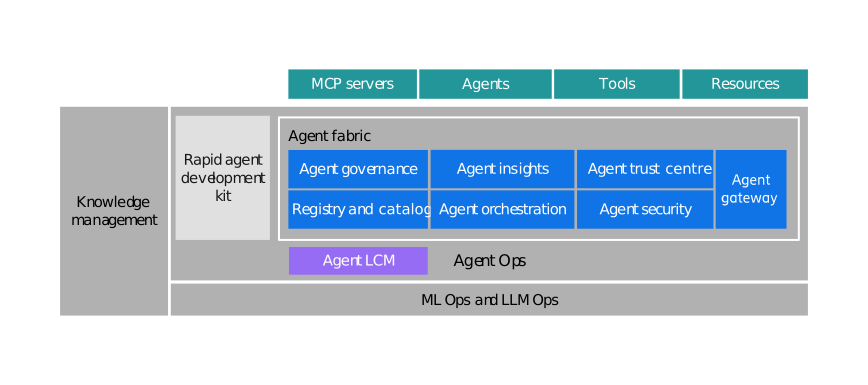
Figure 1: The agent fabric spans all agentic functions.
Four imperatives for impactful agent fabric:
1. Make agents aware of each other
In multi-vendor environments, AI agents must be discoverable and aware of one another. Security and trust are critical. A secure agent registry can act as the "source of truth" for both in-house and third-party AI agents. All agents must be authenticated against this registry before joining the orchestration layer, ensuring that only verified agents can participate. Standard interoperability protocols, most commonly the Agent-to-Agent (A2A) protocol and the Model Context Protocol (MCP), allow multi-vendor AI agents to share context and coordinate reliably at scale.
To orchestrate the ecosystem effectively, the agent fabric should conform to TM Forum standards for agent management and conversational assistants so that registration, dynamic capability discovery, and full lifecycle management are standardized. Embedded guardrails within the execution cycle perform real-time validation of an agent's reasoning path and consistently enforce both traditional software security and specialized AI safety measures, such as preventing goal hijacking.
2. Enable agents to discover tools, data and knowledge
Modern AI agents use small or large language models as their reasoning core, but intelligence alone isn't enough. Agents need connectivity to other agents, to models, to data, and to tools to turn reasoning into action. A tool might be an API access to another piece of software, for example, a call to an analytics tool to get the current state of the network or an action such as a reconfiguration request for a network slice orchestrator.
AI agents make reliable decisions when they have access to knowledge that maintains an up-to-date semantic view of the network across domains—anchored in a shared ontology and enriched with current state, constraints, and policies. This is the context (including guardrails) agents need to act on fresh conditions and historical patterns to determine compliant actions.
To prevent the agent ecosystem from becoming unmanageable, it is important to guarantee:
- Interoperability
- Standardised tool calling
- Structured re-use
A proper tool and knowledge registry is enabled by the agent fabric, with standardized protocols for tool calling.
3. Orchestrate multi-agent tasks
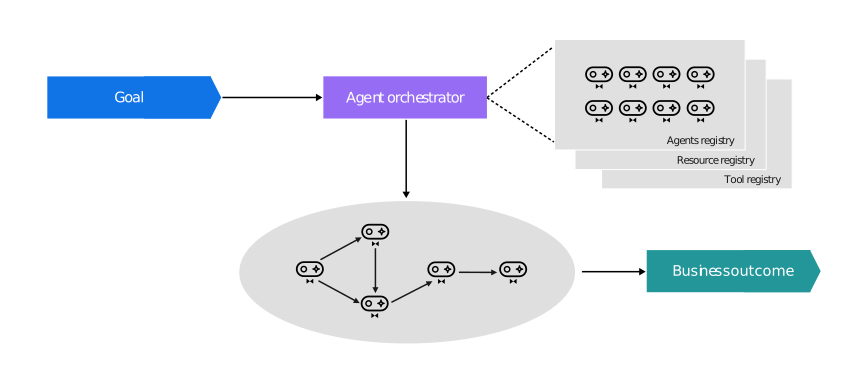
Figure 2: Agents can work toward common goals and business outcomes
Think of the agent fabric as an operating system for any enterprise-grade AI framework. The aim is to move beyond simple chat scripts toward complex, multi-agent workflows. Autonomous entities must collaborate, share state, and solve tiered problems without manual intervention. Insufficient orchestration, risks "agent sprawl," where unmanaged processes cause resource exhaustion and security vulnerabilities, inconsistent or conflicting behavior, overloaded systems and cascading failures. Ultimately, agents will not be able to perform their given tasks.
AI-powered agent orchestration manages the entire agent lifecycle: spawning, heartbeat monitoring, resource cleanup. Agents are also provided with the right context and are enabled with shared state by the fabric. In cloud environments, this enables dynamic scaling, where the framework enables elasticity to meet task demands. A built-in registration and discovery mechanism via a marketplace allows AI agents to broadcast their capabilities, making them programmatically searchable for multi-agent collaboration.
The agent fabric must also act as a sophisticated AI Gateway for external LLM integrations. This gateway should natively support enterprise-grade features like circuit breaking, fallback logic, and load scheduling to ensure resilience. This architecture ensures strict data isolation and governance, protecting sensitive internal resources while maintaining a highly scalable, compliant AI ecosystem.
4. Embed security and guardrails from the outset
Agent observability, evaluation and security are critical in telecommunications because AI agents run complex, non-deterministic, multi-step workflows. Observability allows for effective debugging, cost monitoring, reliability assessments, and evaluation of outputs for hallucinations, confidence, and relevance.
Since observability provides insight into AI agent performance and behavior, it naturally reinforces security and governance by preventing unsafe or unauthorized actions. Security and governance are mandatory: agents must be authorized for their environment, interact only with authorized agents and tools, and be protected against attacks. Guardrails enforce safe behavior through domain and context limits, hallucination checks, and content safety filters.
The agent fabric should provide native governance, centralized policy enforcement, auditing, and lifecycle controls, while also supporting standard security controls, since agents are software processes on conventional platforms. Together, observability and built in security ensure trustworthy and reliable agent deployments.
When administrators can access audit trails of the interaction between agents and tools, it’s clear how the ecosystem is performing and if agents are working within the stipulated boundaries, policies and guardrails.
Create a seamless agentic ecosystem for OSS/BSS with agent fabric
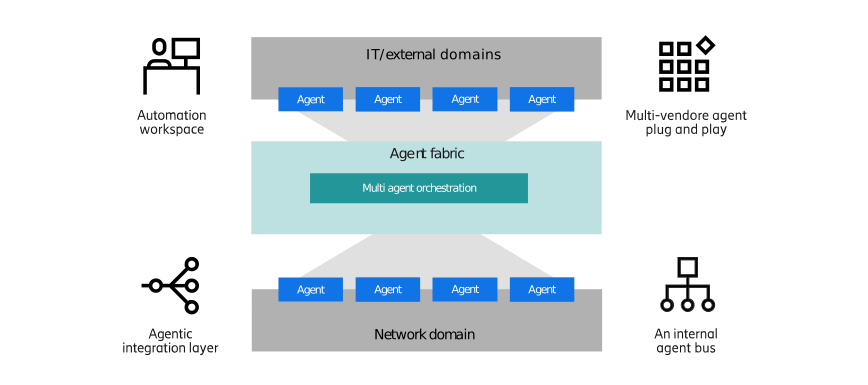
Figure 3: Agentic AI is an integral part of OSS/BSS
Agent fabric provides the foundational layer to operationalize agentic AI across the telco IT domain by enabling intelligent automation, multi-agent collaboration, and seamless cross-domain integration. It enables:
- Centralized automation workspace for designing and managing intent-based automation.
- Multi-vendor plug-and-play agent framework that is technology-agnostic with standardized telemetry and access control.
- Agentic integration layer connecting network, IT, and external domains.
- Internal agent bus that enables secure agent discovery, communication, and coordinated execution to achieve defined operational outcomes.
Avoid overwhelm and sprawl as your agentic systems grow. Find ways to effectively observe, manage, and govern multi-vendor AI agents, ensuring they operate within established guardrails and deliver the intended results. Creating an agentic environment that allows agents to discover other agents, tools, and resources will open the door to more dynamic and innovative automation possibilities. Achieving higher levels of autonomy demands innovating outcome-based agentic behaviour that is not pre-stitched.
AI agents are powerful enough to discover and coordinate tasks with other agents to achieve intended outcome, provided the right agent fabric is in place.
Ericsson provides the ecosystem framework and collaboration management that allows AI agents to coordinate tasks with each other effectively - so that multi-vendor agentic AI becomes viable and safe at scale. To know how Ericsson can help you to embrace agentic AI to automate and transform OSS/BSS, contact us on this link
Read More
Find out more about Agentic AI applications and use-cases in OSS/BSS:
- From data to decisions: Make agentic AI-driven telecom operations a reality
- Leverage agentic AI for intelligent charging and billing operations
- How multi-agent AI is transforming telco product configuration
- Grameenphone is the first CSP to develop Agentic AI solutions with the Gen-AI Lab from Ericsson and AWS
- When will AI agents begin to design and deploy new AI apps for OSS/BSS?
- AI-powered telecom data and analytics solutions
- IT with intent: the interconnected future of telco operations