










From data to decisions: Make agentic AI-driven telecom operations a reality
- 5G redefines how networks operate and how services are delivered. Traditional, reactive network management is evolving into a predictive data-driven and AI-enabled approach.
- Within operations and business support systems (OSS/BSS), a cohesive ecosystem of data, knowledge, analytics, and AI agents is enabling the transformation of vast data streams into real-time intelligence driving meaningful, autonomous actions across operations.

Strategic Product Manager, Data and AI

Strategic Product Manager, Data and AI, Business Area Cloud Software and Services, Ericsson

Strategic Product Manager

Strategic Product Manager, Business and Operations Support Systems

Product Marketing Manager, Business and Operations Support Systems
Strategic Product Manager, Data and AI
Strategic Product Manager, Data and AI, Business Area Cloud Software and Services, Ericsson
Strategic Product Manager
Strategic Product Manager, Business and Operations Support Systems
Product Marketing Manager, Business and Operations Support Systems
Strategic Product Manager, Data and AI
Strategic Product Manager, Data and AI, Business Area Cloud Software and Services, Ericsson
Strategic Product Manager
Strategic Product Manager, Business and Operations Support Systems
Product Marketing Manager, Business and Operations Support Systems
Why insight—not data—is the real bottleneck
Today’s telecom networks generate enormous volumes of telemetry, signaling, subscriber events, assurance metrics and operational alarms. Investments in data platforms, analytics tools and dashboards improve visibility across network, service, IT and customer-facing systems. While data is abundant, what’s still missing is the ability to convert fragmented data into timely, decision-ready action.
At the same time, communication service providers are expected to deliver highly reliable customer experiences while operating increasingly distributed and software-driven infrastructures. This creates a growing gap between operational complexity and human capacity to manage it.
As networks become increasingly distributed, software-driven and service-aware, operations teams must correlate information across domains in near real time. Traditional workflows based on isolated dashboards, static thresholds and manual troubleshooting cannot scale efficiently in this environment. Many incidents are resolved only after customer experience has already degraded.
The fundamental challenge is no longer data availability, but the lack of an intelligent operational loop that can continuously detect, predict, explain, recommend and act on subscriber-impacting incidents with appropriate human control.
Three outcomes that move the needle on network operations
Agentic AI enables a shift from reactive troubleshooting to assisted and accelerated issue resolution. By combining subscriber-level event data, data streaming, analytics tools, AI agents and a domain-specific knowledge base, Ericsson has developed an agentic network intelligence solution. It helps operations teams identify potential issues earlier, understand their likely causes and take informed action faster.
We unlock three key outcomes:
- Predictive customer experience protection: Detecting anomalies from subscriber-level events, given context, relationships, history and behavior patterns, provides correlated analytics signals before they become visible through alarms or customer complaints, enabling earlier intervention
- Knowledge-driven and consistent root cause analysis: Using the knowledge base to match predicted anomalies with historical incidents, documentation and past resolution patterns, helps engineers quickly identify the likely root cause.
- Guided and explainable resolution: Closing the loop through corrective actions with supporting context, allows the human in the loop to validate the remedy through a conversational interface, and triggers approved actuation through the appropriate downstream system.
Together, these capabilities reduce time to insight, improve operational consistency, accelerate incident resolution and create a practical path toward trusted autonomous operations.
The combined power of data, analytics, knowledge and AI agents in action
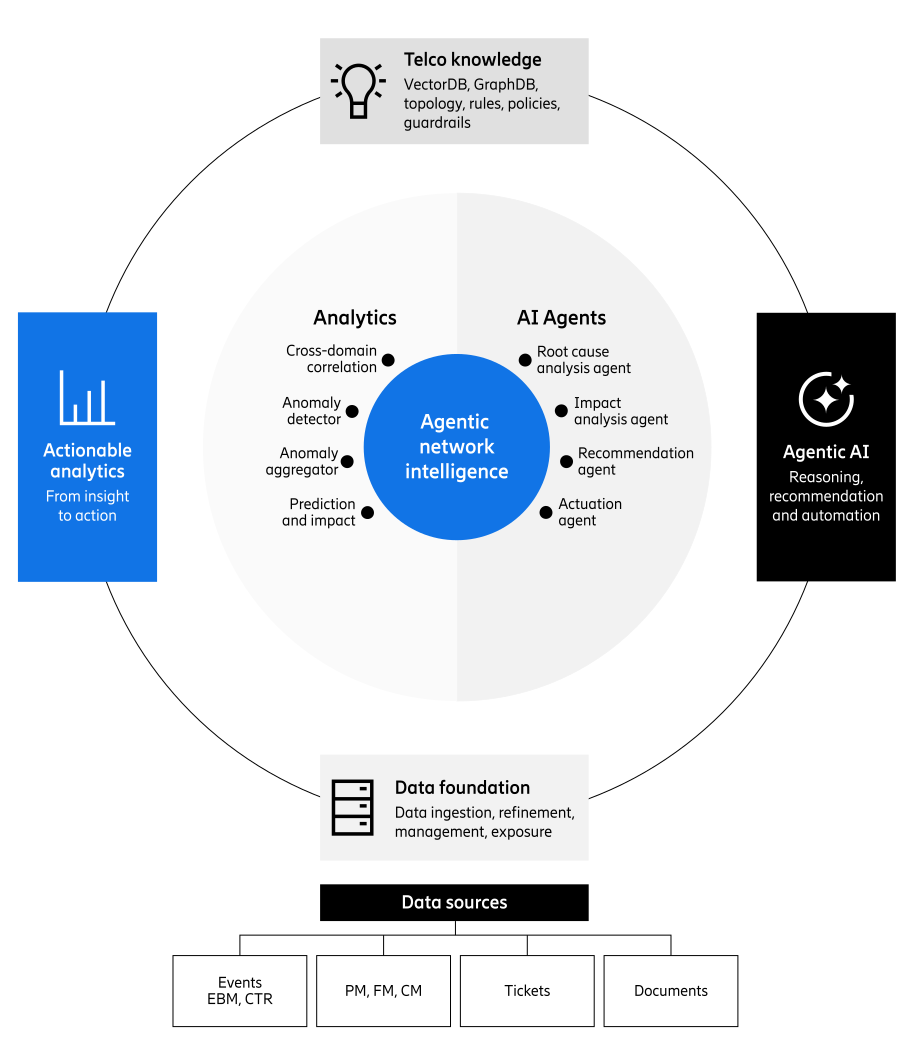
Figure 1: Network resolution intelligence brings together data foundation, advanced analytics, telecom knowledge and specialized AI agents
Let’s explore how this works. The foundation is real-time data streaming, ingestion and structuring of subscriber-level events and related operational data. High-volume data streams from network, IT and business systems are transformed into a consistent and accessible data foundation that can be reused across analytics and AI applications.
On top of this data foundation, analytics identifies anomalies, detects patterns and provides the operational context needed for decision-making. When an anomaly is detected, a root cause analysis agent is triggered. An impact analysis agent evaluates the likely consequences of not resolving the issue, helping the operations team prioritize based on service and customer impact.
The root cause analysis agent searches a telecom knowledge base populated with historical tickets, product and customer documentation, topology, configurations and operational knowledge. This knowledge base can evolve to span cross-domains and unify network entities, services, policies and their relationships through a shared semantic model. Built on graph database principles, this model captures dependencies, constraints and provenance to enable contextual understanding and traceability. Standardized interfaces support the querying, publishing, and governance of knowledge, creating a common foundation for AI agents and applications to drive intelligent automation and decision-making.
After the root cause is identified, a recommendation agent proposes suitable resolution options. These recommendations are based on previous successful fixes, telecom domain context and the specific conditions of the current incident. The human in the loop remains in control and can interact with the application through a chatbot to ask follow-up questions, understand the reasoning, compare alternatives and validate the proposed action.
Once the human in the loop approves the preferred remedy, the actuation agent invokes the required downstream actuation system, automation platform, Model Context Protocol (MCP)-enabled interface or relevant product API to execute the selected action.
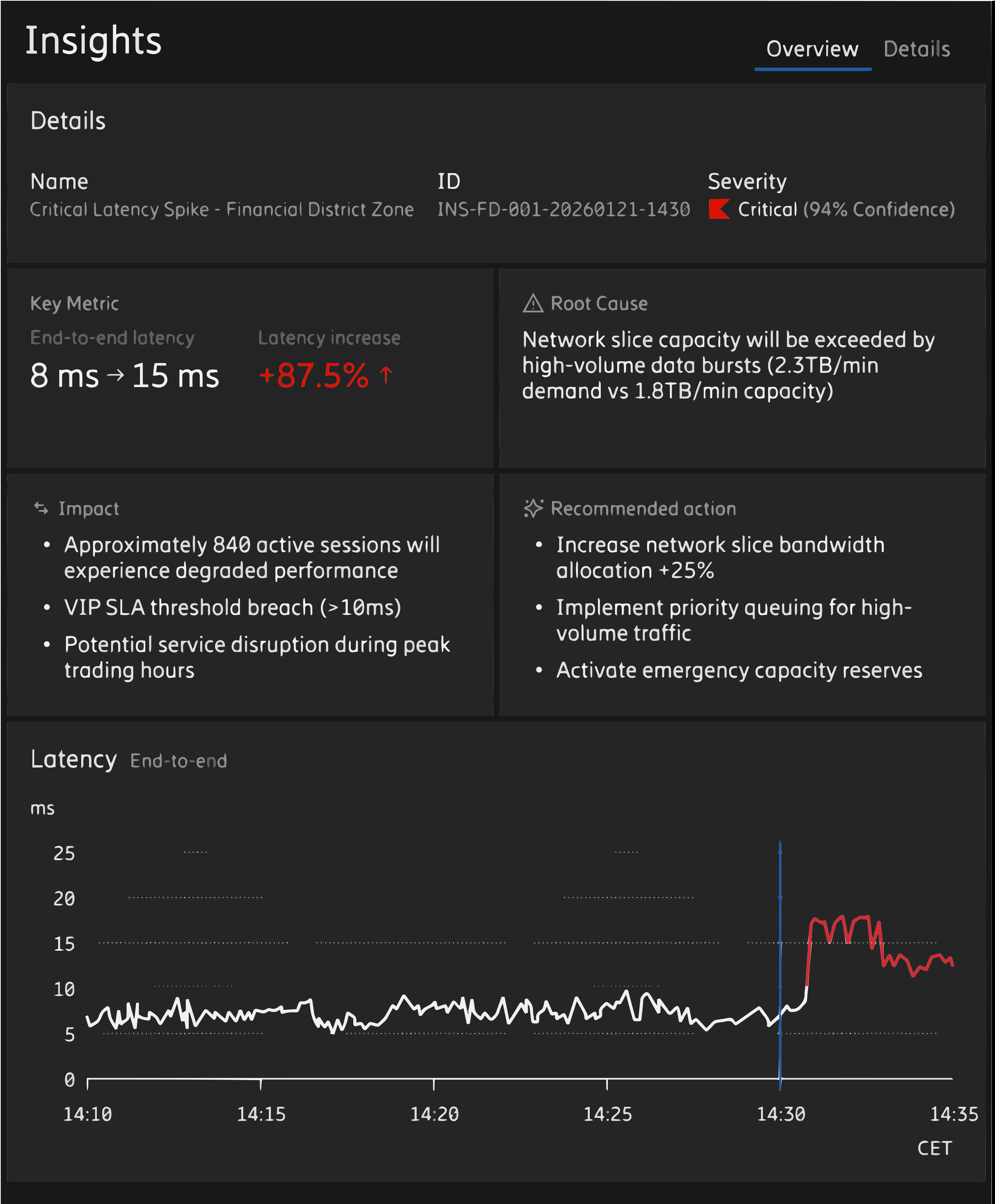
Figure 2: An insight card provides a comprehensive AI assisted view of a subscriber impacting event
The user experience is centered around an insight card. Instead of needing to flip through many dashboards, engineers can access clear insights into the specific issue at hand. The insight card summarizes the predicted issue, affected subscriber or customer experience indicators, correlated events, likely root cause, recommended action and confidence or supporting evidence. The conversational interface then allows engineers to explore the recommendations before approving action.
Simplify, accelerate and scale with agentic network intelligence
The success of tomorrow’s telecom operations will not be defined by AI alone, but by how effectively trusted analytics, operational knowledge and intelligent automation are combined into closed operational loops. The agentic network intelligence solution demonstrates what becomes possible when a flexible data foundation, actionable analytics, AI agents, and knowledge base work together cohesively. It breaks down operational barriers for network automation by:
- simplifying complexity
- accelerating issue resolution
- improving scalability
By combining automation with contextual understanding, we can bridge the gap between raw data and actionable guidance. Engineers can focus on the true underlying issues without being overwhelmed by redundant notifications, while the system continuously learns from user feedback to improve its reasoning.
Over time, it not only accelerates and enhances diagnosis but also lays the foundation for self-learning, autonomous networks capable of executing corrective actions with appropriate governance. You can move beyond reactive operations toward more autonomous, scalable and experience-centric networks. The transition from data to decisions is ultimately about enabling faster understanding, more confident actions and continuously improving operational intelligence.
This approach lays the foundation for a new era in OSS/BSS where data becomes actionable intelligence and decision-making is easier, faster and more reliable.
To enhance your OSS/BSS and help you sell, deliver, and get paid easily, Ericsson provides comprehensive data, analytics, and AI offerings with Ericsson DataOps Platform, Ericsson Expert Analytics, and Ericsson Telco IT AI Apps. Ericsson helps create integrated data, analytics, and AI strategy, to make your data more useful, drive performance with analytics, and let AI solve real problems. Ultimately, you can transform your data into strategic asset and actionable intelligence to drive operational efficiency, boost business growth, and enhance customer experience.
Discover how Ericsson can help you reshape your data, analytics, and AI strategy and ensure you stay ahead of the curve: Telecom data, analytics, and AI to fuel your growth
Read more
- Ericsson OSS/BSS Data and AI
- Maximize OSS/BSS impact with Al and Gen-AI
- Industry perspective: From automation to autonomy
- Ericsson Expert Analytics - advanced troubleshooting
- Driving innovation and efficiency with Ericsson Telco DataOps Platform
- Leverage agentic AI for intelligent charging and billing operations
- Manage business intent with agentic AI for enabling autonomous networks
- How to accelerate automation in OSS/BSS with agent fabric
- How multi-agent AI is transforming telco product
- How to make better use of network insights with Generative AI
- When will AI agents begin to design and deploy new AI apps for OSS/BSS?