










Information transmission with quantum squeezed light
- Squeezed quantum states deliberately reduce noise below classical limits by redistributing it in accordance with Heisenberg’s uncertainty principle.
- This packs far more distinguishable signal levels into optical interconnects than any classical modulation allows, directly boosting capacity

Principal Quantum Engineer

Global Head of AI, Quantum and Blockchain Execution

Senior Quantum Engineer, Blockchain and Quantum Product Line Ericsson
Principal Quantum Engineer
Global Head of AI, Quantum and Blockchain Execution
Senior Quantum Engineer, Blockchain and Quantum Product Line Ericsson
Principal Quantum Engineer
Global Head of AI, Quantum and Blockchain Execution
Senior Quantum Engineer, Blockchain and Quantum Product Line Ericsson
Modern data centers never sleep. Every second, they process torrents of video streams, artificial intelligence (AI) queries, financial transactions, and enterprise workloads, all demanding faster, more reliable, and more energy-efficient connections between the servers, storage, and networking equipment inside them.
The bandwidth problem hiding in plain sight
Today, connections run on light-based optical communication links that already represent a significant leap beyond traditional copper wiring. These links offer terabit-per-second data rates, low latency, minimal signal degradation, and comparatively low power consumption.
For years, they have been the backbone of high-speed data center networking. But as the goalposts keep moving, with bandwidth demand growing exponentially, even advanced optical systems are approaching the limits of what classical physics allows. Current systems cycle through a familiar set of modulation formats, such as NRZ, PAM4, and DP-16QAM, each representing a different trade-off between spectral efficiency, noise tolerance, complexity, and power consumption. Every step toward higher capacity comes with a cost: greater sensitivity to noise, heavier power draw, and increased engineering complexity.
In short, we are engineering our way toward a ceiling. This is precisely where quantum physics opens a genuinely new door.
What squeezed light actually is, and why it matters
In our first post in this series, we introduced quantum light and explored its applications to secure communications and eavesdropping detection. Here, we turn to a different, equally compelling use case: using quantum light to transmit more information.
The key concept is squeezed light. This means a quantum state of light in which noise in one measurable property is deliberately reduced below the classical limit, at the expense of increased noise in another.
To understand why this is useful, we must know how quantum states of light are described. Physicists use a tool called the Wigner function to map a quantum state onto a phase space defined by two measurable properties: the amplitude quadrature (R) and the phase quadrature (p). Think of it as a quantum fingerprint for a light signal.
A standard coherent state, the closest quantum analog of a classical laser beam, appears in this picture as a circular blob, with equal uncertainty in both quadratures. A squeezed state deforms that circle into an ellipse. Heisenberg's uncertainty principle requires that the product of uncertainties in R and p remain above a minimum, but it allows that uncertainty to be redistributed. Squeeze it down in one direction, and it stretches in the other.
The practical consequence is significant, yielding tighter, more distinct signal states. When the noise in one quadrature is reduced, more signal levels can be packed closer together without being confused at the receiver. More distinguishable levels mean more information encoded per transmission, which translates directly into higher channel capacity.
Building a quantum-enhanced transmitter
Squeezed light is generated through nonlinear optical processes such as optical parametric amplification or four-wave mixing, which create correlated photon pairs from a pump laser. In a practical transmitter design, the core component is a degenerate optical parametric oscillator (OPO), a nonlinear optical device operated below threshold that generates quantum states of light from a continuous-wave laser source, the seed laser.
Depending on the strength of the seed signal, the OPO outputs either a squeezed coherent state or, with a weak or absent seed, a squeezed vacuum state. The seed reduces noise in one quadrature below the shot-noise limit, the fundamental noise floor of classical optical systems, producing the squeezing effect. To understand and visualize a squeezed state, we define the following (see Figure 1):
- |0 > vacuum state
- |0,α> = |α> = D(α)|0 > displaced vacuum state or coherent state
- |ζ,0> = S(ζ)|0 > squeezed vacuum state
- |ζ,α> = S(ζ)D(γ)|0 > squeezed-displaced state or squeezed coherent state
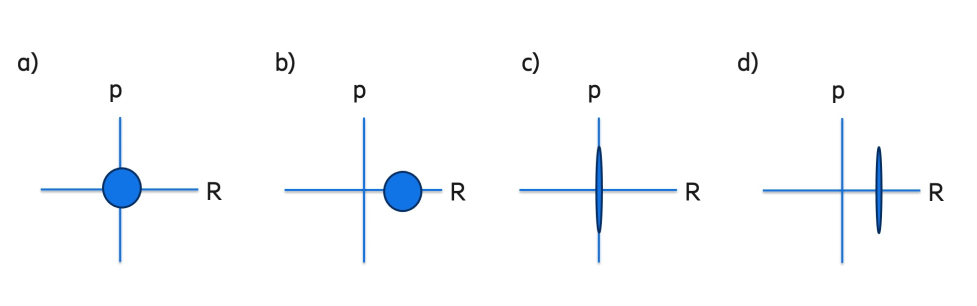
Figure 1. Phase-space representation of a) vacuum state, b) displaced/coherent vacuum state, c) squeezed vacuum state, and d) squeezed-displaced/squeezed coherent state.
Here we consider the squeezing operator S and the displacement operator D. The squeezed-displaced state |ζ,α > can then be written in terms of the ground state |0> as follows:
|ζ,α⟩ = S(ζ)D(γ) |0⟩
where
γ = ch(ζ)α + sh(ζ)α* = αeζ
for
|γ| ≫ |α| and α = α*
Information is then encoded by applying what physicists call a displacement operator to the squeezed state. Essentially, we shift the elliptical noise distribution along the R-axis to represent different signal levels. This is achieved using amplitude and phase modulators—for example, electro-optical modulators or Mach-Zehnder modulators—which vary both the amplitude and phase of the output signal according to a defined encoding scheme.
A practical encoding example using Gray encoding illustrates how this works in a four-symbol scheme (see Table 1). In Gray encoding, adjacent symbols differ by only one bit, minimizing the impact of any residual symbol errors.
Gray encoding 2 bits
| 00 | Amplitude 1, phase 0 |
| 01 | Amplitude 2, phase 0 |
| 10 | Amplitude 1, phase 180 |
| 11 | Amplitude 2, phase 180 |
Table 1. Gray encoding example for 2 bits, showing four possible combinations
Because squeezed light is a Gaussian state and the modulators are linear optical devices, the quantum properties of the squeezed state are preserved under modulation. The output is a squeezed, modulated signal ready for transmission. Also, because the noise in the encoded quadrature has been reduced, more signal levels fit within the same noise envelope than any classical modulation scheme could support.
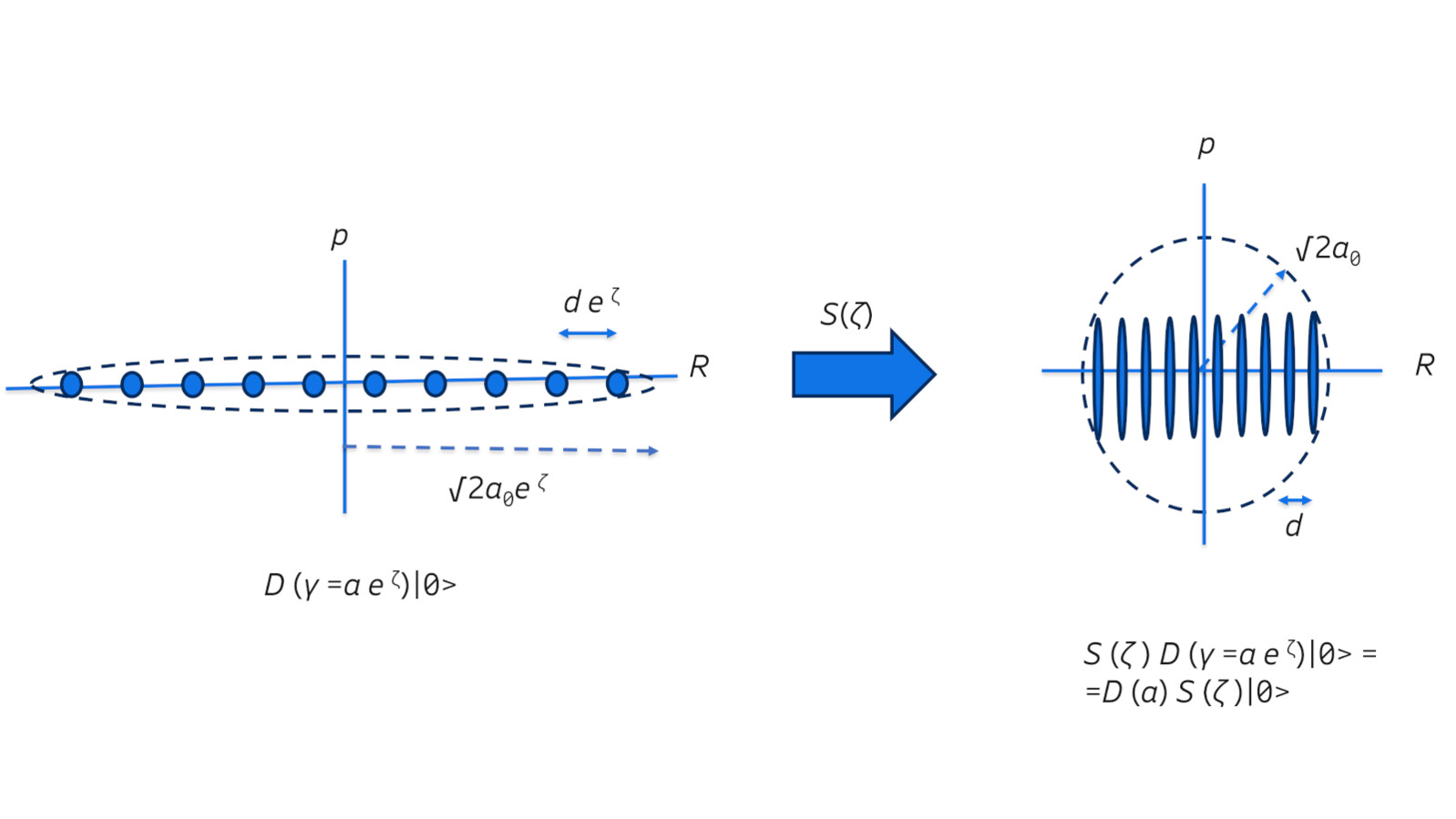
Figure 2. Effect of squeezing on the transmitter.
Figure 2 above shows the effect of squeezing in the p–R space on the transmitter output representation:
- Left: Typical constellation diagram for an 8-PAM scheme. The distance between the constellation points is d eζ, with an uncertainty that reaches the Heisenberg limit 1/√2 for both quadratures (circular blobs). The modulation operation uses the parameter γ=α eζ. The constellation is within a very elongated ellipse.
- Right: The effect of the squeezing operator S(ζ) is to squeeze everything along the R-axis, and to stretch everything along the p-axis by the same factor eζ. This makes the nearest-neighbor (NN) symbol distance d. The uncertainties become very elongated ellipses with a squeezed uncertainty along the R-axis and anti-squeezed uncertainty along the p-axis. The whole constellation is now encased within a circle of radius √2α0, which is determined by the error rate of a comparative 2-PAM modulation scheme.
Detection: reading the quantum signal at the receiver
At the receiver, the information is recovered using homodyne detection with photon-counting detectors,a technique purpose-built for reading out quantum states of light.
A homodyne detector works by passing the incoming signal through a beam splitter, where it interferes with a local oscillator (LO), which is a reference laser whose phase is locked to the transmitter. The two output beams from the beam splitter are each measured by photon-counting detectors. By analyzing the difference in detected photon counts between the two arms—a process called balanced homodyne detection—the receiver extracts the value of the encoded quadrature with high precision.
The mathematical machinery behind this process is sophisticated. The variance of the homodyne-measured quadrature, which calculates how precisely the receiver can determine the encoded signal level, depends on three contributions: the squeezing level, the LO phase angle, and the ratio of signal photons to local-oscillator photons. Crucially, balanced detection—a 50:50 beam splitter—eliminates two sources of variance entirely, leaving only the contributions from squeezing and the signal-to-LO photon ratio.
By choosing the local-oscillator phase to align with the signal phase (setting θ = 0), the contribution from the anti-squeezed quadrature vanishes, and the receiver operates with the full benefit of squeezing. There is also an optimal squeezing level for any given local-oscillator strength; too little squeezing leaves noise on the table, while too much squeezing causes the third variance term, from the signal-to-LO ratio, to grow and dominate. Careful optimization of this trade-off, guided by the signal displacement and the acceptable symbol error probability, determines the system's practical operating point.
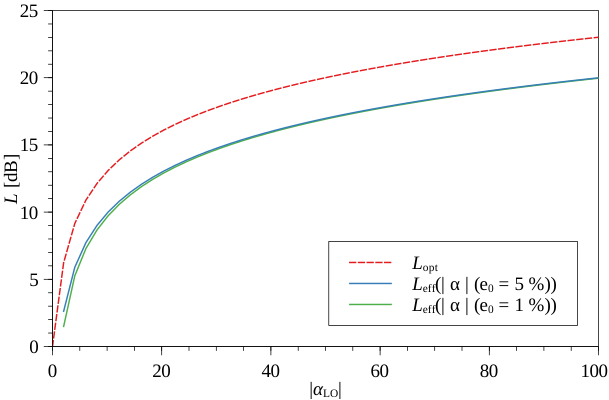
Figure 3. Optimal transmitter squeezing and effective detected squeezing versus local-oscillator amplitude for different target error rates.
In the figure above, the dashed red curve shows the optimal squeezing at the transmitter, as measured by the squeezing level in decibels (dB), for a given displacement of the LO coherent state αLO. For this optimal squeezing, the effective squeezing level is measured by the minimum variance of the homodyne-detected quadrature for a signal displacement α, corresponding to error rates e0 = 5% (solid blue) and e0 = 1% (solid green).
How much capacity can squeezed light actually deliver?
The ultimate figure of merit for any communication system is channel capacity, the maximum rate at which information can be transmitted reliably over a noisy channel. Calculating it for a squeezed-light system requires deriving the conditional transition probabilities between sent and received symbols, then applying the Blahut-Arimoto algorithm to maximize the mutual information over all possible input symbol distributions.
The results are promising. For a given acceptable symbol error probability, a squeezed system can accommodate a significantly larger alphabet of distinguishable symbols than a classical system operating under the same noise conditions. A larger alphabet means more bits per transmitted symbol, and therefore higher capacity.
Concretely, for a nearest-neighbor symbol error probability of five percent (see Figure 4), theoretical analysis shows that increasing the squeezing level progressively expands the alphabet size and raises the maximum mutual information (the channel capacity) beyond what any classical PAM or QAM scheme can achieve in the same channel. The squeezed system effectively uses quantum mechanics to do what classical engineering cannot—to reduce noise at the fundamental level, rather than simply engineering around it.
![Alphabet Size/Lsequence[dB]](/4a2648/assets/global/qbank/2026/07/31/figure4a-195074d41d8cd98f00b204e9800998ecf8427e.svg)
![Channel Capacity(bits/symbol)/Lsqueeze[dB]](/4a26b2/assets/global/qbank/2026/07/31/figure4b-195075d41d8cd98f00b204e9800998ecf8427e.svg)
Figure 4. Channel capacity versus squeezing level for a fixed NN error probability
Our figure shows the theoretical channel capacity as a function of squeezing level L for an NN symbol error probability e0 = 0.05. The left panel plots the alphabet size, while the right panel shows the maximal mutual information after optimizing over input symbol frequencies.
This is not just an incremental improvement in modulation complexity, but a genuine, physics-grounded capacity advantage and a step change enabled by operating in a regime that classical systems cannot access.
From laboratory to data center: where things stand
It is important to be clear about where this technology sits today. Squeezed light for communications is an active research area, not a deployed technology. Demonstrations of squeezing in seeded OPOs, high squeezing in degenerate OPO configurations, and homodyne detection of squeezed states in controlled laboratory settings have all been published in research papers. Theoretical frameworks for channel capacity estimation with squeezed modulation formats are well developed. What remains to be solved is the engineering path from these laboratory demonstrations to practical, cost-effective, and scalable components suitable for deployment in real data-center optical interconnects. Key challenges include:
- generating and maintaining stable squeezing under real-world operating conditions
- designing low-loss, high-bandwidth modulators and detectors compatible with squeezed states
- integrating all these components into a coherent, manufacturable system
These are non-trivial challenges. But they are engineering challenges that, historically, have yielded to sustained investment and ingenuity once the underlying physics case is made.