Skip navigation
Vodafone Tower Düsseldorf, Germany

Vodafone and Ericsson

Shaping Germany’s 5G future with 5G standalone and cloud-native 5G Core.

Vodafone’s deployment of Europe’s first 5G standalone core

This is the story of how Vodafone Germany became the first operator to launch 5G standalone in Europe and is bringing a wealth of new opportunities and use cases to shape Germany’s 5G future.

Case

Highlights

Watch this video with Vodafone top executives sharing their insights from the drivers, challenges, and learnings from this journey. 

In April 2021, Vodafone Germany became the first operator to launch 5G standalone in Europe. In contrast to the more limited capabilities of their 5G non-standalone network, the implementation of Ericsson’s cloud-native dual-mode 5G Core has brought with it a wealth of new opportunities and use cases. The process required a steep learning curve for both teams but with continuous learning, development, and implementation. The result is a highly capable, fully standalone, cloud-native 5G network that is ready to be used by Vodafone and their partners as a springboard for ground-breaking innovation.

“In order to be “first” in the telecommunications industry, you really need to be ambitious and work as a team. There was a perfect collaborative opportunity with Ericsson in the endeavor to be the first in Germany and Europe to deliver 5G core services.”

- Guido Weissbrich, Chief Network Officer, Vodafone Germany.

Guido

The challenge

Vodafone’s motivation to become the first service provider in Germany, and in Europe, to commercially offer 5G Standalone based services was highly driven by their desire of using this new technology to address the industry challenges and needs, such as:

Overcome technical limitations from 5G non-standalone

The core network in 5G non-standalone solutions is based on existing LTE infrastructure, meaning customers are not able to fully exploit advanced 5G capabilities such as network slicing and ultra-low latency. Vodafone wanted their customers to, for example, be able to experience applications such as lag-free online gaming experiences and virtual reality, and for enterprises, industrial robot applications, or remotely operated drone fleets, which is only possible with 5G Standalone.

Better support and accelerate Industry 4.0 realization across Germany

Vodafone is considered a key contributor to the development of Germany’s digital infrastructure whose customers rely on them to deliver the best in connectivity. The German market has a very high percentage of small and medium enterprises that are world market leaders, and for those industries, it is super important to be competitive now in the journey towards digitalization and industry 4.0.  Vodafone wanted to be ready to support them.

Be first to market to capture new business opportunities early

Vodafone believed that they needed to be there first and deliver the 5G Core and all the new capabilities of 5G standalone so that they can develop with their customers’ new use cases that will bring their production efficiency to the whole new levels. This is vital for both Vodafone, their customers, and Germany’s successful future with 5G.

Lay the groundwork for developers to innovate with this new technology

There's a lot of uncertainty about the real use cases that 5G is going to bring. But Vodafone believed that to tackle the opportunities in 5G, it is important for the people that are going to be using their services and for the partners that they will work with, to validate those opportunities in real life environments. In other words, Vodafone Germany wanted to lay the groundwork for developers to innovate with this new technology.

Vodafone’s motivation

The solution

The Ericsson’s 5G solutions deployed by Vodafone Germany as part of this project includes:

Ericsson Evolved Packet Core (EPC): The existing Ericsson Cloud Packet Core for EPC solution was upgraded to support 5G non-standalone services (NSA) and 4G services.

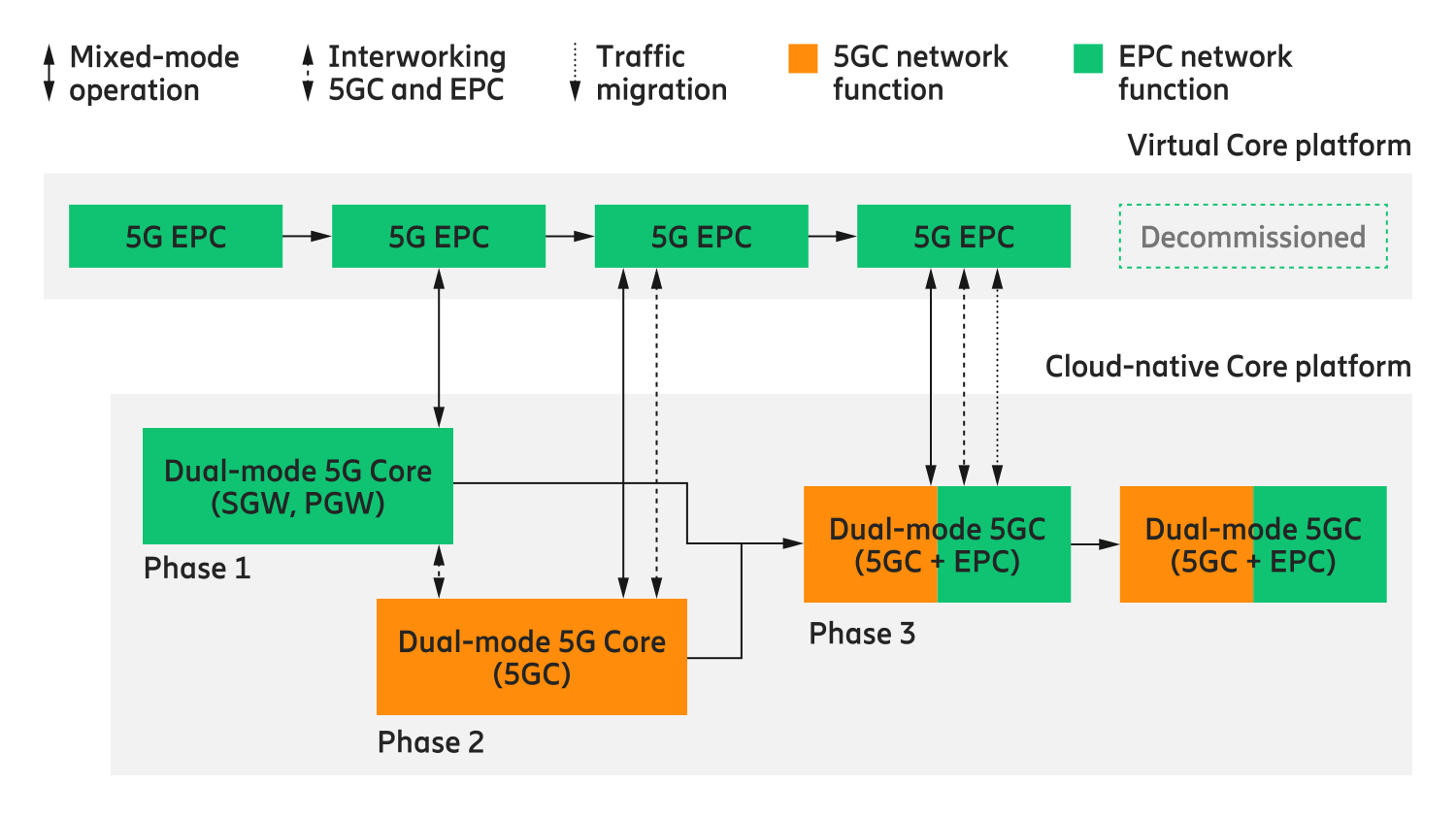
Ericsson’s dual-mode 5G Core: A container-based cloud-native platform deployed to implement the 5G Core network functions.

Ericsson NFVI: The existing Ericsson NFVI cloud infrastructure was evolved with the contained management capabilities through Ericsson Cloud Contained Distribution (CCD) supporting a Kubernetes environment.

Ericsson 5G Radio Access Network (RAN): Antennas, radios, baseband (RAN Compute), and RAN software to enable incredible speeds and mobility. 

Ericsson Spectrum Sharing: For a quick introduction of 5G over a wide area, leveraging 4G spectrum and existing Ericsson Radio System infrastructure.

Ericsson Carrier Aggregation: To extend the coverage of mid-band and high band 5G while enabling faster data speeds and enhanced performance.

Solution digram overview
“Supporting Vodafone Germany to launch Europe’s first commercial 5G standalone network is a privilege and a proof of the trust Vodafone have has on Ericsson. This milestone is the result of true collaboration and transparency between our companies, and from our engineers working together as a one-team. The transformation to cloud native and 5G standalone will enable Vodafone to take a prominent role as service innovator in Germany and empowering the country’s digital economy."

- Daniel Leimbach – Key Account Manager for Vodafone Germany at‎ Ericsson.

Daniel Leimbach

The result

First commercially live 5G standalone network in Europe enabling to pursue new business segments for top-line growth faster than the competition.

Expanded their service offerings in a highly competitive environment and reaffirmed their position as a market leader in Germany.

Greater speed and agility to bring new services to market in line with their customer expectations.

Operational processes transformation to achieve higher efficiency and dynamism to manage all 5G related new technologies.

Set the foundation for a future expansion of its 5G Core into a single core platform able to care for both 5G and legacy services for higher efficiency and cost-effectiveness.

5g
“The relationship between local teams helped a lot because Ericsson shares a very good understanding of the network. Their understanding of the different processes and technical complexities have been a true asset.”

- Julia Velasco, Head of Data Core Engineering, Vodafone Group.

Julia