








The vision of a fully autonomous or ‘zero-touch’ network is a network that operates without human intervention, meaning that it would be able to deploy, configure, maintain (monitor, optimize, heal and protect) and retire itself independently.
There are several forces driving the autonomous network vision in which humans manage automation rather than controlling the network directly [1][2][3]. One of the most compelling is the opportunity to reduce total cost of ownership (TCO) by improving aspects such as network resource utilization and personnel efficiency in operations and maintenance. A higher level of autonomy also makes it possible to improve customer experience in the form of service assurance and network reliability, for example, which tends to boost both customer loyalty and revenue. More generally, a network with a high level of autonomy would be highly versatile with the ability to quickly adapt to new situations, thereby generating new revenue through faster time to market for new services.
The concept of autonomous domains
The vision of autonomous networks builds on a proper separation of concerns based on the concept of autonomous domains (ADs). TM Forum defines an AD as “a system (or set of systems or agents) that is capable of autonomous behavior (e.g., resolve tasks, adhere to objectives) without manual human intervention. The AD does this by realizing self-management capabilities using a closed control loop mechanism, using four key phases: awareness, analysis, decision-making, and execution. It is a domain with an administrative governance boundary that defines the scope of encapsulated autonomous behaviors.” [4]
Figure 1 shows Ericsson’s high-level architectural blueprint for ADs. It is aligned with the TM Forum architecture and principles, and incorporates influences from multiple industry fora. The ADs provide a resource-facing or customer-facing service and have both resource and service operations.
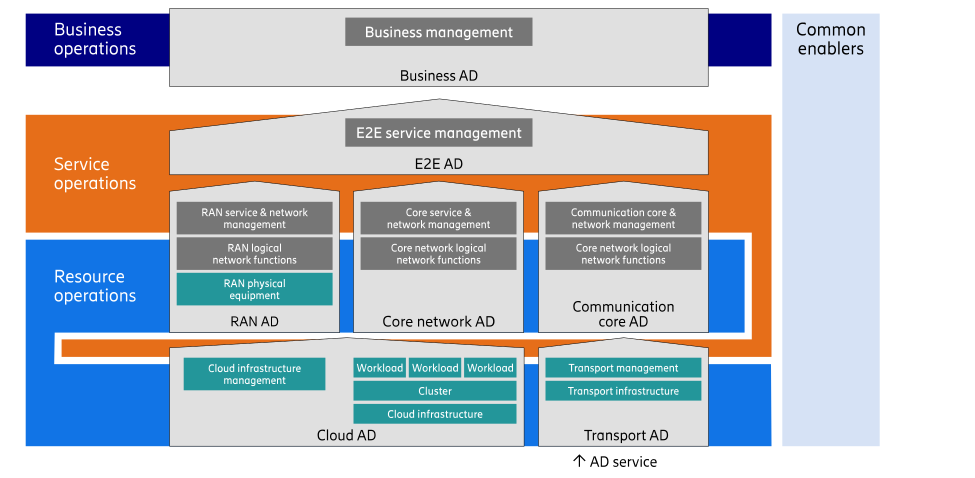
Figure 1: Ericsson’s representation of a blueprint for ADs
The capabilities offered by the AD align well with the capabilities of the domain management functions and capabilities described by TM Forum [5]. This enables a means to have governance by the communication service provider (CSP) across the ADs and at the same time it allows for each AD to make the best choices for that domain.
We recommend a stepwise approach to network autonomy that prioritizes the parts of the network where autonomy is most desirable and profitable. Time will tell if the vision of truly autonomous networks is ultimately achieved; it may transpire that there are parts of the network where full autonomy is either not desirable or not profitable.
Navigating the path toward network autonomy and assessing progress
On a high level, the zero-touch vision is about moving from manual operations to automated operations, and then to autonomous operations. This can be compared to driving a car; not long ago, the driver did everything manually, while today the driver has all kinds of assistance (cruise control and so on). In the future vision for cars, the car will be self-driving with the driver merely instructing it about where to go. Similarly, in today’s automated network operations, humans design workflows that are executed by machines. In future autonomous operations, the workflows will be designed by machines and humans will merely supervise and manage the automation.
Due to the complexity of telecommunications networks and the organizations managing these networks, it is surprisingly difficult to quantify exactly where we are on the path toward autonomous networks. One of the most prominent methods to make an assessment is the Autonomous Network Levels Evaluation Methodology proposed by TM Forum [6]. It defines six levels of autonomy, where level 0 means manual management and level 5 indicates a fully autonomous network.
The first step in the assessment process is to break the system (a network or portion of a network) down into smaller components called evaluation objects. Each individual object is then assessed to determine its current automation level. In the end, the object scores are averaged, which gives the automation level of the system under assessment.
The TM Forum methodology uses a three-dimensional space of network domain, service domain and operation flow domain. Each evaluation object belongs to a certain network domain (radio access network, core network, transport network and so on), to a certain service (mobile broadband or leased line, for example) and a certain phase in the operation flow (planning, deployment, service provision, maintenance, optimization or inventory management).
It is important to note that the TM Forum methodology can only provide a very coarse classification of the autonomy level of a system. It does not specify in detail exactly what a system is, which means that it cannot specify which evaluation objects it should be broken down into either. The defined network domains, service domains and subphases of each operation flow phase are not exhaustive. Finally, the autonomy levels themselves are only roughly defined. In other words, the overall method results in a rough indication of ‘where we are today,’ and when scores of a system are presented, it is important to ask what exactly has been assessed, especially when comparing scores of multiple systems from assessments made by different organizations.
TM Forum regularly uses its Autonomous Network Levels Evaluation Methodology to make concrete assessments of telecommunication networks. In its latest assessment [2], TM Forum explicitly acknowledged the limitations, however, and used “a more comprehensive self-service assessment tool” based on the framework method [7] described above. The results showed that most of the CSPs (82 percent) are today still at level 2 or below. Level 2 is ‘partial autonomous networks,’ where automation is typically “driven by statically configured rules.” [6] Slightly more than half (52 percent) of the CSPs are today still at level 1 or below. The overall average would be only 1.6.
At the same time, TM Forum’s latest assessment indicates that ambitions are high, with 81 percent of the CSPs reporting that they want to reach level 4 by 2030.
Level 4 is ‘high autonomous networks,’ which means that the automation implementation is “driven by AI with continuous learning and rapid evolution.” [6] A comparable report by Omdia [3] gives similar results. Omdia states an average for all interviewed CSPs of 2.4 today. An additional breakdown of figures per operation flow is provided and, interestingly, there is little difference in achieved level per flow; the averages of the individual flows range between 2.0 and 2.6. Ambitions in the Omdia report seem on a par with the TM Forum report, with half of the CSPs (48 percent) expecting their networks to be at level 4 or higher by 2027.
Identifying the challenges
The research from both TM Forum and Omdia shows a high level of ambition among CSPs to get closer to the zero-touch vision and to move at a fast pace, but there is a lack of clarity about which next steps are desirable and feasible. According to the research, the main challenges that CSPs perceive in progressing toward the vision are:
- the complexity of the matter, especially since automation typically goes across domains
- the business case – that is, unclear return on investment and lack of budget
- unclear roadmap for how to gradually move toward a higher level of network autonomy
- the employee skillset
- the maturity of technology and standards [2][3].
From our perspective, the best way to tackle these challenges is by taking a holistic approach and analyzing them from two viewpoints – that of the functional network architecture and that of the life cycle of network products, solutions and services. From both of these viewpoints, we must begin by asking ourselves where most manual effort is still needed – in other words, where we best invest with the purpose of getting closer to the vision of full autonomy.
The functional architecture viewpoint
Figure 2 illustrates the high-level functional architecture for 6G. The use of machines to relieve humans of repetitive tasks (automation) is naturally mostly relevant for the upper layer of end-to-end (E2E) management in the form of operations support systems (OSS) and business support systems (BSS). Lower layers, including radio access networks (RANs), the core network (CN), cloud and transport, are already fully automated. For example, there is no human support needed for the Access Management Function (AMF) in the CN to perform paging, or for the Next Generation Node B (gNB) in the RAN to setup a connection to a mobile device. Required human handling would rather come in the form of life-cycle managing these nodes, which is functionally placed in the higher layers like OSS. Novel implementation technologies such as artificial intelligence (AI) may be used to achieve more efficient resource usage in functions like AMFs of gNBs, thereby contributing to the self-optimization aspect of autonomous networks.
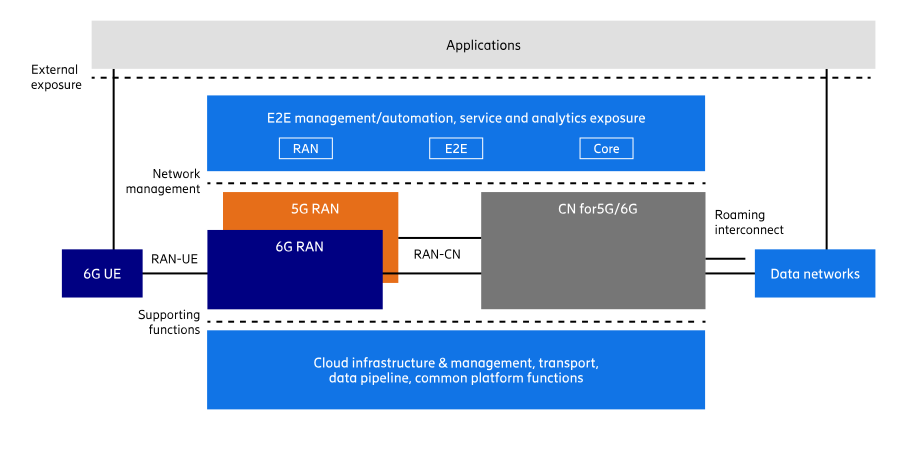
Figure 2: High-level functional architecture for 6G
Top layer: Automation of process flows
In the top layer of the functional architecture, notably the BSS, we see many process flows that today are fully or partially performed by humans. One example is a flow for ordering a new network service. Today, this is a fairly time-consuming process involving a human customer sales representative at the CSP. This sales representative analyses the needs of the customer, tries to match those with existing services available in the CSP’s product catalog, negotiates with the customer to make a good match at a good price and eventually places the agreed order in the order handling system. Advances in technologies like generative AI and AI agents are enablers that can automate most, if not all, of the steps in this process flow [8]. The customer would interact with a copilot instead of a human. Note that even on the customer side, the ordering entity may no longer be a human but also an automated copilot. Automation of this flow speeds up the entire process of service order and delivery. Consequently, this would be an enabler for CSPs to support a much larger number of diverse orders faster, including many small orders that would not be profitable without automation.
End-to-end layer and below: Assurance
CSPs indicate that improved service delivery is a top-3 priority [2]. But there is no point in improving service delivery if the delivered service cannot be assured in an automated way. Not surprisingly, service assurance is mentioned as a top-2 priority. We foresee intents as the key enabling technology for service assurance, representing a major step forward in the evolution toward autonomous networks [9]. Using intents, the operator interacts with the system by describing expectations instead of ordering what to do. This approach provides simplification from the human handling point of view, thereby reducing TCO.
At the same time, intents enable a more versatile system that can automatically adapt to new requirements such as new types of customer orders that could be the basis for generating new revenues. The introduction of intents will impact all network layers, from BSS at the top to RAN resource handling at the bottom. The impact would show both in the implementation of network functions, but also in the architecture in the form of extended or even new standardized network interfaces [10].
All layers: Observability
An important underlying requirement for autonomous networks is that controlling functions can observe the current system state. Without proper observability mechanisms, for example, it would not be possible to assess whether enough resources were available to accommodate a new service order. In other words, a highly flexible observability framework is essential.
The life-cycle viewpoint
Automated service ordering, delivery and assurance are central aspects of network autonomy, but they are not sufficient to create a fully autonomous network. Reflecting back on the car analogy, if a car is self-driving but still requires human involvement for maintenance, the car would not be zero-touch.
On the journey toward fully autonomous networks, the role of humans will shift from executing repetitive tasks to supervising, guiding and refining autonomous flows. In this way, operational efficiency is not just about doing today’s work faster. Rather, it is about designing products, solutions and services in such a way that it enables the operational flow to evolve into self-optimizing, self-healing and self-protecting processes.
Serviceability is the aspect of making products, solutions and services easy to handle for humans. The operational flow and its efficiency are directly related to the user experience and the effectiveness of executing tasks across products and solutions. Humans interact with the system through distinct operational tasks across various life-cycle stages, each of which are connected to specific business processes. Quantifiable serviceability metrics are a key characteristic to ensure efficient operations across the life-cycle stages.
The life-cycle viewpoint for networks shown in Figure 3 is based on the operational flow defined by TM Forum [6]. It consists of five phases: planning, deployment, service provision, maintenance and optimization, the last of which we explained in the functional architecture viewpoint section. The entity that is the subject of life-cycle management may be an individual network product or a solution comprised of several products. Solutions are, in turn, the basis for providing services that can also be life-cycle managed.
| Planning | Deployment | Service provision | Maintenance | Optimization |
|
|
|
|
|
| Inventory management |
|
|||
Figure 3: TM Forum’s decomposition of the operational flow
Planning and deployment
The first two phases of the life cycle, planning and deployment, typically have long lead times and require multiple interactions between the CSP and its vendors. Today’s demand forecasting, capacity planning and network roadmap migration involve a substantial amount of manual work. Advanced automation has the potential to drastically reduce this by using intents both in the planning and deployment processes, and as input to provisioning and configuration in the service provision phase. A potential enabler is a digital twin to test what-if scenarios on the CSP’s particular environment before proposing a concrete solution to provision [11]. The agents for automating the customer ordering process that were mentioned in the functional architecture viewpoint section are also an enabler here.
Service provision and maintenance
The service provision and maintenance phases are already relatively well-automated today. However, every CSP has a unique network in terms of size, sites and installedbase. Due to these unique aspects, installation, upgrade and configuration of products is often done manually or is only semi-automated. The non-automated parts cause a longer lead time and are a source of cost and a risk for failures. In an autonomous network, this work becomes part of a continuous closed loop governed by intents, with assurance feedback and minimal human intervention. The transformation path includes:
- intent-based provisioning, where for example “deploy sion 1.3” shifts to “ensure 5G core capacity meets requirement x”
- the introduction of a continuous integration and continuous delivery (CI/CD) pipeline
- proper observability and closed-loop monitoring such that the CI/CD pipeline reacts to performance or quality deviations.
Furthermore, configuration validation agents such as digital twins would automatically generate configurations and validate them against the requirements provided in the intent.
The maintenance phase includes the broad area of fault management, which comprises finding anomalies, identifying the root cause of anomalies and faults, and proposing and implementing resolutions. In fact, automating processes for fault management is the top-1 priority for CSPs in moving toward the vision (the related area of troubleshooting is mentioned as top-4) [2].
There is already a plethora of tools available for this area, with new tools becoming available regularly. Examples include talk-to-your-network solutions, generative AI to find the root cause of an issue, and AI agents to propose and implement solutions to issues (self-healing). A next step in this evolution would be to enable the tools to have a broader perspective across stack layers and network domains, as the more complex issues often transcend such boundaries.
Life-cycle management of artificial intelligence
AI in its various forms is a key technology for autonomous networks. It should be introduced with care to ensure that life-cycle management of AI does not require additional human effort – that is, AI solutions need to be designed with full autonomy in mind from the start. Trustworthy and explainable AI is a key requirement – it must be possible for humans to evaluate and understand why AI solutions produce a certain outcome.
Conclusion
The journey toward autonomous, self-managing networks is as much a design philosophy as it is a technological pursuit. Achieving true autonomy requires embedding automation, artificial intelligence, observability and serviceability into every layer and across every phase of the network life cycle – from planning and deployment to operation, assurance, maintenance and retirement. While most communication service providers remain in the early stages of automation maturity, industry ambitions for high autonomy are strong and closely aligned with broader digital transformation goals.
Taking a holistic approach that unites the functional architecture and life-cycle perspectives allows the industry to identify where automation investments deliver the greatest value: in cost efficiency, operational reliability and customer experience. Intent-based operations, AI-driven assurance and closed-loop service management are central building blocks that, when combined with network digital twins and agentic AI, enable networks to interpret high-level goals, predict outcomes and take context-aware actions rather than simply executing predefined tasks.
Equally important is serviceability – designing products, solutions and services so that life-cycle tasks become easier for humans to oversee and for machines to perform autonomously. This design focus reduces operational friction, shortens time to market for new services and mitigates risk as automation expands across domains and vendors.
Autonomy by design ultimately means creating networks that learn, evolve, optimize and heal themselves, while human expertise shifts from manual intervention to oversight, policy setting and innovation. Step by step, this approach moves the industry closer to the zero-touch vision: resilient, self-managing networks that continuously improve across their life cycle and unlock new business and societal value in the 6G era and beyond.
Further reading


References
Authors

Dinand Roeland

Farnaz Moradi

Alla Lokhanko

Ignacio Más