









How zero can we touch?

Principal Researcher, Networks

Research Leader, Networks research

Senior Researcher, Network management and automation

Principal Researcher, Artificial Intelligence

Research Leader, Network automation

Principal Researcher, Networks
Research Leader, Networks research
Senior Researcher, Network management and automation
Principal Researcher, Artificial Intelligence
Research Leader, Network automation
Principal Researcher, Networks
Research Leader, Networks research
Senior Researcher, Network management and automation
Principal Researcher, Artificial Intelligence
Research Leader, Network automation
One aspect of our 6G vision is zero-touch management. A zero-touch network is an autonomous network, which is a network with self-* capabilities, for example:
- self-configuration
- self-healing
- self-optimization
- self-protection
In other words, a zero-touch network would be capable of configuring, healing, optimizing, and protecting itself, without active involvement of humans. This would enable humans to move into a more supervisory role. Figure 1 illustrates the journey from manual operation to autonomous operation via an intermediate step of automated operation. Simplified, one could say that today’s products are moving from manual operations to automated operations, whereas research and early development is ongoing for autonomous operations in future products.
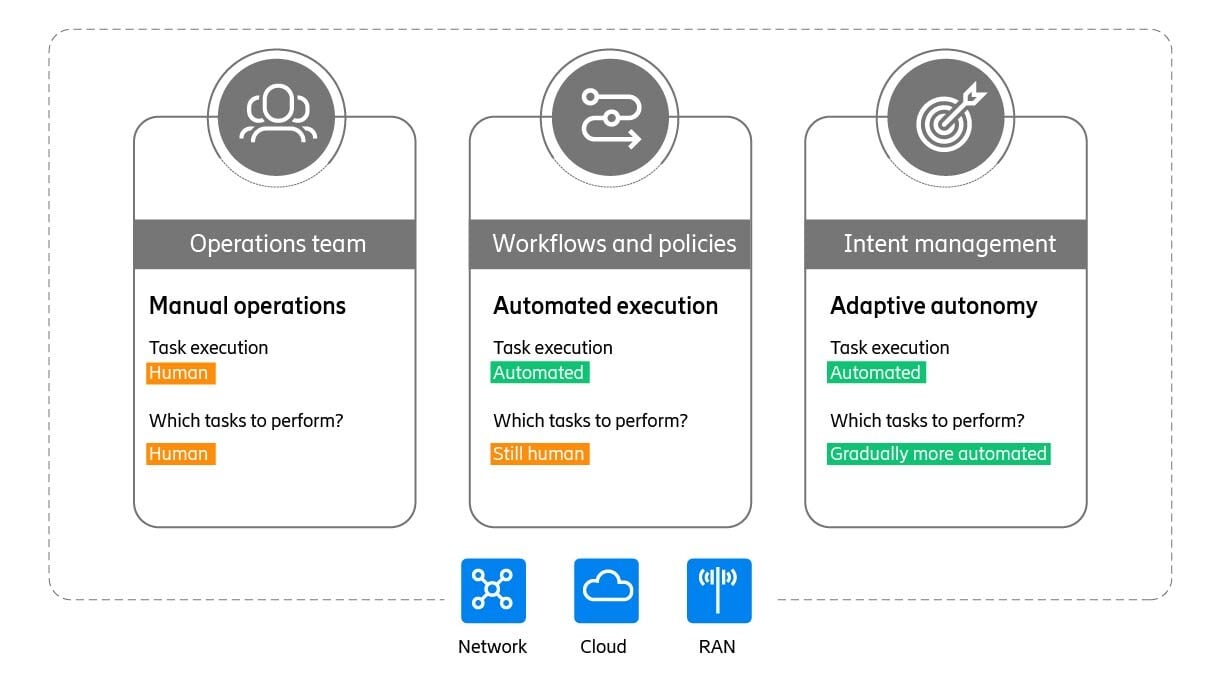
Figure 1. Moving from manual operations to automated operations to autonomous operations
What does an autonomous zero-touch network mean in practice? One way to partly answer that question is to summarize which tasks humans perform in today’s radio access networks (RANs), as shown in Figure 2. The grouping is according to the life cycle of the RAN: planning the network evolution, deploying the network, optimizing and healing a deployed network. For each life cycle stage, the most important human tasks are listed. Note that the list is not exhaustive.
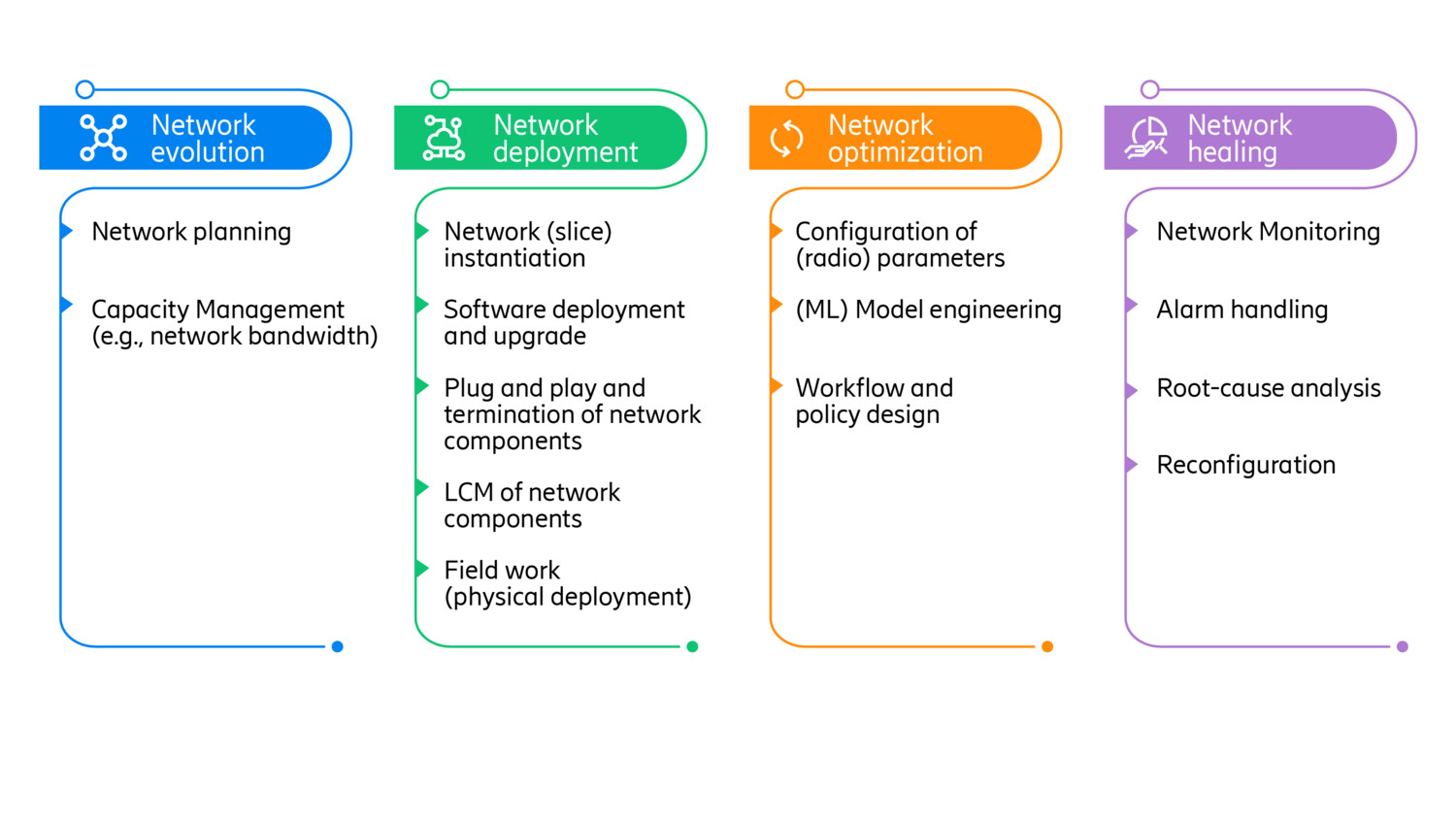
Figure 2. Summary of human-operated tasks in today’s networks
Before diving into how to achieve autonomous zero-touch networks, let us first investigate the advantages such future networks have in comparison to today’s networks. On a high level, there are three classes of benefits with automated and autonomous operations:
1. Cost saving: This is a very important short-term benefit. Use cases include reduction of field work costs (for example by avoiding unnecessary field visits through better alarm handling and better root-cause analysis), reduction of energy consumption (for example by a more optimal network configuration) and cost savings by better network planning.
2. New revenue generation: The idea would be to design networks such that they can be re-configured to support deployment and assurance of new services in a fully automated way. This would reduce the service-to-market time to a minimum, enabling the generation of new revenues for these new services. This is a more long-term benefit, since many pieces need to fall in place before we reach these highly flexible networks.
3. Increased revenue generation for already existing services: This is mainly driven by automating service assurance, which is today, in many cases, too costly to achieve for humans. This is a benefit that would be possible to achieve in the medium term.
One step towards zero -touch would be to automate tasks in figure 2 by programmatically coding sequences of operational steps. Repetitive tasks would be replaced by automated workflows and by policies controlling these workflows. However, this would not bring us all the way to autonomous operation. It would bring us to automated operations. Even though the repetitive tasks are performed by the system instead of the human, it’s still the human that decides how these tasks are performed. If situations arise that deviate from the coded workflow, the human will still need to be involved to decide how to resolve those situations. To reach a truly autonomous system, we cannot rely only on technologies that automate repetitive tasks. There must also be a built-in capability to handle unforeseen situations. This implies that humans should not tell the system exactly what to do in each possible foreseen situation. Instead, humans should tell the system what requirements are to be fulfilled, thereby leaving some freedom to the system to decide exactly how to fulfill those requirements. The autonomous system would still consult the human if there was any ambiguity about how to deal with a certain situation.
It should also be noted that figure 2 mainly lists repetitive tasks performed by humans today. There are tasks that are not listed since they are simply too human labor intensive in today’s networks. An example is tasks related to service assurance. If such tasks are performed manually today, it’s only feasible on a small scale. But those tasks would be needed in an autonomous system to achieve the benefits of generating increased or new revenues mentioned before.
Artificial intelligence (AI) plays an important role when it comes to reaching a fully automated, and eventually fully autonomous, system. This includes both AI machine learning (AI/ML) and AI machine reasoning (AI/MR) technologies. AI enables a cognitive network, which is an AI-native implementation of an autonomous network. Figure 3 gives a high-level summary.
| CSPs desire | Relevant AI technology field |
| Automated alarm handling | Various AI/ML and AI/MR technologies; for example, data clustering and abductive reasoning |
| Automated root cause analysis | Explainable AI, in particular causal AI |
| Simplification | Intent-based management raises the level of abstraction by instructing the system what to achieve instead of how to achieve it |
| Ability to run what-if scenarios | Digital twin |
| End-to-end service assurance (that is, including all network domains) | Intent-based management where the key performance indicators (KPIs) to be assured are given as requirements to the system |
| Human agency (participation of the human in the decision-making of the autonomous system) | Explainable AI, such that relevant AI components in the system can explain what decision is proposed and why |
Figure 3. Relevant AI technologies to achieve an automated/autonomous system
Under the hood, AI/ML models are used. These models need to be life-cycle managed, which in its turn need to be done in an automated way. One stage of the life cycle of a model is training, and that requires data. This implies a requirement on data observability (the ability to acquire relevant data from relevant sources in the network) and a distributed data infrastructure (the ability to handle the observed data).
How will these relevant AI technologies help materialize the ‘wants’ of communications service providers’ (CSP), and what will be the role of human operator when moving from manual operations towards more autonomous operations? To respond to these questions, below we’ll expand on two relevant examples from figure 3 above: end-to-end (end-to-end) assurance and automated alarm handling.
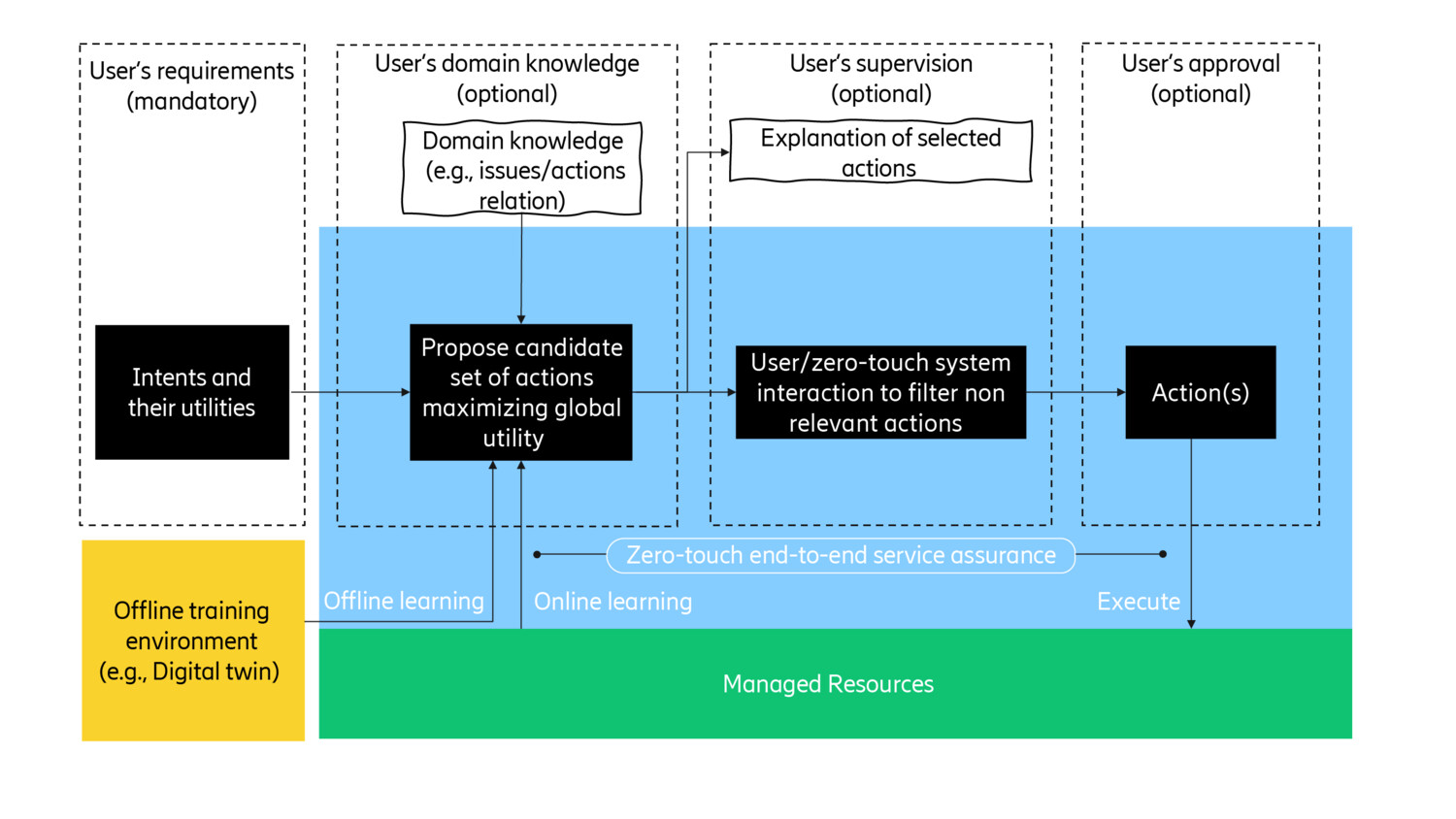
Figure 4. End-to-end service assurance
Referring to figure 4, the zero-touch end-to-end service assurance example, the (human) user is responsible for providing requirements in the form of intents.
Experts' domain knowledge can be embedded in the form of rules to enhance the zero-touch system. For instance, "increasing the user plane priority improves throughput" is an example of such knowledge.” Obviously, the system can learn and reuse this type of knowledge itself.
Indeed, the zero-touch system is trained in an offline environment (for example, an end-to-end digital twin of the managed network) and/or it learns online from the execution of previous actions. We believe that all these three forms of knowledge: domain knowledge, offline learning knowledge and online learning knowledge are important for providing the system self-*capabilities.
The zero-touch system can then use both the acquired and provided knowledge to propose a set of candidate actions to maximize the global utility given the active intents. The system's role is to determine the optimal strategies from many possibilities based on given requirements. By doing so, it relieves humans from the burden of finding correlations between requirements, network configurations, and expected network states. Furthermore, the system can provide explanations that accompany the selected actions.
If the system can safely operate autonomously in the given situation, the human can be left out of the loop and action configuration can happen with the human operator taking a monitoring role. Alternatively, if the system is configured to operate under strict human supervision, the operator can look at the explanations of the actions that are considered relevant. The system might also require human intervention in case there is not enough information to determine which reconfiguration strategies are preferable. Under these conditions, humans are involved in the approval of actions. The journey to an autonomous network will be an evolution. When automating human tasks, it is important that the system can explain its proposed decisions. This will give humans trust in the system, and confidence to take further steps toward an autonomous network.
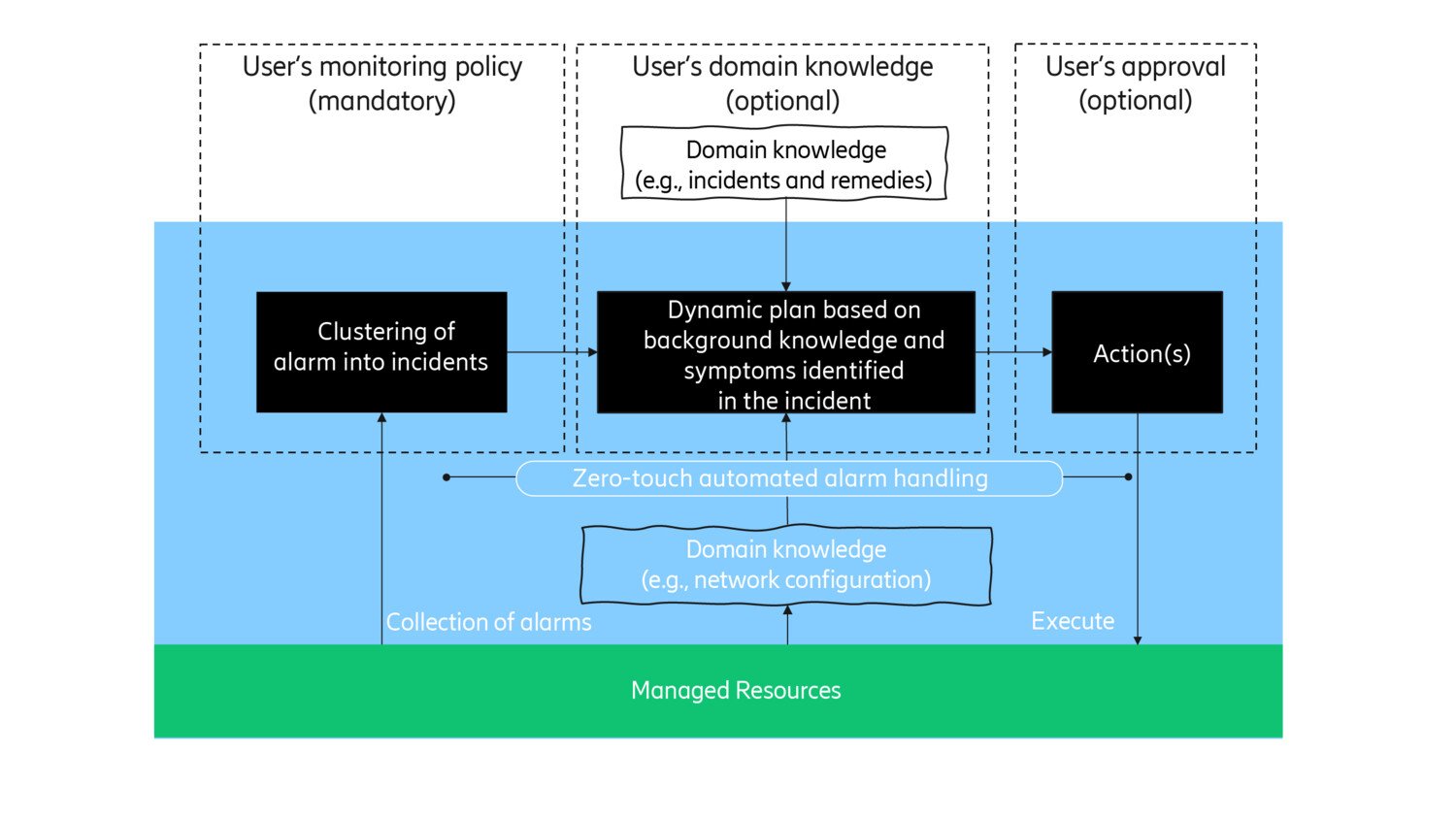
Figure 5 Automated alarm handling
Figure 5 shows the zero-touch automated alarm handling use case. This use case aims to achieve faster and more accurate classification of problems in the Network Operations Centre (NOC) through automation. The system dynamically selects the best plan of action based on the current situation, which is easier to maintain and update than the manual methods currently used. This process involves two key aspects: first, collecting and clustering alarms from network equipment into incidents, and second, creating a dynamic plan based on background knowledge and identified symptoms to mitigate the problem, taking into consideration both the time and cost of resolution. This enables a reduction in escalations to human operators as well as unnecessary site visits by automatically identifying “cheaper” actions that can be executed remotely first. The success of this approach relies heavily on its ability to identify fault conditions by recognizing their symptoms and recommended remedies, while also maintaining up-to-date site configurations in the knowledge base. The method employs an abductive reasoning approach, where relevant potential faults are proposed and then automatically confirmed or ruled out.
The two examples introduced above provide an overview of how the role of humans is evolving with the increasing adoption of autonomous solutions. We can summarize these tasks according to different categories:
- Design tasks (such as ML model engineering, rApps/xApps development, domain knowledge curation). For example, figure 4 shows how telecom domain knowledge synthesized by humans can be leveraged to propose reconfiguration actions.
- Goals management (such as intent settings, intent prioritization, intent-based networks). In figure 4, humans interact with the system by specifying which requirements need to be achieved and by specifying the importance of each requirement.
- System supervision (such as monitoring, optional approval of management actions, definition of the level of autonomy of the system). In the journey toward adaptive autonomy
the selection of tasks to be performed is gradually more automated (see figure 1). In figure 5, user’s supervision allows to keep the human in the loop and allows for human-centered autonomy, which is paramount to enhance the level of trust of humans toward autonomous solutions.
Looking ahead
AI is critical for the successful implementation of a zero-touch network, bringing about cost savings, revenue generation, and increased reliability and efficiency. Through AI integration, a fully autonomous system can handle unforeseen situations and adapt to new challenges, resulting in a more efficient and reliable network. Human involvement in goals management and system supervision remains essential for maintaining human-centered autonomy and enhancing trust in autonomous solutions.
Dive deeper into Ericsson’s cognitive network focused research:
Creating autonomous networks with intent-based closed loops
Defining AI native: A key enabler for advanced intelligent telecom networks
Operations of the future: Reaching for the North Star of zero-touch operations
Explore network automation
Learn more about AI in networks
Read more on telecom AI