The number of commercially available offerings based on 5G standalone (SA) network slicing has surged to 84 – a significant jump from the 65 reported just 6 months ago – signaling that differentiated connectivity is rapidly moving from early adoption to mainstream commercialization.
Key insights
Growth is broadly distributed across regions, with Europe and Asia-Pacific continuing to lead, consistent with findings from six months ago.
Ambition is outpacing execution in many markets. Service providers have the intent and, increasingly, the network capability, but gaps in marketing strategy, go-to-market readiness and contextual engagement models remain critical obstacles to scaling.
Context-driven engagement dramatically outperforms traditional sales channels: In-the-moment, app-integrated offers have been shown to be up to 20 times more effective than conventional outreach.
From 65 to 84: The numbers tell a story of rapid scaling
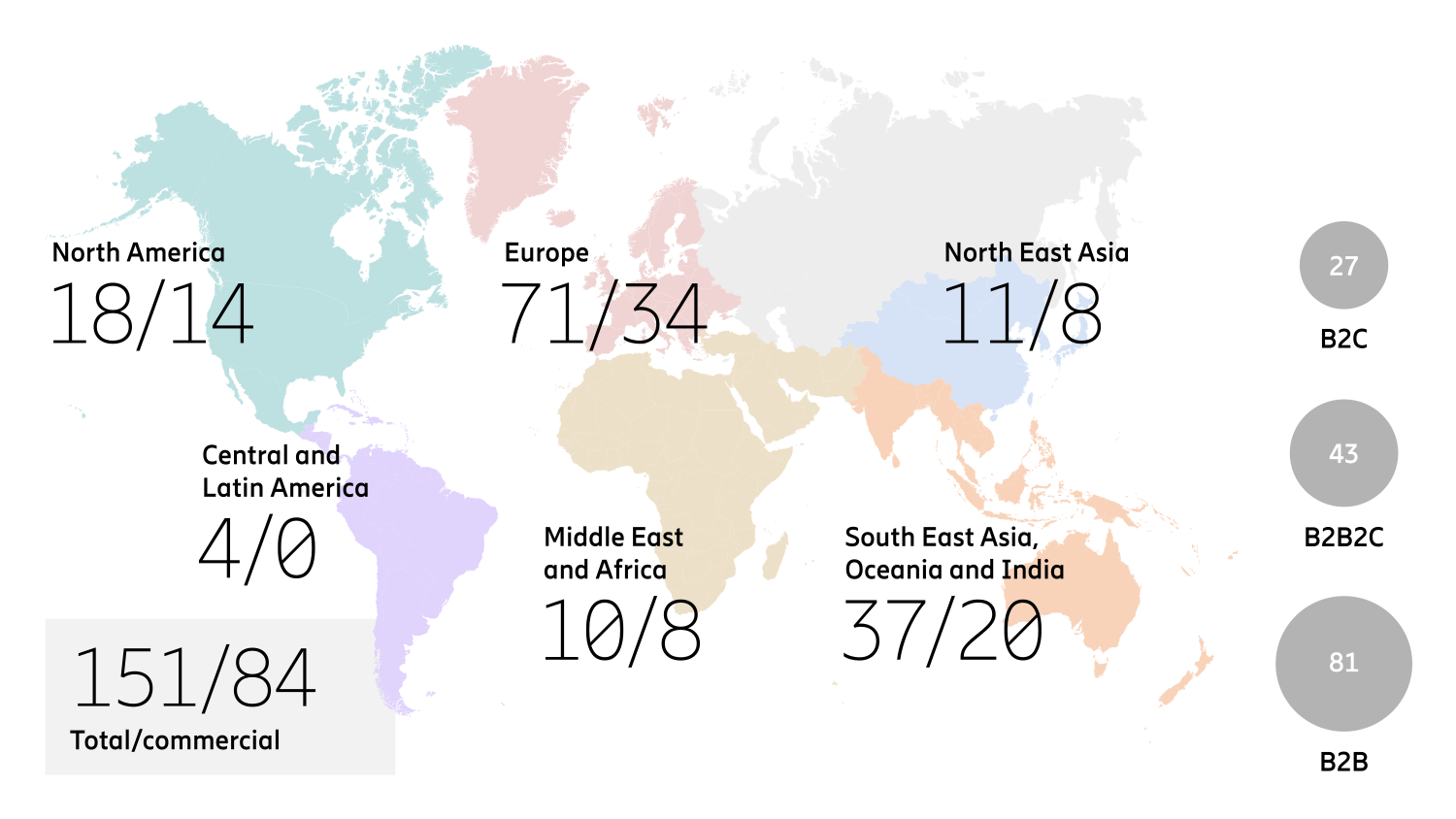
The previous edition of the Ericsson Mobility Report identified that 65 out of 118 total differentiated connectivity offerings were commercially available. Updated analysis of publicly available information across more than 300 service providers in 134 markets shows that number has risen to 84 out of 151 – equivalent to an annual growth rate of around 58 percent.
The regional distribution of these offerings remains broadly consistent – Europe leads with approximately 41 percent of all commercial offerings globally, followed by Asia-Pacific at around 24 percent. North America contributes approximately 16 percent, with the remainder distributed across the Middle East and Africa, Latin America and North East Asia regions.
The majority of new offerings come from service providers with existing commercial services. However, seven service providers have introduced their first offering(s), alongside their recent launches of 5G SA. Most of these service providers, six out of the seven, are in Europe, while the other is in North East Asia.
There are also 14 new trials and proofs of concept, of which about half are venturing into use cases outside of the existing commercial cases. These include slicing for self-driving trucks on public roads and autonomous drone systems, along with various advanced public safety and defense applications. About 57 percent of these trials are happening in Europe, 29 percent in Asia Pacific and the rest are split between North and Latin America.
Most of the new commercial offerings are found in the B2B segment, but B2C and B2B2C offerings are growing as service providers develop more consumer use cases. The majority of the B2C offerings are boost solutions. While they leverage 5G SA to deliver performance improvement, they are typically too generic to address any specific needs of most consumers or businesses, and mostly become “just another G” type of offering. The exceptions are more targeted offerings – focusing on gaming, live event connectivity, video calling and premium FWA tiers.
Figure 16: Global instances of network slicing coverage – total/commercial
Source: Ericsson analysis of public data.
Understanding the drivers: Why now?
The number of service providers with commercially deployed 5G SA is now around 90. The evidence points to a market building real and sustained momentum – and the high growth in commercially launched differentiated connectivity offerings is no coincidence. Several converging factors are at work.
Network readiness has crossed a threshold: For several years, 5G SA – the architecture that enables true network slicing and differentiated connectivity – was limited to a small number of early movers. That picture has changed materially. Today, conversations with service providers on the topic of differentiated connectivity have largely shifted from “whether” they will deploy 5G SA, to “when” they will – and what they can offer once they do so. Technology is no longer the gating factor.
Confidence is spreading through the ecosystem: The service providers that launched commercial services earliest – some as far back as 2022 – have had time to validate their approaches and refine their offerings. Some service providers are now beginning to report tangible results, whether in financial terms or through measurable uptake. Early movers’ experiences show that customers are willing to pay for guaranteed performance at key moments, such as during a gaming session or for priority connectivity at a crowded venue. The rest of the market is taking note.
Business model innovation is maturing: The range of approaches in the market – from subscription-based consumer tiers and event-specific boosts, to enterprise SLA-backed services – reflects growing sophistication in how service providers approach monetization of differentiated connectivity services. As mentioned above, now that the network technology is available, focus has shifted toward defining offers for customer segments and working out how to communicate their value.
Commercially available differentiated connectivity offerings have risen from 65 to 84, equivalent to an annual growth rate of 58 percent.
The persistent challenge: Bridging ambition and execution
Despite the encouraging trajectory of uptake, a significant gap remains between the ambition many service providers express and their ability to execute at scale. This pattern repeats consistently in discussions and collaborative engagements with service providers across markets.
In these settings, a familiar dynamic plays out. A service provider articulates a clear ambition: to launch a differentiated gaming offer, provide enterprises with SLA-backed mobile connectivity, or offer real-time connectivity boosts for consumers at live events. The vision is there, but when the conversation turns to execution, important gaps appear.
The marketing strategy may be underdeveloped – a compelling proposition exists on a slide deck, but the customer segmentation, pricing logic and channel strategy have not been worked through. Additionally, technical requirements may not yet be fully aligned with service design – the network capability exists in principle, but the majority of service providers have not updated operational systems in order to provision, monitor and assure the service at scale. Additionally, the go-to-market assumptions about how customers will discover and adopt the offering often do not hold up under scrutiny.
This reflects the inherent complexity of bringing a new category of connectivity service to market. Differentiated connectivity requires alignment across the entire organization, spanning technology, business and customer experience functions in ways that traditional service plans did not. Getting that alignment right takes time, cross-functional effort and a willingness to work through the details.
The right message at the right moment
Of all the execution challenges, the question of how to reach customers with the right offer at the right moment remains the most underestimated. Evidence consistently shows that connectivity performance is most salient – and most valued – when it is about to matter, with app-integrated offers having shown to be up to 20 times more effective than any other marketing channel. A user preparing to start a gaming session, join a critical video call, or stream a live event in a crowded venue is in exactly the right state of mind to respond to a guaranteed performance offer.
Yet, very few service providers are taking advantage of this. Most offerings are still marketed in broadly traditional ways, with the only notable shift being the use of the word “guarantee” alongside a connectivity performance metric.
That is not enough. In a world where consumers are flooded with messages across social media and digital platforms, a value proposition must be very clear and concise. If a user has to translate a performance metric into personal relevance and value, the moment – and the sale – is likely lost. The most effective messaging translates technical capabilities into experience outcomes: Guaranteeing a minimum 3 or 4 Mbit/s may be what makes a video call reliable, but what resonates with the user is the assurance that their camera stays on for the entire call. Messaging should not promise “priority QoS,” but rather “your game won’t lag, even in a packed arena.” Not “guaranteed bandwidth,” but “your video call stays sharp, wherever you are.”
The service providers who find the language for these benefits that resonates clearly with consumers are the ones building the most loyal and engaged customer bases.