










High-performance networks allow us to reimagine the value of digital

CTO Ericsson
CTO Ericsson
CTO Ericsson
Today, our societies and workplaces are entering a new mixed-mode hybrid normal, where the integration of physical and digital worlds are allowing us to imagine new possibilities for business delivery. As a society, we have taken a critical first step into the emerging mobile-first economy, catalyzed by the acceleration effect of a pandemic that has fast-tracked several years of digitalization in just 18 months.
Throughout the ongoing digital acceleration, robust mobile networks have proved themselves to be invaluable in weathering the traffic storm and, in doing so, have provided the resilience to keep businesses connected, societies interactive, and mission-critical communication use cases running – as demonstrated in our ongoing collaborations with public safety operators FirstNet US and Erillisverkot Group.
The pace of digitalization has been fast, yet the scale and impact has been uneven. Last year, in the midst of the pandemic, the World Economic Forum estimated that 84 percent of employers within white-collar industries were set to rapidly digitize their working processes in response to Covid-19 restrictions. Yet for many micro, small and medium-sized enterprises (MSMEs), which account for 80 percent of total businesses worldwide and who have generally lacked the agility to digitalize on a par with larger enterprises, that critical first step has not been as profound.
Today, the world is moving steadily into an era of 5G high-performance networks where advanced edge and cloud technologies have the potential to create enormous economic growth opportunities across all industry segments, including healthcare, construction, retail, banking, manufacturing and travel. According to the McKinsey Global Institute, this can generate a significant annual labor productivity growth increase by as much as a percentage point across the world’s largest economies, presenting enterprises with new opportunities to deliver unique products and services, adopt strong managerial and operational competences and remain flexible in adapting to changing demands.
It should be clear to everyone that the ramifications of high-performing and secure 5G networks will be decisive – at a plant level, supply chain level, in a broader macro-economic context. To remain competitive and ensure fair and wide-ranging impacts of the emerging mobile-first economy, it is critical that business, tech and government leaders make concerted efforts to bridge digital investment gaps, deliver a strong and resilient digital infrastructure, and provide favorable conditions on which to innovate this next era of industry.
Emerging mobile-first economy
The move to remote working has made many thousands of enterprises realize that brick-and-mortar and local data centers are not always integral to today’s business plan, and certainly not tomorrow’s.
By our own estimates at Ericsson, in 2030, we expect that almost 60 percent of white-collar work will still take place outside of company premises, much as it is today. However, tomorrow’s dematerialized office will be underpinned by a highly-predictable and resilient digital infrastructure – enabling critical efficiency gains and spurring advanced mobile cloud use cases based on extended reality services and other technologies.
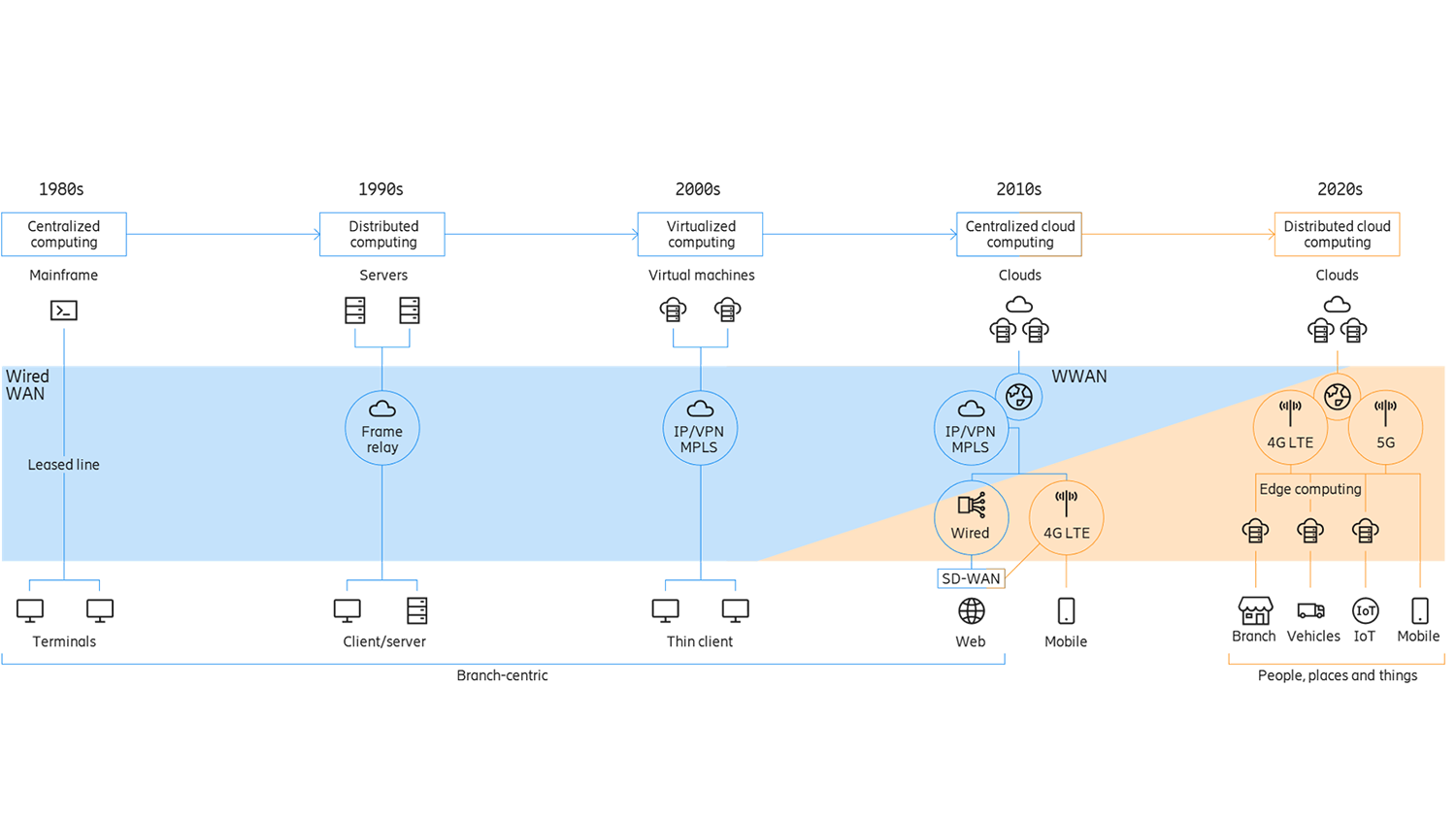
Already today, there are many early enterprise frontrunners who are demonstrating the technology potential of being mobile first – across all industry segments. A recent 5G wireless WAN report by CradlePoint highlights many early enterprise and public safety use cases where cloud-delivered wireless network edge solutions are enabling enterprises to benefit from improved connection flexibility, expedited deployment, minimized network downtime, reduced overall costs and the realization of low-latency IoT and mixed reality technologies.
This trajectory will intensify and broaden in coming years as both network and application technology domains develop and mature – ensuring that all enterprises will no longer need to rebuild connectivity or compute for each part of their business and logistics chain.
Breakthrough of high-performing and secure 5G networks
To enable this next era of industry, we are re-inventing the building blocks of enterprise connectivity and compute – delivering the highest possible performance standards and security assurance of mission and business-critical processes such as factory automation, remote control of assets and more.
As such, 5G will be the only ICT platform which can connect private enterprise to the global innovation ecosystem. This promise is founded on high-performance 5G technologies such as ultra-reliable low latency communications (URLLC) and time-sensitive networking (TSN); and will be served through network slicing models where tailormade performance will be delivered to enterprises as-a-service on one single, resilient infrastructure. As such, the new enterprise platform will be characterized by a resilient and interoperable system in all major dimensions, including reliability, availability, robustness, security and privacy.

Using trusted computing and a secure cloud-native implementation, 5G offers enterprise and society the secure, resilient and capable platform needed to innovate and rationalize using the entire array of digital technologies. What is more, having these types of functionalities built in the global standard and supported in scale by a vast ecosystem means that enterprises can benefit from efficient ready to go solutions minimizing the need for system integration beyond what is enterprise specific.
As an enabler of new dynamic mobile use cases, network slicing will serve as the crucial catalyst behind the 5G enterprise era. Today, we’re already seeing a lot of substantial early momentum across many network slicing use case areas where varying network performance characteristics are required to deliver on business or mission-critical targets, including public safety, factory automation, automotive and logistics cases. Here, the versatility offered by such models enables communications service providers (CSPs) to deliver capabilities such as ultra-low latency and enhanced network security – including traffic isolation, data integrity protection and privacy – in an on-demand self-service manner. Today, we are collaborating intensely with the enterprise and edge cloud ecosystem, including frontrunners such as Atlas Copco, ABB, and Mercedes Benz at their Factory 56, to create a blueprint on which to scale such business cases across new enterprise.
Five-nines resilience for enterprise
As an industry, the value of our achievements across consumer markets has been extraordinary. If we put that value into context, for a cost little more than a cinema ticket or a meal out each month, our agnostic and standards-based approach to mobile technologies have made it possible for subscribers to experience up to 99.999 percent high-availability connectivity with seamless interoperability and global multi-vendor support. Today, with high-performance 5G networks and the groundbreaking performance, assurance, and security capabilities inherent within 5G mobile technologies, we have a platform capable of introducing those same resilient connectivity standards across almost all enterprise application and services.
To continually deliver on this high benchmark and meet the critical security needs of new enterprise, our resilient 5G system is based on a zero-trust concept and built upon four key components: service availability, which is integral for both business and mission-critical use cases; solutions built on confidential computing, allowing us to protect data also when being processed, providing assurance for users and regulators; secure identities and protocols, which are essential to protect communication at every layer between humans, devices and applications in different segments; and security assurance, evolving to built-in assurance and proof-of-compliance mechanisms. As industries and technologies begin to develop, scale and shift rapidly, this strong baseline will continue to be secured through common global mobile standards frameworks such as 3GPP, IETF, ETSI, GSMA, and NIST, as well as industry-specific fora such as 5GAA and AECC, and global cybersecurity consortia such as CONCORDIA.
The resulting increased demands on the network, through new business contexts, use cases, and a growth in potentially unsecure devices, will continue to generate new complex security and privacy requirements. As such, the challenges presented to enterprise security postures will be unprecedented, but not insurmountable. Through the inherent security of the resilient 5G infrastructure and future IoT devices, based on common global standards, and coexisting with other proprietary IT platforms, enterprises will be equipped to meet the increasingly diverse and complex cybersecurity challenges associated with the new mobile cloud paradigm.
Collaborating to secure tomorrow’s potential
By the end of this year, the world will have surpassed half a billion 5G users. By 2026, this will rise to 3.5 billion, making the speed of 5G uptake far higher than it was for 4G, let alone 3G. This next digital acceleration, one of universal 5G coverage and private 5G networks, will irrevocably shift the business landscape for private enterprise, telecom providers and tech vendors. As the number of connected applications and devices increases exponentially, so too will the economic value of the goods and services that rely on their integrity.
Resilient, high-performance 5G systems that are always available, always perform as expected and always deliver information uncompromised from the source will play a critical role not only in securing those assets, but will be key to enabling wider economic growth and market competitiveness. As such, it is in the interest of all stakeholders across industries, tech ecosystems and governments that we collaborate openly and holistically to ensure the interoperability of diverse and emerging digital infrastructures, and thus deliver the full revenue and technological potential of this powerful innovation platform in the coming years.

Security and privacy in resilient 5G systems
Learn more
Read more about resilient 5G systems – Network resilience and security.
Read Erik Ekudden’s previous blog post CTO Focus: How to ensure 5G and edge become the innovation platform they’re meant to be.
Learn how network slicing enables customized connectivity with assured performance for enterprise, consumer and industry-specific services.