










Persevering with flexibility and scalability is key to monetizing enterprise 5G

Head of Business and Operations Support Systems (BOS) Portfolio

Head of Business and Operations Support Systems (BOS) Portfolio
Head of Business and Operations Support Systems (BOS) Portfolio
The in-depth 2021 TM Forum report, Is BSS ready to monetize enterprise 5G?, revealed that only 10 percent of the communication service provider (CSP) survey respondents consider their company fully ready to deliver and monetize their planned 5G enterprise services, while roughly 44 percent were less than halfway there.
The recent TM Forum webinar discussed this report in-depth and I had the pleasure of unpacking these research findings with TM Forum’s Mark Newman and Ed Finegold, as well as the options and challenges CSPs are facing as they shore up their business support systems (BSS) for demanding B2B 5G use cases, like smart manufacturing.
Closing the BSS gap
Considering that most legacy telecom platforms cannot do the heavy lifting required in B2B 5G, it’s urgent for CSPs to identify priorities, pinpoint challenges and make strides in closing the gap between their existing operations and the advanced BSS platforms needed to successfully bill, charge, scale and monetize 5G B2B use cases.
Traditional ‘underinvestment’ in sophisticated B2B features and the need to close this substantial gap, are the most pressing problems holding CSPs back. The TM Forum report quotes Adrian Matei, Data, AI & Enterprise Solutions Director for Orange Romania, who assessed the situation this way:
“B2B is underinvested in terms of technical solutions. This is especially true for B2C, mobile-centric businesses that continue to focus most of their IT investments in defending the core business, at times to the detriment of B2B that is a true high potential sustainable growth engine.”
Since enterprise 5G is more than just selling voice, text and data, CSPs now need to deploy a complete BSS ecosystem that can handle the more sophisticated tasks associated with the provision of one or more 5G B2B use cases such as creating orders, charging and billing, selling network slices and managing the partner experience.
BSS 5G readiness requires that service providers address many pressing issues at once, including the following key takeaways:
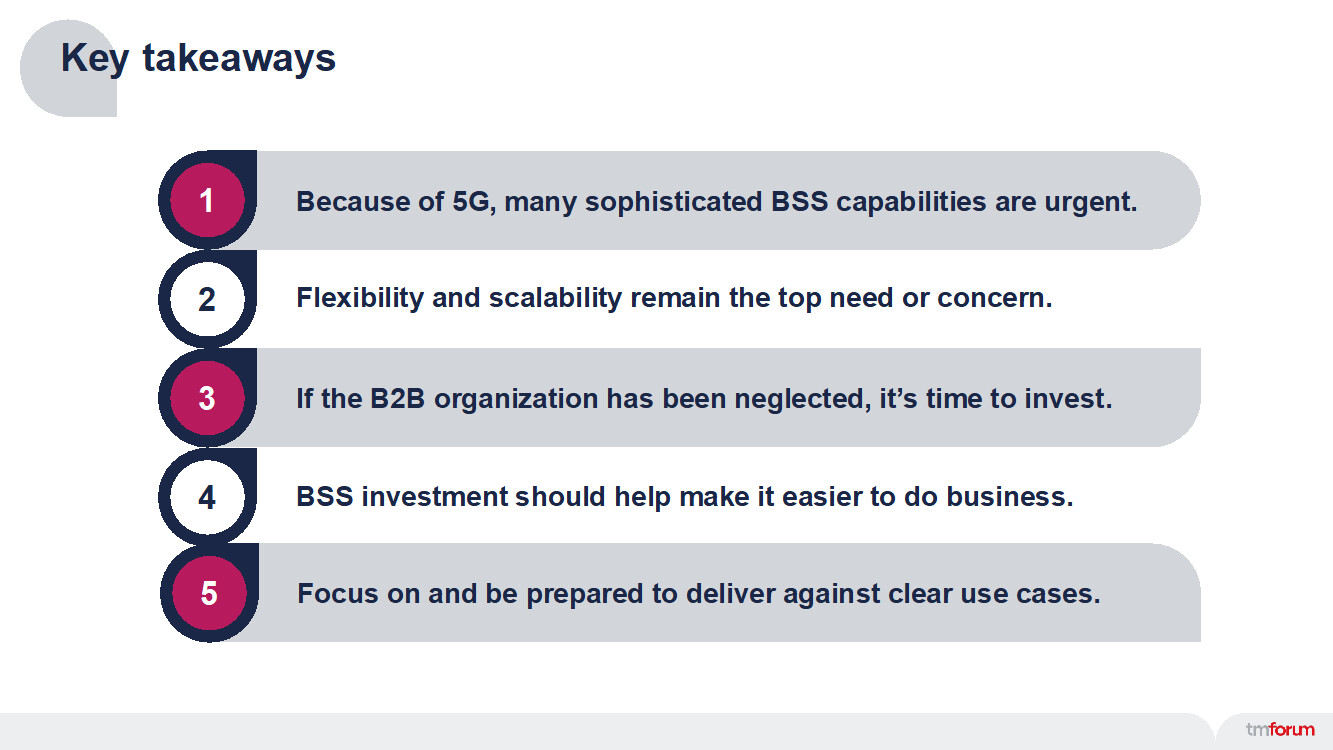
The ability to change, grow and adapt technologically will likely be an on-going challenge for CSPs. Rather than performing a costly customization development to upgrade their existing legacy stacks, CSPs should deploy BSS platforms that are more configuration-based because it allows for greater flexibility, agility and a stepwise transformation to monetizing different 5G B2B use cases. Simply put, if you’re going to exploit the benefits of 5G for making money, you’ve got to be able to offer the same service, or different services, through configuration, not development.
Pivotal business decisions at hand
CSPs need to have a well-defined, practical 5G enterprise business plan in place because it’s difficult and costly to start up many services across different verticals at once. The business plan should also take into consideration the vertical domain knowledge necessary to properly serve a target industry such as finance, healthcare, automotive, energy, or manufacturing.
Like the old adage, 'When everything is a priority, nothing is a priority,’ CSPs need to ask themselves: “What role do I want to play? And how far do I want to take it?”
There’s no right or wrong answer: it’s a whole new paradigm, so focus on where you will create the most value, not on everything.
Ready to seize opportunities
A fundamental question for CSPs is: “What role do we want to play in the value chain? Is it that of service creator, service enabler, or continuing as a network developer offering connectivity alone?”
- The network developer role applies the B2X business model, which is close to the current core business of CSPs. CSPs provide tailored connectivity solutions for consumers and business by implementing and operating network infrastructure, including access, core and transport.
- A CSP acting as service enabler applies the B2B2X business model. Here the basic connectivity offering is evolved into a network and digital platform offering with end-to-end (E2E) orchestration and programmability enabled by service exposure.
- When acting as service creator, the CSP operates as integrator in the B2B2X business model and creates whole solutions by bundling platform services with applications to address vertical sectors directly.
While being a service creator gives CSPs control over their end-to-end workflow, there is a case to be made about offering a network slice or service-level agreement (SLA) to contract third-party partners that can in turn use the CSP’s 5G platform to create and fulfill their own services.
For example, maybe you decide you’re not going to participate in energy and utilities, but if a partner comes along and says they want to use your network to capture meter readings, you might want to let them order the service and connect their IoT meters. This prospect forces the need for having a sufficiently capable operations and business support (OSS/BSS) systems platform in place to manage the complexities of this business arrangement.
The following graphic illustrates what survey respondents cited as their most pressing BSS needs and priorities:
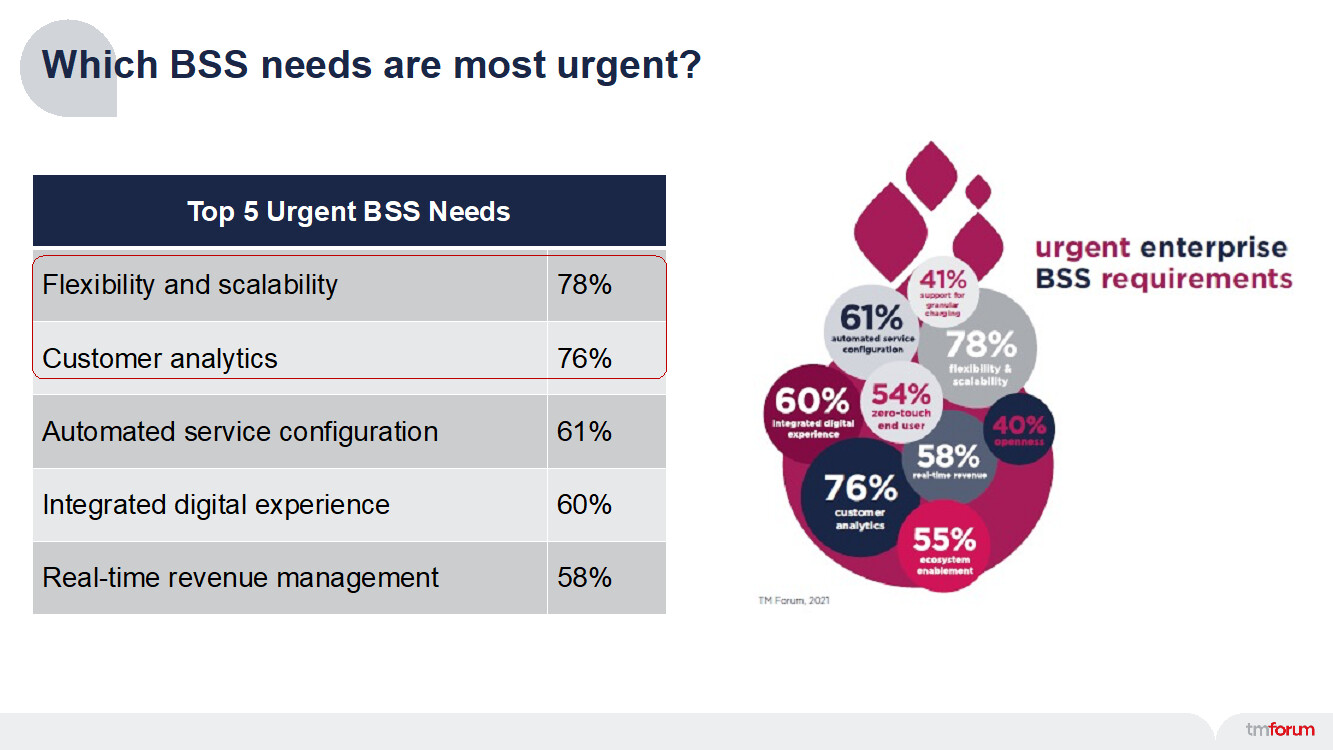
Source: Is BSS ready to monetize enterprise 5G? - On demand: TM Forum Inform webinar, Nov 11
It’s clear that both flexibility and scalability matter because we don’t know every opportunity that is going to come. By investing in the platform, CSPs can capture 5G B2B opportunities in a meaningful way.
Moving towards smart factories
The TM Forum report quotes Sofiene Kamoun, General Director, Strategic Initiatives for Vidéotron: “You’ve got to focus. It is very hard to start in many verticals all at once and have the domain expertise.” However, survey participants identified an average of 2.6 different B2B verticals in which they’d like to engage. For example, the research shows that 50 percent of CSPs in healthcare also want to target financial services 56 percent have their sights set on transportation and 58 percent want to target both the automotive industry and healthcare.
The growth opportunities span many industry verticals. Smart manufacturing alone is expected to grow from USD 165 billion in 2019 to USD 250 billion by 2024. TM Forum survey respondents who want to pursue this vertical emphasized the need for BSS capabilities like zero-touch automation, granular charging and automated service configurations. In addressing the needs of a technologically sophisticated sector like smart manufacturing, we must remember that 5G is an ecosystem. It’s important that your RAN, your network, your core, your OSS, and your BSS work in tandem.
Smart manufacturing presents many innovative new 5G use case opportunities that will demand new BSS capabilities. One example is the use of augmented reality (AR) and low latency connectivity to enable off-site experts to remotely inspect and troubleshoot equipment problems on factory floors in real-time. The following workflow for remote AR inspection and troubleshooting serves as a good example of a 5G enterprise use case:
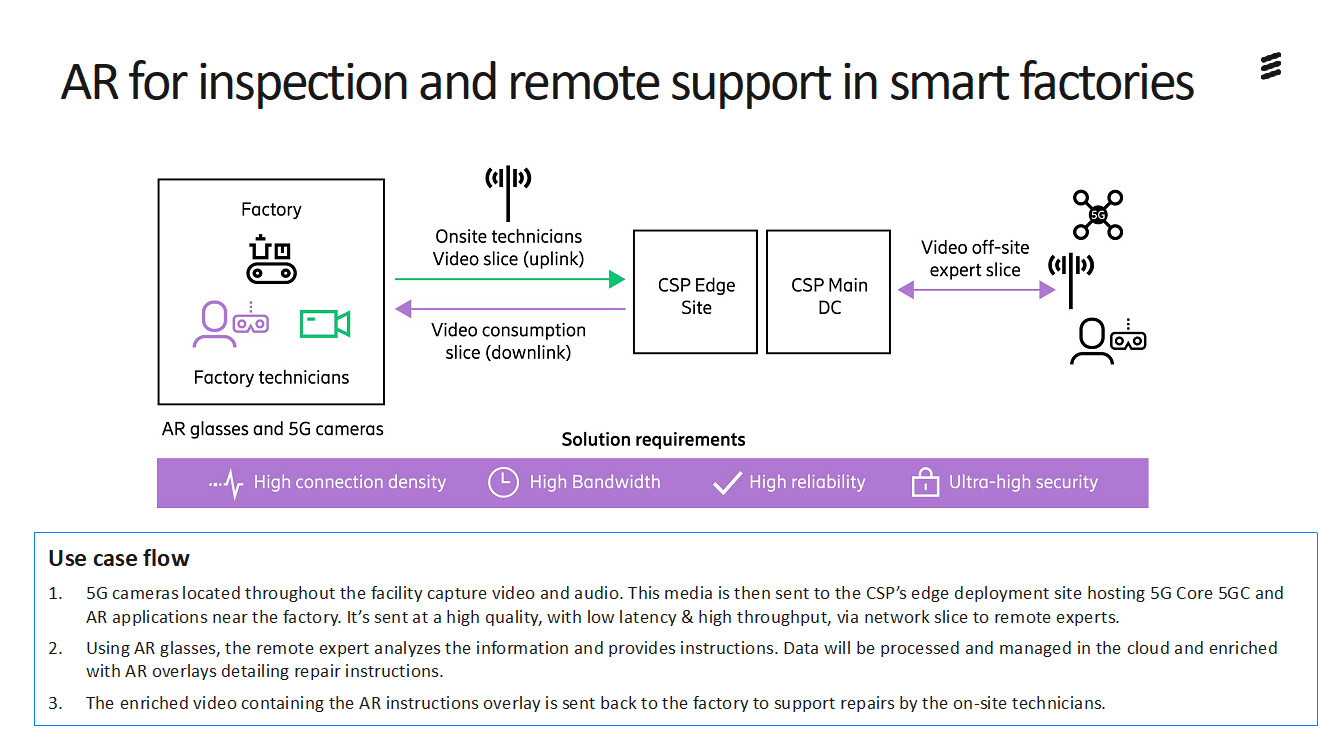
Source: Ericsson eBrief: ‘Full steam ahead for Industry 4.0: Exploring BSS for smart factories.’
While a CSP may not be an expert in AR-driven smart manufacturing, one possible scenario is to set-up and enable the service, provide the enhanced 5G connectivity and then engage partners and stakeholders who are experts in AR and maintaining precision robotic machines.
Take, for example, the value this 5G B2B service offers to enterprise customers in the smart manufacturing vertical. Assuming it costs a factory thousands of dollars per minute in lost revenue whenever critical robotic equipment goes down, the ability to capitalize on remote AR troubleshooting protects the manufacturer’s bottom line. The faster the robotic equipment can be fixed and put back online; the faster losses can be stemmed by restarting the production line. AR and remote connectivity enable quick access to highly specialized repair engineers, without delay or travel costs, while making better use of their time and talents.
In this instance, the CSP is the service enabler and the BSS takes care of creating the order, billing for the order, managing the slice, and contracting the partners. To succeed in monetizing 5G CSPs need to invest in partnerships and ensure the BSS can support the partnerships. While CSPs are more comfortable with end-to-end control, playing in a certain vertical might require exposing their platform to strategic partners that would then use it to fulfill their own service.
Strategizing the best path forward
So, is your BSS ready to monetize enterprise 5G services? Before answering this question, CSPs must first consider the role they would like to play, which service model promotes growth and which business model allows them to deliver the greatest business value to enterprise customers.
The single killer 5G use case is elusive, more realistically, there are multiple uses cases needed to support the business case. So, if you don’t know which vertical would be the best to target, or you prefer to stay open to interesting opportunities that may arise, the key is to be as flexible and agile as possible. Regarding BSS, 78 percent of survey respondents said they had an urgent need for flexibility and scalability.
TM Forum survey results showed that 76 percent of respondents regarded customer analytics as an urgent need. AI, machine learning, monitoring, data analytics engines and other tools can help track and evaluate how well the BSS for 5G enterprise services, especially product catalog and charging, are stimulating sales, growth, and value.
Creating a business plan helps justify the B2B investment relative to the revenue that can be generated. So, perhaps the real question is: “How can I make sure I have a BSS that will enable revenue capture?”
Overview of the TM Forum Inform webinar: ‘Is BSS ready to monetize enterprise 5G?’
‘Is BSS ready to monetize enterprise 5G?’ was a live webinar hosted by TM Forum on November 11, 2021, that delved into the opportunities and challenges facing today’s CSPs as they prepare to support the innovative use cases enabled by 5G’s exceptional speed, bandwidth and low latency.
Moderated by TM Forum Chief Analyst Mark Newman, the webinar featured Ed Finegold, TM Forum Contributing Analyst and author of “Is BSS ready to monetize enterprise 5G?” This in-depth report analyzes the results of a recent TM Forum Benchmark Survey of 173 CSP professionals from 61 telecom companies worldwide.
Finegold was joined by Jason Keane, Head of BSS Product and Solutions at Ericsson, who discussed the importance of establishing a robust digital OSS/BSS platform to support complex 5G enterprise use cases, with a deep dive on a smart manufacturing use case. Together, these panelists also shed light on the costs and risks of being unprepared for enterprise 5G; and strategies for tackling essential OSS/BSS upgrades and partnerships.
Find out more
- Watch the TM Forum Information webinar (on demand): Is BSS ready to monetize enterprise 5G?
- Read the TM Forum report: Is BSS ready to monetize enterprise 5G? by contributing analyst, Ed Finegold.
- Dig deeper with Ericsson’s eBrief: ‘Full steam ahead for Industry 4.0: Exploring BSS for smart factories.’
- Read our blog: Is your BSS ready to monetize enterprise 5G services?