










Six experience continents are defining the world of 5G

Head of Thought Leadership
Head of Thought Leadership
Head of Thought Leadership
Enhanced mobile broadband and fixed wireless access experiences drive 5G network coverage and capacity build-outs. Massive IoT and Broadband IoT experiences are today served by 4G and mature markets, where 5G is set to enhance existing experiences. The Critical IoT and Industrial Automation IoT experiences are in the early stages and developing quickly.

Mobile broadband has long been the anchor of 4G, providing an experience delivered with data connectivity in low- and mid-band spectrum, gradually pushing average traffic volumes upwards through increased usage and more advanced applications. This is an experience that is well understood by consumers and business users in developed markets.
Five areas are in focus, which aim to enhance the mobile broadband experience. The first is centered on securing the experience with mobile apps. The push toward media-rich apps requires higher performance at the cell edge to support mobile apps consistently across the network. 20Mbps downstream to users and 0.5Mbps upstream is the norm to support this foundational experience.
The second area aims to improve video experiences, from the standard definition option that is the norm for 4G, to support HD, 4K, 360 degrees, and 3D video. Achieving higher video qualities and bringing existing formats into the mobile world are vital for enhancing the entertainment experiences on smartphones, tablets, and laptops.
The third area is support for the streaming of games to mobile devices. Game consoles and powerful PCs dominate gaming today, but mobile devices become accessible for new users and new mobile experiences when games can be streamed on them. The streaming of games to mobile devices requires network capacity on par with advanced video formats.
The fourth area of enhancement is related to the untethering of AR and VR goggles, and new XR device innovations. A large share of the compute-intensive rendering requires a desktop PC nearby and a cable connected to the goggles. 5G allows edge computing to take the PC's role without any wires being required for the goggles.
The final area of enhancement is related to traffic from smartphones to the network—a domain in which 5G can provide an order of magnitude higher capacity from devices towards the network, compared to 4G. Users will experience this advantage when sharing videos from crowded areas on social media and for video-based communication.
Which of these enhancements can the network support depend on the type of 5G spectrum in use? Services in the high-band or millimeter-wave spectrum provide the most considerable enhancements, but over short distances, mobile broadband in the mid-band spectrum brings material capacity enhancements across metropolitan areas. 5G in the low-band spectrum provides a foundation of low latency connectivity everywhere. The contrast between services in different spectrum will be less visible over time when aggregating multiple band types into a seamless connectivity service.

The possibility of fixed wireless access, using cellular technologies, has been explored since the time of 1G. The fixed wireless access performance in the past was slower than that of fixed broadband alternatives, and introduced once the mobile applications were mature. The main difference with 5G-based networks is that fixed wireless services are rolled out earlier, with a reduced or eliminated performance gap compared to fixed broadband alternatives. Traffic volumes of fixed wireless access follow fixed broadband traffic patterns rather than those of mobile broadband.
The new fixed wireless opportunities build on a mix of outdoor and indoor terminal devices—the outdoor terminals with external antennas providing a leap in performance over indoor terminals with integrated antennas. Fixed wireless access offers a faster time to market than fiber to the premises. Both consumers and businesses outside the existing fiber footprint can leverage fixed wireless access. Fiber-like performance over the millimeter-wave spectrum can be provided in towns and suburban households. Dual-play, fixed, and mobile broadband bundles are available for young consumers moving from their parents' family plans and becoming service providers’ customers on their own. Fixed wireless access is attractive in rural areas, for upgrades from cable and DSL broadband where fiber is unlikely to be deployed in the foreseeable future. Fixed wireless access also serves small and medium business customers, and for primary and backup connectivity services to branch offices.
Fixed wireless access has seen a large upswing in interest across all markets and applications. Ericsson projects growth reaching 180 million connections by 2026 with fixed wireless generating traffic volumes one to two orders of magnitude larger than mobile broadband in the same areas.
The Internet of Things' connectivity consists of two broad categories, which are short-range radio and wide-area radio networking. The short-range IoT is the largest market (20.6 billion connections projected by 2026) from a volume point of view. Cellular IoT dominates the wide-area market with 5.8 billion connections projected by 2026.
To better understand the world of cellular IoT connectivity, we must look at the four continents and their different characteristics. 4G can support Massive IoT and Broadband IoT and enhance these experiences with 5G. Critical IoT and Industrial Automation IoT require 5G.

The Massive IoT segment targets low-traffic applications where low-cost devices and long battery lives are vital characteristics. Cost and battery life have been an issue when applying standard 3G and 4G technologies in the past. The massive growth of sensors for generating data and the need for flexible deployments make cellular options attractive for fixed connection alternatives.
The Massive IoT segment is one of the 5G standardization areas that has been focused on from the start, referred to as massive machine-type communication (mMTC). Two new cellular options, NB-IoT and CAT-M1, deliver through 4G-LTE or 5G-NR, address this segment. These new technologies allow us to target applications where revenues are between a few cents and a few dollars a month. The traffic volumes are very low, but each bit of data can carry significant information value. Increased battery life allows us to introduce “fit and forget” solutions, where the lifetime of a device is equal to the length of its battery life. Universal network coverage will be common once this network technology has been deployed.
Massive IoT is a mature market with significant growth projections for the coming five years. By 2026, Massive IoT will be equal in size to all other 4G and 5G based cellular IoT segments in terms of connections. Typical devices in this category are smart meters, smart sensors, basic wearables, and fleet management modules in vehicles.

Broadband IoT piggybacks on mobile broadband capabilities and relies on technology already integrated into smartphones. Traffic volumes are higher than those for Massive IoT but lower than what smartphones generate. Monthly revenues in dollars are in high single digits or double digits. There are no unique requirements beyond what mobile broadband already necessitates. We introduced the term Broadband IoT as part of a broader cellular IoT report in 2019.
Broadband IoT is the second biggest category in terms of connection volumes. Capabilities surge with the mobile broadband evolution for both 4G and 5G. Existing traffic-based business models are proven and work well. Networks are available wherever smartphones work.
Broadband IoT is a mature market with proven technology and business models. Typical devices in this category are advanced wearables, vending machines, Cooperative Intelligent Transport Systems (C-ITS), and connected grid elements beyond meters.

Critical IoT is an emerging experience category, where service providers work closely with industry leaders to identify and develop use cases. These use cases are dependent on 5G to reach the minimum required connectivity levels to function correctly. There is a high level of innovation taking place, and use cases mature in multiple steps. Nailing use cases before scaling is an essential strategic priority. Validating market requirements, and identifying all required ecosystem and business model innovation happen on top of the creation of technical solutions.
Critical IoT represents a vital driver for 5G standardization, also referred to as critical machine type communication (cMTC) or ultra-reliable low latency communication (URLLC). The value proposition relies on very low latency, very high reliability, and exceptional capacity. The low latency opens the door to real-time applications, with minimal lag from triggers to action. Reliability is essential for business-critical and mission-critical applications. The high capacity enables data-rich and media-heavy applications. In this category, business models focus on the value created for businesses and consumers rather than data traffic-centric models as the norm. Network coverage for Critical IoT is demand driven, starting in urban areas and zones of urban and suburban areas.
Critical IoT is an emerging market. The six crucial stakeholders in the ecosystem leverage the network base driven by enhanced mobile broadband as a foundation for use case innovation. From initial showcasing to proven solutions and business models, the nailing of use cases is characteristic of the 2021 and 2022 market development. The devices and applications we foresee in this category are autonomous vehicles, remote control of industrial systems, fully immersive AR/VR/XR, and real-time control of industrial systems.

Industrial Automation IoT contains the most advanced use cases. These are central capabilities in enabling smart manufacturing and supporting advanced industrial processes. We introduced the term Industrial Automation IoT as part of the cellular IoT positioning work in 2019 by breaking up cMTC and URLLC into two segments with different characteristics.
The new 5G capabilities required for Industrial Automation IoT are part of releases 16 and 17 of the 5G standards defined by3GPP. Time-sensitive networking protocols offer support for the most real-time critical use cases. The ability to provide native ethernet services over 5G NR facilitates the transition from wired to wireless connectivity indoors. Network coverage for this category is limited to a zone characterized by buildings and their immediate surroundings, focusing on indoor coverage.
Industrial Automation IoT is an emerging market. Ericsson collaborates with CSPs, vertical industry leaders, and equipment providers to nail solutions and business models. Devices in this category are manufacturing robots and power generation equipment.
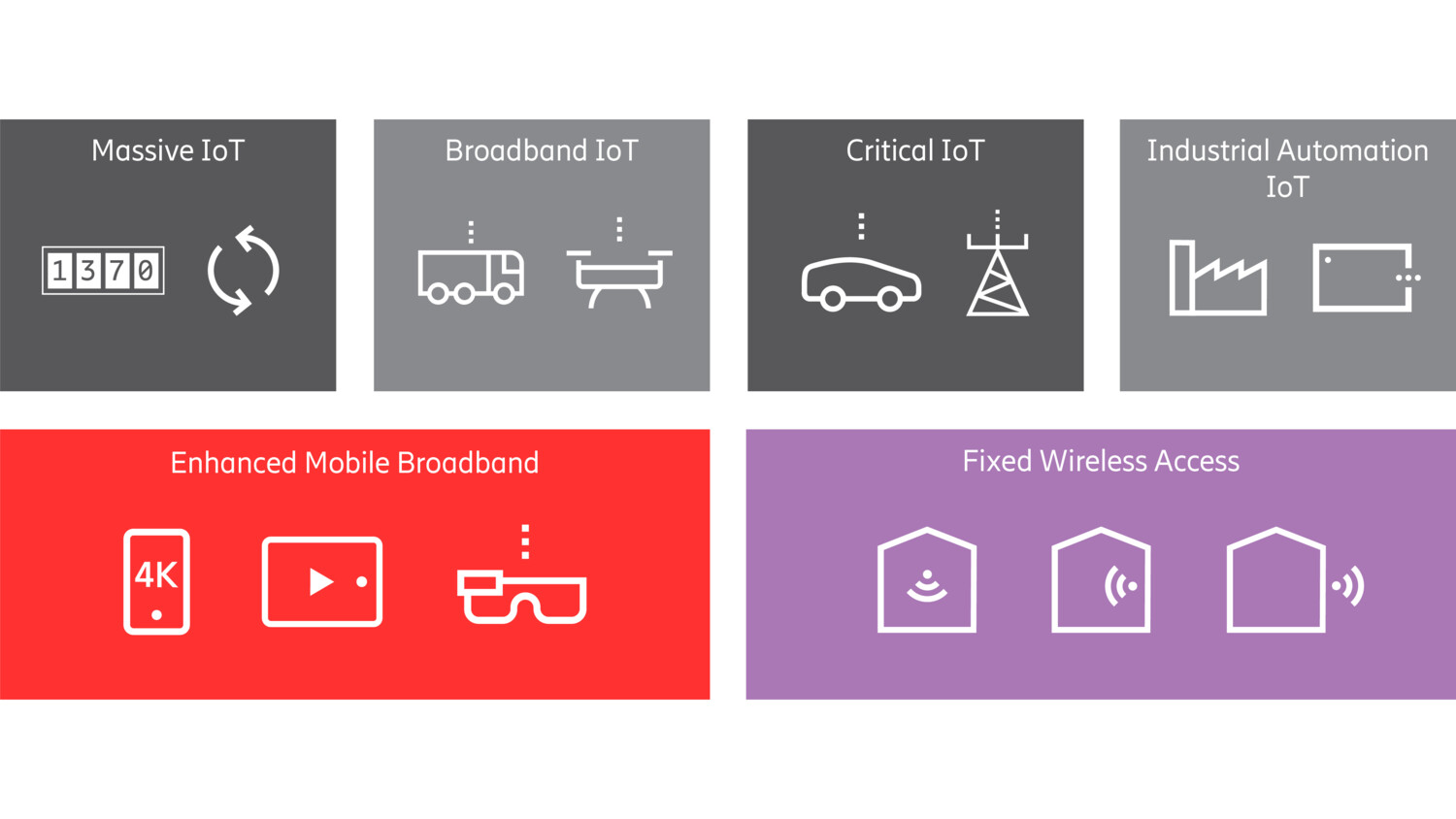
The 5G world offers unique possibilities to improve the experiences for each of these six continents. Enhanced mobile broadband and fixed wireless access drive the initial 5G network build. Massive IoT and Broadband IoT start with 4G with evolved use cases when 5G becomes available. Critical IoT and Industrial Automation IoT use 5G from the start, developed in zones, mostly indoors.
Practitioner’s Guide to 5G for Business - Five episodes during the fall 2021
If you signed up to the Practitioner's Guide in 2020, you’ll receive email when new episodes are published.
If you’re new to the Practitioner’s Guide to 5G for Business, you’re welcome to sign up here for an exciting series. In addition to the blog posts, you can expect one-page cheat sheets that summarize each topic. We’re also keen to support you in how you and your team can leverage this material and take conversations further at the intersection of service providers and enterprises.
Read previous blogs in the series:
Introduction to A Practitioner’s Guide to 5G for Business
Episode 1: Five reasons why 5G makes a difference
Episode 2: Five tech inflections