










Don’t take AI and ML for granted - understand why they’re critical for your RAN automation

Senior Solutions Marketing Manager OSS
Senior Solutions Marketing Manager OSS
Senior Solutions Marketing Manager OSS

The use of artificial intelligence and machine learning techniques such as reinforced learning and deep learning are so embedded in Ericsson’s approach to SMO at every level of the technologies we use that we forget to talk about them. Understanding how AI and ML are used in SMO is key to understanding why these technologies are critical for improving network performance and customer experience and for driving new service provider revenues in sustainable networks.
Network automation is a key component of digital transformation. When we think about mobile networks, the radio access network (RAN) is typically the largest and therefore the most relevant part of any mobile network both in terms of capital expenditures (CAPEX) and operating expenses (OPEX). This means that RAN automation has the potential to deliver the greatest return on investment (ROI) for service providers looking to reduce operational costs, improve customer experience and create new revenue opportunities.
On top of this, the need for RAN automation has never been greater. The introduction of 5G, Open RAN and cloud technologies further amplify this. Networks now have multiple different users, services and applications with different performance requirements and usage peaks. This requires a highly dynamic and intelligent approach to automation.
Artificial intelligence (AI) and machine learning (ML) have been widely used to automate all sorts of technologies, networks, platforms, and applications. In fact, the use of AI and ML technologies is so pervasive that we sometimes forget that these are bleeding edge technologies. And that is the purpose of this blog – to explain why AI and ML are fundamental for RAN automation and how we use these technologies in the service management and orchestration (SMO) domain.
The SMO domain automates the RAN by running RAN automation applications, called rApps. In this case, AI and ML are applied to manage and orchestrate the different ecosystem elements and domains in three major areas (see figure below):
- Service Management and Orchestration Platform
- RAN software (SW) and rApps life-cycle management
- rApps running on the SMO platform
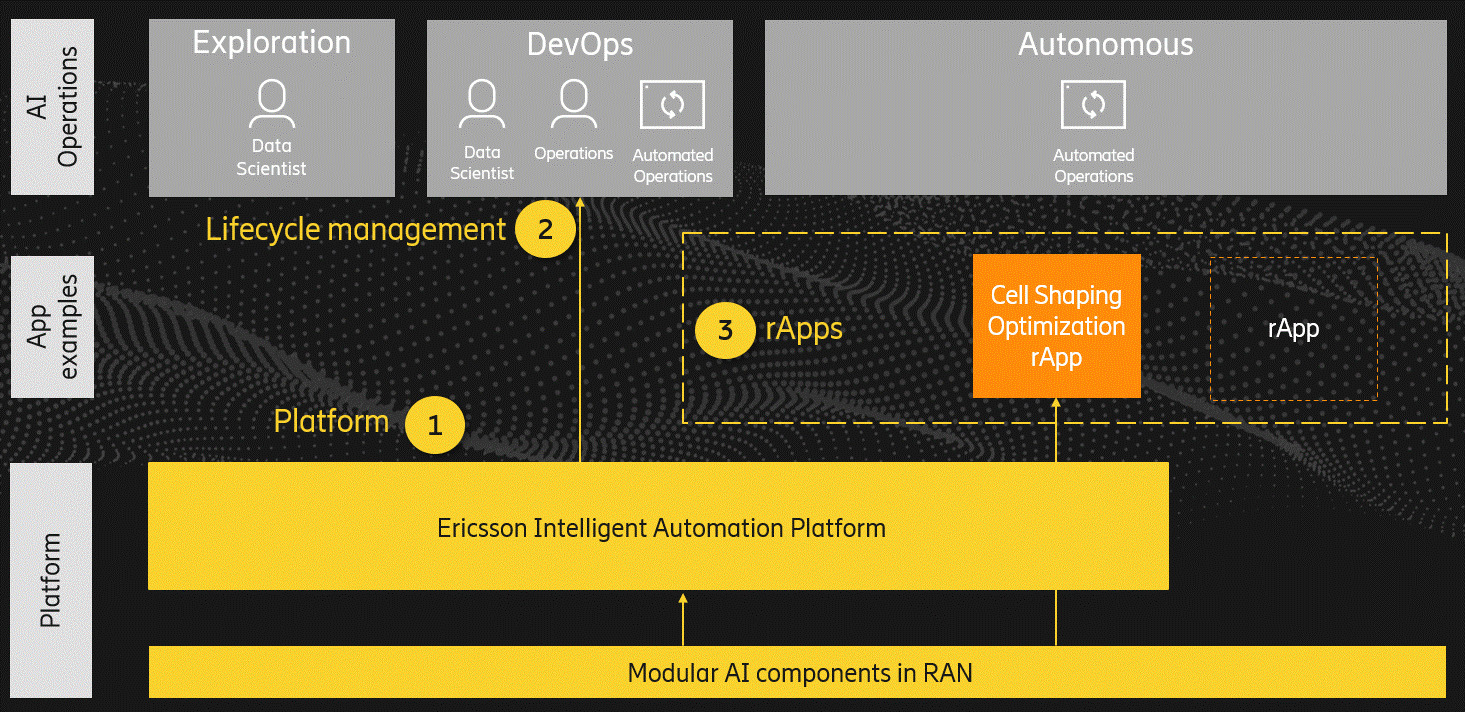
AI and ML is used in three key areas of service management and orchestration (SMO)
Let us look at each of these areas in more detail.
1. Service Management and Orchestration Platform
The Ericsson Intelligent Automation Platform takes the O-RAN Alliance SMO/Non-real-time RAN Intelligent Controller (RIC) concept and extends it from the Open RAN domain to support the existing, purpose-built 4G and 5G networks, which make up 98% of RAN equipment today. This innovative extension offers services providers choice in their approach to RAN automation.
The reason why we use the term “intelligent” is because the whole platform utilizes AI and ML. Besides supporting AI and ML training, the platform supports AI and ML-driven execution and AI and ML-driven life cycle management.
However, what isn’t so clear to many is why AI and ML are essential. Quite simply, modern RAN networks are becoming too complex to operate efficiently without AI and ML. The proliferation of devices and services, combined with more infrastructure, cell sites and sectors; more frequency bands in use; and highly differentiated quality of service (QoS) parameters including end-to-end network slicing are making the network increasingly complex to manage with existing systems and technologies. While network engineers can use their skills and knowledge to optimize an individual cell, this activity does not scale efficiently . AI and ML enable service providers to do significantly more with the same network operations and engineering resources. AI and ML are a way of enabling automating operations and making DevOps a reality.
The Intelligent Automation Platform includes a dedicated AI and ML execution environment for local training and execution. This environment performs five specific functions:
AI and ML models
- Model onboarding: Enables the onboarding of existing AI and ML models and algorithms onto the platform
- Model inventory (catalog): Provides an overview or catalog of the onboarded models, effectively a menu of models that can be deployed
- Model training: Allows the onboarded models to be trained with either generic or local, customer specific data
- Model deployment: Enables the user to create the method for model deployment
- Model monitoring: Allows the deployed models to be monitored, analyzed and updated or retrained, as required
This powerful AI and ML capability within the platform can access data from policy control functions and analytics as well as third-party data sources, such as weather forecast data or traffic congestion data, to execute important RAN automation decisions. This allows users to explore the full possibilities of AI and ML models.
2. RAN software (SW) and rApps life cycle management
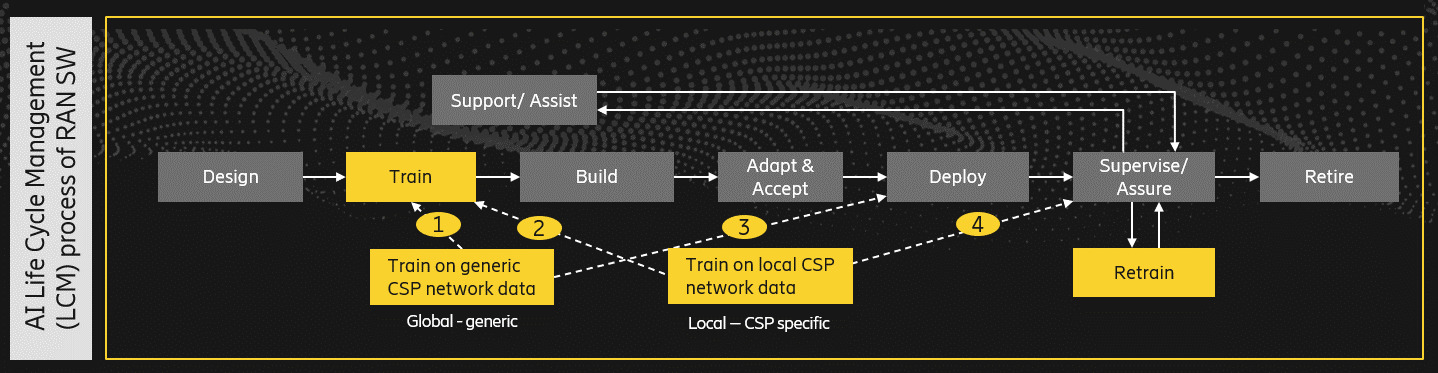
The radio features are built as AI models for the real time and near real time radio functionality, like the ones that take care of the traffic mobility. In this case, there is an automated process that is embedded in the Ericsson radio that constantly improves the performance of its functionalities. In the case of the rApps, which take care of the non-real time functionality, there is an AI life cycle management process that can be shaped or configured according to different operational models.
In both cases, the ability to use AI and ML technologies in network operations is key to driving down operating costs. Ericsson envisages four different AI and ML approaches to network automation, depending on the use case. This gives services providers the freedom to choose the option that suits them best:
- Global Model – The platform vendor either uses a generic or a standardized model to pre-tune an application before deployment. It may take the generic, anonymized network data for multiple cities to provide a “pre-tuned” model for the deployment of the frequency layer manager (FLM) in the service provider network. This global model may work very well for cities that have a plain geography – for instance, one that is not constrained by the coast, lakes, or mountains, which give cities an unusual topology.
- Local Model – The platform vendor takes data from a specific customer’s own network to train the model before initial deployment. This approach may be more appropriate for a city which doesn’t follow a typical profile. For example, Hong Kong has two central business districts, Kowloon and Hong Kong Island, with mountains and a large body of water within the city. A local model approach will likely give a more accurate starting dataset to train the rApp.
- Global Model with Retraining – The generic model is retrained by the service provider during the adapt and accept phases. This is a semi-closed loop approach, which takes the generic model and uses AI and ML data to amend the model over time.
- Embedded AI Model – This model enables continuous and autonomous training and re-training of the model within the service provider network. This is a closed loop or fully autonomous approach.
3. rApps running on the SMO platform
Ericsson envisages a expanding suite of rApps in four main categories: network evolution; network deployment; network optimization and network healing. Examples of early rApps from Ericsson and third-party developers are shown below:
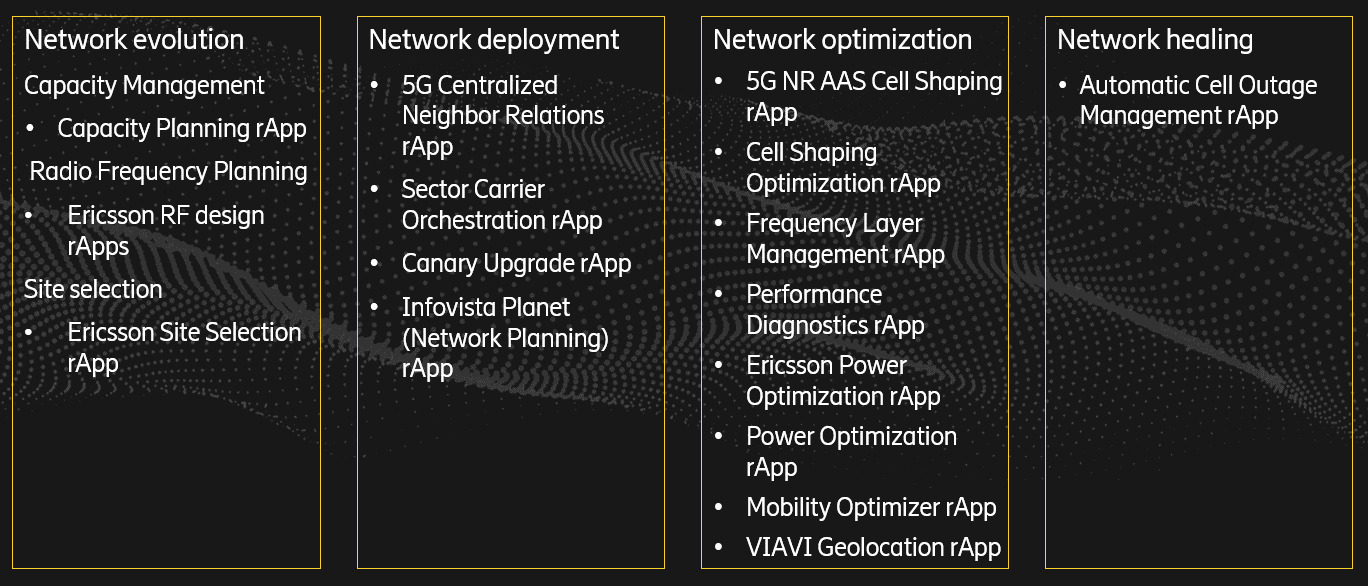
Early RAN automation rApps
A great example of the power of AI and ML-driven rApps is the Ericsson New Radio (NR) Cell Shaping rApp. In any real network, there are different problems related to coverage, capacity and radio quality. Those can be managed by using optimization algorithms. The Ericsson NR Cell Shaping rApp optimizes cell coverage for NR mid-band cells by controlling the digital tilt (vertical plane) and the beam width (horizontal plane) in Active Antenna Systems (AAS). Effectively, the application automatically fine-tunes the cell footprint to eliminate performance issues. This rApp is based on a reinforcement learning model which determines the optimal parameters to improve the cell edge/cell center user throughput. With this algorithm, we try to avoid coverage holes, overshooting and excessive overlapping between cells, which causes interference that could be translated into dropped calls or bad user experience.
One of the major challenges for service providers is that, because of the hugely complex nature of urban radio environments, there is always a risk of unintended consequences, where a relatively minor change in one cell may have implications elsewhere. This is why a core part of the rApp is the execution of performance assurance policies. AI and ML can manage such complexity by enabling the development of centralized policies that coordinate actions from neighboring cells.
This algorithm is being tested in a real network environment in collaboration with a major European operator. A generalized ML model has been trained using ray-tracing data from a radio simulator, but this model can be updated continuously by using real network data. So, the model will be able to learn from previous experiences and will create tailored versions for specific radio environments.
As an example, when changes are made to the cell shape, multiple parameters are measured in the target and adjacent cells to see what the holistic impact is. If the change improved throughput in the target cell, but reduced throughput or increased dropped call rate (DCR) in adjacent cells, it would not be considered a good change, and would therefore not be executed.
The development of the cell shaping optimization rApp in conjunction with a major UK operator led to the use of highly detailed AI and ML-driven data models for major cities like London, to accurately understand the radio environment and the impact of changes to the cell shape. In our simulations, we were able to:
- Improve up to 30% of the throughput for the worst User Equipment (UE) in the network, with around 75%-80% of utilization (i.e., high load). The impact of the algorithm is much smaller (around 5%) with less load (<50%).
- Improve between 5% and 10% the throughput for the average UEs in the network with around 75%-80% of utilization (i.e., high load). The impact of the algorithm is much smaller (0.5%-2%) with less load (<50%).
It should be noted that the worst UEs are not always UEs at the cell edge (although most of them are). We can also have bad coverage in other places in the cell, for example at lateral borders or at the cell center due to fading.
Getting real with AI and ML in the Ericsson Intelligent Automation Platform
As part of their digital transformation strategies, many service providers prioritize the automation of the RAN because it is the largest component of their network both in terms of CAPEX and OPEX and, as a result, it provides the greatest ROI from widespread automation. When we look at mobile networks, SMO is the key to automating not only Open RAN networks, but also the purpose-built 4G and 5G networks, which make up 98% of deployed networks today. However, the increasing complexity of multi-vendor, multi-technology networks mean that AI and ML technologies are fundamental to ensure automation can be managed efficiently and scaled effectively to deliver reductions in operational costs and enable new revenue streams.
Ericsson Intelligent Automation Platform is designed to support AI and ML in all dimensions – in the platform, in the RAN software and rApps life cycle management and in the rApps themselves. On top of this, the platform monitors and retrains its AI and ML models with real and local data, feeding them into the model automatically. This enables the models to learn from previous experiences and be continuously updated with real network data to create tailored radio environments for service providers.
To find out more watch our Tech Unveiled episode on Why service management and orchestration needs AI/ML.
Other related content
Ericsson Intelligent Automation Platform
Explore telecom AI
Explore AI in networks