






6G beyond connectivity: Giving AI agents real-world awareness
- When a person collapses on the street, an emergency center AI agent must quickly decide what help is needed and how to send it. Doing so requires both intelligence and awareness of what’s happening in the real world.
- 6G networks can give AI agents that awareness by sensing the environment and connecting them to sensors across the city – a new role for networks beyond connectivity.

Senior Expert, Internet architecture

Expert, IoT standards and protocols

Principal Researcher, Radio concepts and performance
Senior Expert, Internet architecture
Expert, IoT standards and protocols
Principal Researcher, Radio concepts and performance
Senior Expert, Internet architecture
Expert, IoT standards and protocols
Principal Researcher, Radio concepts and performance
Mobile networks are built to connect people and things. But they can also tell us a great deal about the world around them. For example, networks can:
- locate connected devices when someone makes an emergency call
- detect large crowds of people so that delivery drones can avoid flying over them
- sense the environment through radio waves to detect moving objects on roads or in the air, or to detect interference to communications
- act as a discovery and access layer for data from connected sensors and smart devices, making their data available to authorized applications and AI agents.
In this post, we’ll look at how humans, AI agents and networks can work together in a city emergency center to get help to patients faster. This is a use case for the future, but the technology is real. The same approach could also work in many other areas, from other critical functions in society to enterprises, factories, ports and traffic management.
We ran the scenario end to end in experiments, with real observations of the environment, all the necessary processing, and an AI agent powered by a large language model. For the detailed wind analysis, we worked with Dassault Systèmes. The emergencies are fictional.
How 6G networks sense the environment
When radio-based sensing is built into a communication system such as a mobile network, it is known as integrated sensing and communication (ISAC). The network uses radio waves to detect objects and determine characteristics such as their position and velocity. 3GPP is currently studying initial sensing capabilities for 5G Advanced, and the full potential of integrated sensing in 6G. Network sensing opens up significant market opportunities, for example in:
- public safety, such as detecting drones
- collision avoidance in traffic or between automated guided vehicles (AGVs)
- optimizing communications by tracking objects that block signals.
Because sensing and positioning can involve information about people, these capabilities need to be designed with a high level of privacy and consent in mind.
Figure 1 shows examples of sensing use cases.
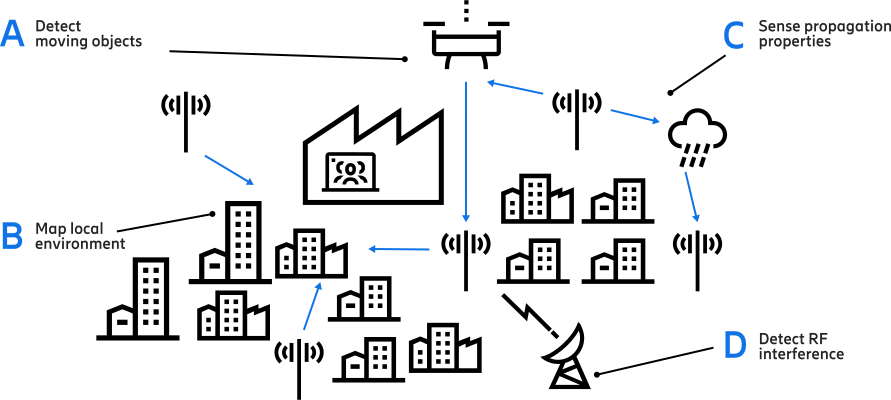
Figure 1: Sensing use cases
How an AI agent speeds up emergency response
Imagine a future city where a jogger has fallen seriously ill. The city’s emergency center is notified by the jogger’s smart watch, which also sends key biometric data. Based on this information and observations of the real-world environment, an AI agent at the emergency center draws up a plan for the best course of action, which a human operator can approve or change.
The AI agent can send an ambulance and alert nearby volunteer first responders based on their known locations. It can also send a drone to drop situation-specific medical aid, such as a defibrillator or an EpiPen.
Both the agent’s intelligence and real-world information matter at every step: to find out about the incident in the first place, to choose which medical aid and teams to send, and to pick the right starting points and routes for drones and ambulances.
Drones fly above traffic but can be affected by wind, so the agent needs to choose the right drone center to launch from and the right route to fly. Similarly, sensing traffic conditions in the city helps it pick the right available ambulance and the fastest route.
Figure 2 shows an illustration of an emergency center where a human operator reviews the AI agent’s plan to use ambulances, drones, and volunteer first responders to solve the emergency.
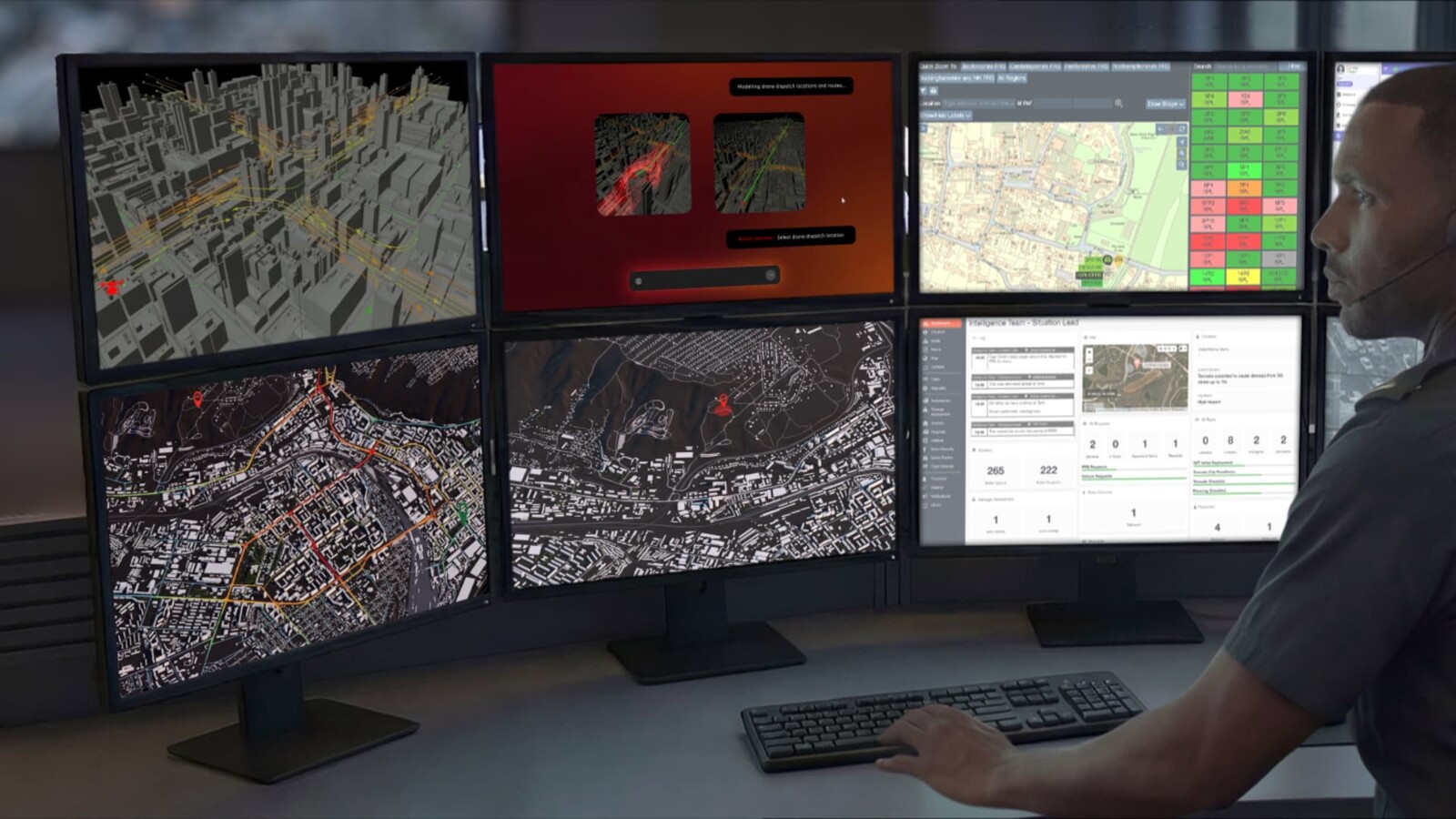
Figure 2: An emergency center operator and AI agent in action
What information does an emergency center need?
The emergency center needs timely, accurate and trustworthy information about the situation.
It all starts when the center learns about an incident. A smart watch, for instance, may report an irregular heart rhythm. With 6G, we expect such watches to communicate even more power-efficiently, thanks to the lean design of the new 6G radio. Networks can also make sure that messages get through and even simultaneously track the smart watch’s battery level so that critical information is delivered before the battery runs out.
Once the emergency center knows about the incident, it starts acting. In the model we envision, human operators make the decisions, helped by AI agents that first gather all relevant information and propose plans, which the operators can then revise as needed.
Emergency center decisions are complex and depend on many different sources of information, including:
- information about the incident from an emergency call, smart watch or other source
- the center’s resources, such as the locations of available ambulances, drones and supplies
- possible routes for drones and ambulances
- wind and other conditions affecting drones, such as no-fly zones and large crowds
- traffic conditions affecting ambulances
- continuous monitoring of the patient – if possible, also before professional help arrives.
Deciding when and where drones can fly
How windy is too windy for a drone? Wind can be handled in different ways, from flying the most wind-resistant drones to not flying at all if winds across the city are too strong. In our example, we wanted to show how additional information helps the agent decide both whether flying is possible and which route is best for delivery time.
We used a three-step approach to wind analysis. First, the network acts as a discovery mechanism to find a particular type of sensor: wind sensors in the city. Second, once found and contacted, the sensors report the overall wind level and direction. Third, we use this information to select a detailed, building-level analysis of wind behavior in those overall conditions. For this, we used environmental simulators from Dassault Systèmes, which show the winds a drone would encounter on a given route – along a particular road and sheltered by particular buildings, for example.
The wind sensors illustrate a broader capability of 6G networks: acting as a real-time data access layer for IoT devices. A city could have thousands of sensors and smart devices, from air quality monitors and traffic cameras to building management systems and personal health wearables. Today, accessing their data requires knowing about each system and integrating with proprietary platforms one by one.
A 6G network can instead serve as a unified discovery and access layer, where authorized applications can ask, “what sensors exist in this area?” and retrieve the data through standardized interfaces. This means our emergency AI agent doesn’t need pre-configured integrations with every sensor vendor in the city. It can discover and access relevant data sources as the situation requires.
Figure 3 shows our demonstrator, with the wind simulation at the bottom left. High wind speeds are marked in red, while green, yellow and blue mark lower speeds. Chimney effects appear in narrow city streets.
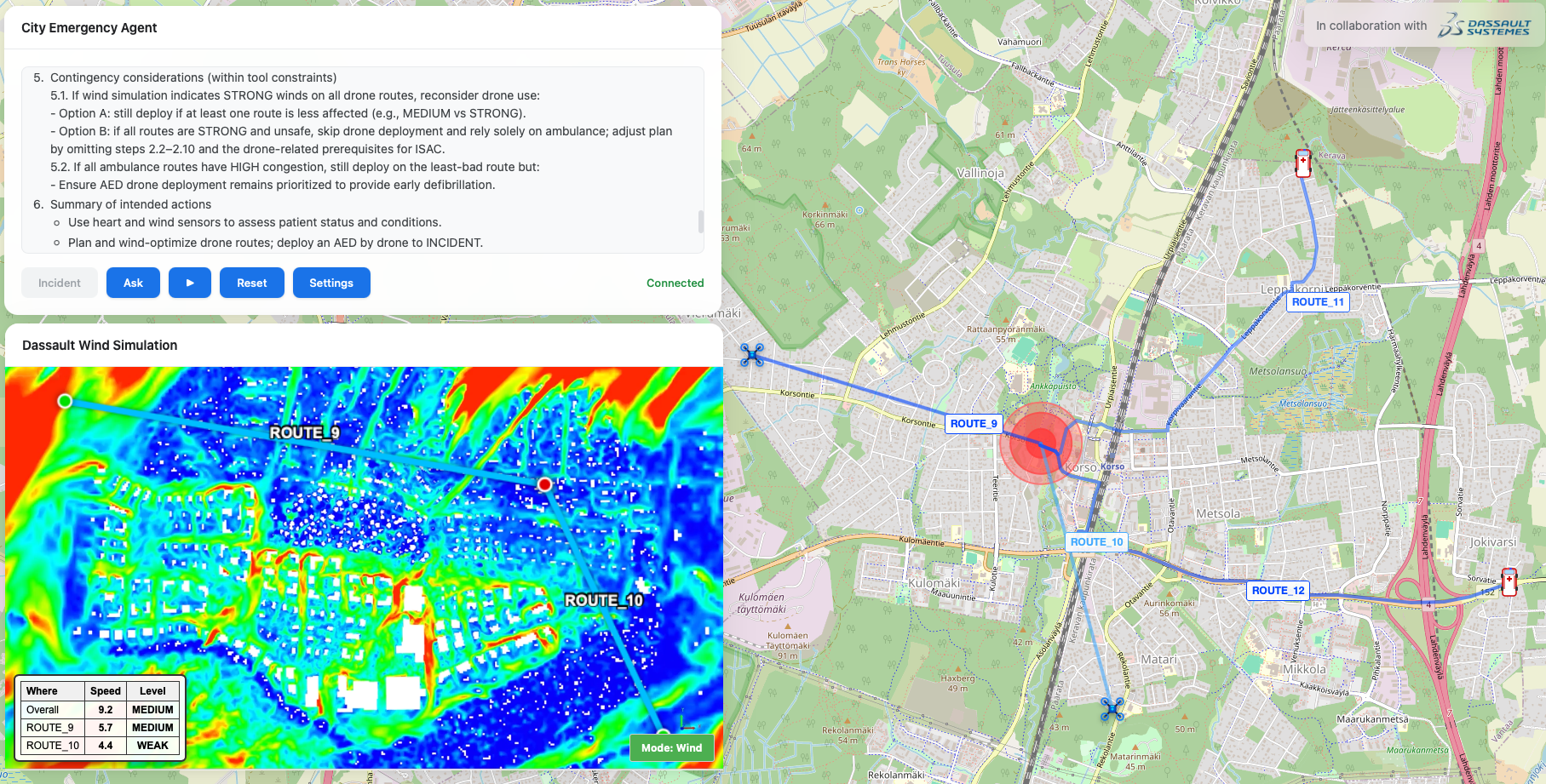
Figure 3: Our demonstrator, with Dassault Systèmes’ wind simulation for two possible drone routes and the routes on the city map
Finding the fastest route for the ambulance
Which route will get the ambulance there fastest? Traffic information can come from many sources. We chose network sensing to detect moving objects along possible routes through the road system. The number of moving objects per kilometer of road indicates traffic density, which lets the agent choose the least congested route.
Figure 4 shows the street congestion status along the routes that the two available ambulances would have to take to the incident site indicated by a circle. The red color along the routes indicates heavier traffic.
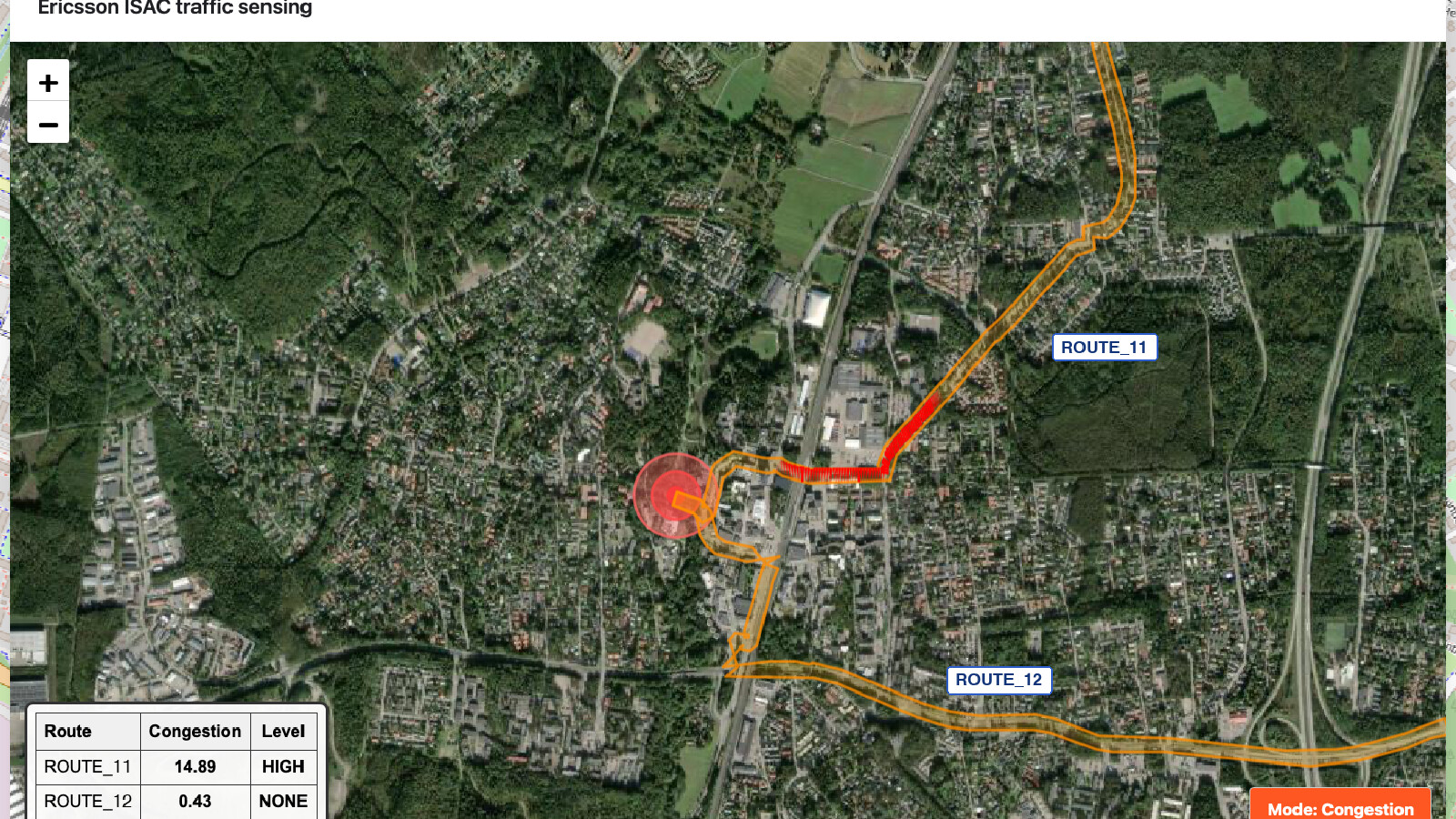
Figure 4: Network sensing of traffic congestion along two possible ambulance routes
Connecting AI agents with the real world
A key enabler for solving real-world problems is the agents’ ability to interact with physical reality. So, we asked our emergency AI agent, which runs on the GPT-5.1 large language model, how it does this. Here’s its answer (edited for brevity):
“AI agents interact with the outside world through clearly defined interfaces, most commonly APIs. In general, these interfaces expose specific functions, such as sending a message or retrieving a specific piece of information. Agents reason about what they want to achieve and then choose to call one or more APIs. Responses from the APIs guide the agents’ further steps. This turns the agent from a passive text generator into an active system that can read, write, and change external state.
More structured approaches push this further. For instance, the Model Context Protocol (MCP) framework used in this agent defines a catalogue of tools and resources the agent can use. The agent doesn’t “magically” access the world; it issues explicit tool calls that a host environment executes, and then it integrates those results into its reasoning.
In this particular experiment, I operate as an emergency‑response planning agent. I don’t directly “talk” to hardware; instead, I interact with a set of tools that abstract devices and services, such as sensor discovery and value retrieval mechanisms. I use this information with the smart watch to understand the patient’s vital signs and to prioritize urgency and decide what resources are needed.
Similarly, I can query live wind conditions near the incident and use a wind simulator tool to assess specific conditions on a route. This helps choose safe, feasible drone routes. There are route finding tools for both drones and cars. For ambulances, once I have car routes and (if required) have finished drone/wind analysis, I enable ISAC traffic sensing, wait for congestion analysis to complete, and then query congestion per route to pick the fastest path.
I can also command the actual deployment of resources. I get apprised of the real-time situation and for instance get notifications that ambulances or drones have actually arrived on scene.
Throughout, my “interaction with the world” is constrained, explicit, and ordered: planning, choosing tools, waiting for results or completion, interpreting results, and deciding next steps.”
Networks as a data layer for AI agents
Our use case is just one example, but it points to some bigger opportunities. First, AI agents can help deliver better services in many fields. Our example shows a particularly important kind of agent: one that assists a human operator, who reviews its proposals, instead of acting fully on its own. Agents like this are likely to be easier to deploy.
Second, networks aren’t just for connectivity. They can also be a valuable source of information in their own right. Our traffic example was simple, but in many other use cases, real-time observations – and the ability to detect objects whether they’re connected or not – will be also essential.
Networks are also becoming programmable: you can instruct them to provide a particular type of connectivity or to perform other tasks, and AI agents are important users of these programmable services. Seeing networks as information providers takes programmable networks and network APIs a step further. And for agents to use these capabilities, they need to be easy to access – through MCP and other frameworks.
The same idea extends naturally to the wider IoT ecosystem. 6G networks can connect massive numbers of devices with very different requirements, so they’re well placed to help applications find and access data from smart city infrastructure, environmental sensors and personal devices. This opens up opportunities for communications service providers (CSPs) to offer new data services, where device owners can share their data – with appropriate privacy controls and consent – with applications that need real-time situational awareness. Instead of each application building its own IoT integration stack, the network provides a common platform for data exchange.
We also want to highlight that we didn’t do this alone, we worked with others in the ecosystem. For example, Dassault Systèmes provided information that was vital for the agents to be able to do their job. That’s a good illustration of two things:
- Agents rely on information from multiple sources.
- Agents need an ecosystem where different players work together to help them understand the real world.
From connectivity to awareness
Our emergency example shows what 6G beyond connectivity can look like in practice. When networks sense the environment and give AI agents access to real-time data from across the city, the agents can understand what’s happening – and humans and AI agents together can make faster, better decisions when it matters most. For CSPs, this opens up a role beyond connectivity: providing sensing and data services that AI agents can use. Our experiments show that these building blocks already work together. As 6G takes shape, the next step is to make them easily available to the AI agents that will increasingly rely on them.