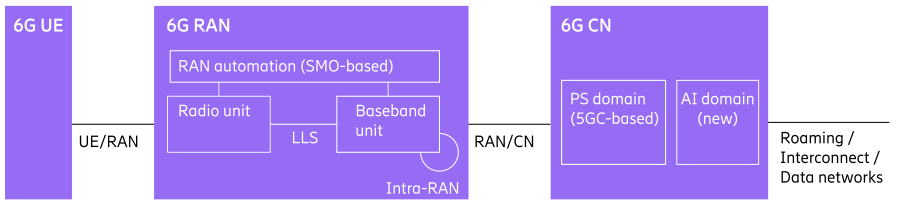
The main architecture principles of 6G, earlier presented in [ref], include: having a standalone 6G RAN architecture, connecting to the core network (CN) over a point-to-point interface, and minimizing the number of standardized internal interfaces. The most relevant RAN internal interfaces are the interface interconnecting different base stations, which in 6G will ensure that there is a single control point for the user equipment (UE), and the open fronthaul, also known as next-generation lower layer split (LLS), connecting baseband and radio. For the 6G CN, the Packet Switched (PS) domain will be based on the 5GC (5G Core) service-based architecture, to minimize re-standardization work of existing functionality and interfaces. A new AI Domain is added to the 6G CN to address new opportunities.
In line with earlier generations, most of these interfaces, as well as the air interface will be specified by 3GPP. The open-RAN alliance will specify the open fronthaul and the service management and orchestration (SMO)-based management architecture for RAN autonomous domains. Moving beyond the 5G AI-powered automation and realizing the full potential of 6G requires networks to be fully autonomous and AI-native [ref] by design. To enable this, ETSI’s industry specification group on Zero touch network and Service Management (IETSI ZSM) provides an end-to-end framework for zero-touch service management and orchestration across multi-domain networks and TMF advances operations support system/business support system (OSS/BSS) processes, framework, information models, and open APIs for end-to-end and dynamic intent management.
Multi-vendor interfaces are important for our industry and the operator services delivered. To target new revenue streams, it is crucial to focus on the business-relevant interfaces enabling that, such as exposure interfaces. In addition, some fundamental system interfaces require attention, such as the radio interface, roaming interfaces, the RAN-CN and management interfaces. While working on these interfaces, it is important to avoid specifying solutions that quickly become outdated, such as, in case of the rapidly evolving field of AI technologies. Here it is important to focus on AI enablers, for example data collection, rather than technology as such. In this way, 6G will build on a set of open interfaces of practical business relevance.
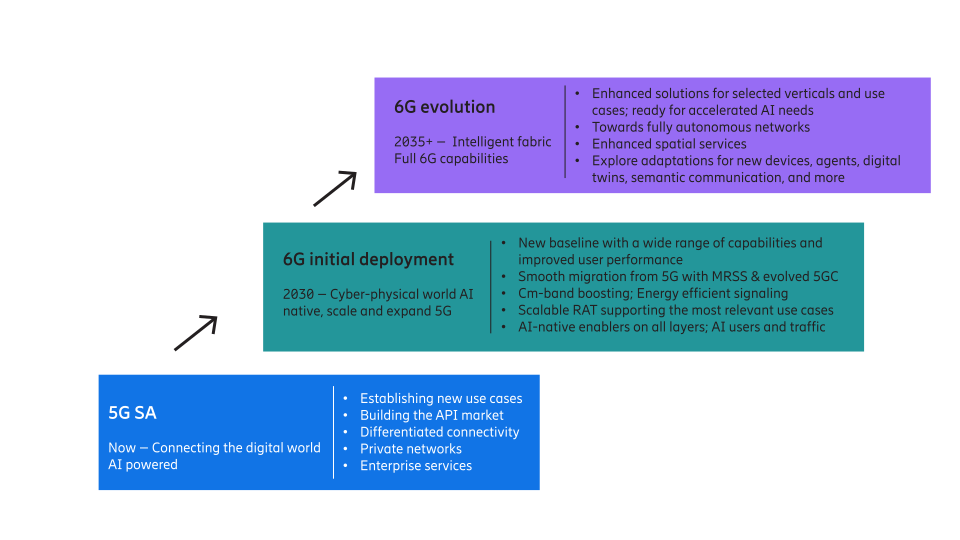
The following highlights key capabilities that the 6G standard will provide. To leverage the new cm-wave bands spectrum assets, 6G will support a larger number of antennas, up to 1024, ensuring 6G downlink coverage provided on par with existing midband deployments and allowing operators to reuse their midband sites for cm-wave deployments.
MRSS will be an integrated part of the 6G specifications, enabling in-band coexistence between 5G and 6G. Thanks to the lean design of 5G, the standardization impact for 6G will be quite small. The scheduler will be able to realize MRSS, scheduling 6G transmissions while avoiding impact to basic 5G signaling, at an overhead of at most a few percent.
6G will enhance the carrier aggregation framework to reduce the time to activate a carrier, improving the latency behavior and the user experience. A new scheduling framework in 6G, with reduced scheduling constraints compared to 5G, as well as improved control signaling, will also contribute to improving user experience. These enhancements have the potential of improving the end-user experience—beyond 50 percent increase in uplink data rates for small packets [ref]—and reduce the scheduling latency for a user.
The 6G specifications will support uplink-downlink decoupling as part of the enhanced carrier aggregation framework. This can significantly improve uplink coverage for devices with challenging propagation conditions—a tenfold increase in data rates in some cases [ref]—by taking advantage of better propagation conditions at lower frequencies in the uplink while using the very wide bandwidths available at higher frequency bands for the downlink, individually for each device. In addition, 6G will natively support NTN communications, thereby providing additional coverage possibilities.
The introduction of wake-up signals will allow the device to extend its sleep time thereby improving the device energy efficiency and the battery lifetime. On the network side, redesigning the initial access procedures to work with a much longer synchronization signals block (SSB) period of up to 160 ms will improve energy efficiency for the network operator. The longer periodicity will allow network nodes to sleep in between at low network loads, thereby reducing the energy consumption to almost 80 percent [ref].
A cornerstone for the scalability of the radio access will be the new design of the initial access and connection setup mechanisms, providing the possibility to serve a wide range of services and devices, ranging from low-end massive IoT to high-end XR glasses, with a common solution. Thus, it will not be necessary to deploy and maintain separate access technologies such as NB-IoT and LTE-M for IoT applications [ref], thereby reducing operational costs. In addition, the different features or technology components of 6G will not be tailored to a specific use case but widely applicable to any of them, improving the commercialization opportunities for all segments.
Sensing in the form of ISAC is one example of services beyond connectivity supported by 6G [ref], where the network infrastructure is used to detect and track different objects or obtain environmental information. For example, experiments in a live test communication network[ref] have shown that a drone can be tracked with a horizontal accuracy of 2 to 3 m [ref].
In 6G, the use cases will expand to detection and tracking of automated guided vehicles (AGVs), support for self-driving cars and sense-assisted communication. In addition, the supported sensing topologies will be widened from sensing using a single base station to sensing among multiple base stations or sensing between base stations and devices. Sensing requires processing of large amounts of data, often in ways that are specific for the use case. To maximize innovation, it is important to keep most of the sensing processing together within the RAN domain.
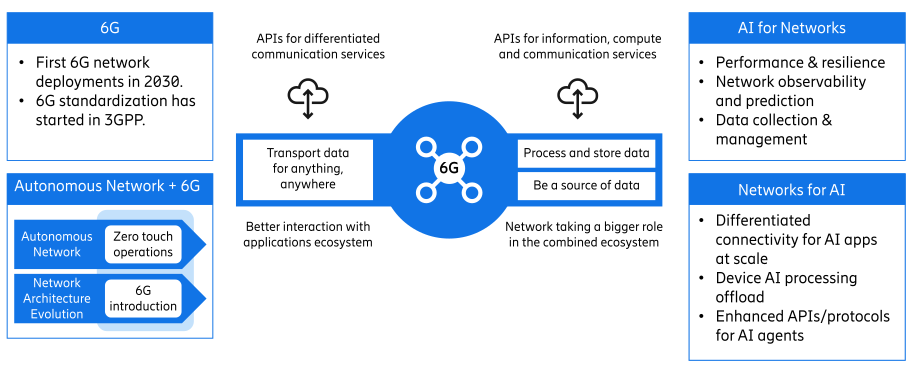
AI use cases in the network will be supported by a unified and coherent framework for observability, data collection, and management. AI solutions at different layers in the network will rely on this framework to realize the different use cases. An AI domain in the 6G CN can ensure support functions for use cases where UEs or application functions provide their intents to the network. Intents that could be provided by AI agents. To fully cater for AI agent-based use cases, the AI domain would also facilitate agent-to-agent
communication between devices. Thus, by providing a set of data-related and AI supporting capabilities in the standards, 6G will enable the introduction of value-add solutions using the latest AI technology addressing different use cases at fast pace, without needing to standardize them.
Resiliency of the network and the connectivity against failures and intentional disturbances is highly relevant for 6G. Tools such as enhanced carrier aggregation and other improvements of the basic 6G procedures will provide means to minimize the impact of and recover from failures and incidences. Finally, resilience will also be improved for 6G NTN connectivity, ensuring that it can operate without relying on Global Navigation Satellite System (GNSS) signals.