








- We walked into an operator-run benchmark on a competitor-controlled RAN as the clear underdog: our compact stacked antenna vs. their flagship side-by-side “should-win” setup—on their home turf.
- What happened next challenged the datasheet mindset: real network results showed +23.23% uplink traffic, +12.32% downlink traffic, and +41.91% uplink user throughput, with lower energy per bit—proof that beam efficiency and stability can beat headline gain.

Account Manager, Americas LATAM region

Account Manager, Americas Hispam

Customer Solution Director, Americas LATAM South

Antenna System Solution Manager for Europe and Latin America

Account Manager, Americas LATAM region
Account Manager, Americas Hispam
Customer Solution Director, Americas LATAM South
Antenna System Solution Manager for Europe and Latin America
Account Manager, Americas LATAM region
Account Manager, Americas Hispam
Customer Solution Director, Americas LATAM South
Antenna System Solution Manager for Europe and Latin America
Some matches look decided before they even begin. The lineup, the conditions, the odds – everything points one way. But when the whistle blows, anything can happen. Often those games are the most interesting ones, and that is exactly why this benchmark became one of the most telling antenna trials Ericsson Antenna System has ever been part of.
A football match nobody would schedule
If you work with antennas, you know the trade-offs. A compact stacked antenna is space-efficient, lighter, and easier to deploy. But no one expects it to outperform a full-sized, flagship antenna-built side-by-side for maximum gain and performance.
It’s like football. Different leagues have different characteristics. One league may have technically brilliant, disciplined, and tactically sharp players. But physically, they may still be at a disadvantage against strongly built teams in a more athletic league.
That’s the match we entered. A typical challenger game, a true underdog story.
We sent our best-performing compact stacked antenna, confident in its engineering and its ability to challenge the existing stacked set-up in the operator network. However, our competitor sent the strongest antenna in their entire portfolio with a side-by-side set-up. We entered the game knowing that typically in these types of matchups, a side-by-side antenna should win 9 out of 10 times.
On top of that, the game was to be played on their home turf: their own RAN network.
We quickly realized we were not the favorites to win this game. But the match was just about to start.
The operator challenge: congestion, capacity, and a growing uplink problem
A Tier-1 operator in South America operated a highly congested network. Like many operators in the region, they faced:
- Sustained cell utilization above 85%, indicating structural congestion rather than occasional peak load
- Coverage and capacity challenges in both urban and dense-urban areas
- Heavy traffic growth, with limited short-term options to add spectrum or densify sites
- Increasing pressure on uplink performance, driven by video, gaming, social uploads, and emerging AI-based applications
- An upcoming 5G rollout, where capacity, uplink efficiency, and overall spectral efficiency will become even more critical
In a technical workshop, Ericsson Antenna System had the opportunity to introduce a different way of looking at antenna performance: through beam efficiency – showing how much of the radiated signal actually contributes to useful coverage and traffic.
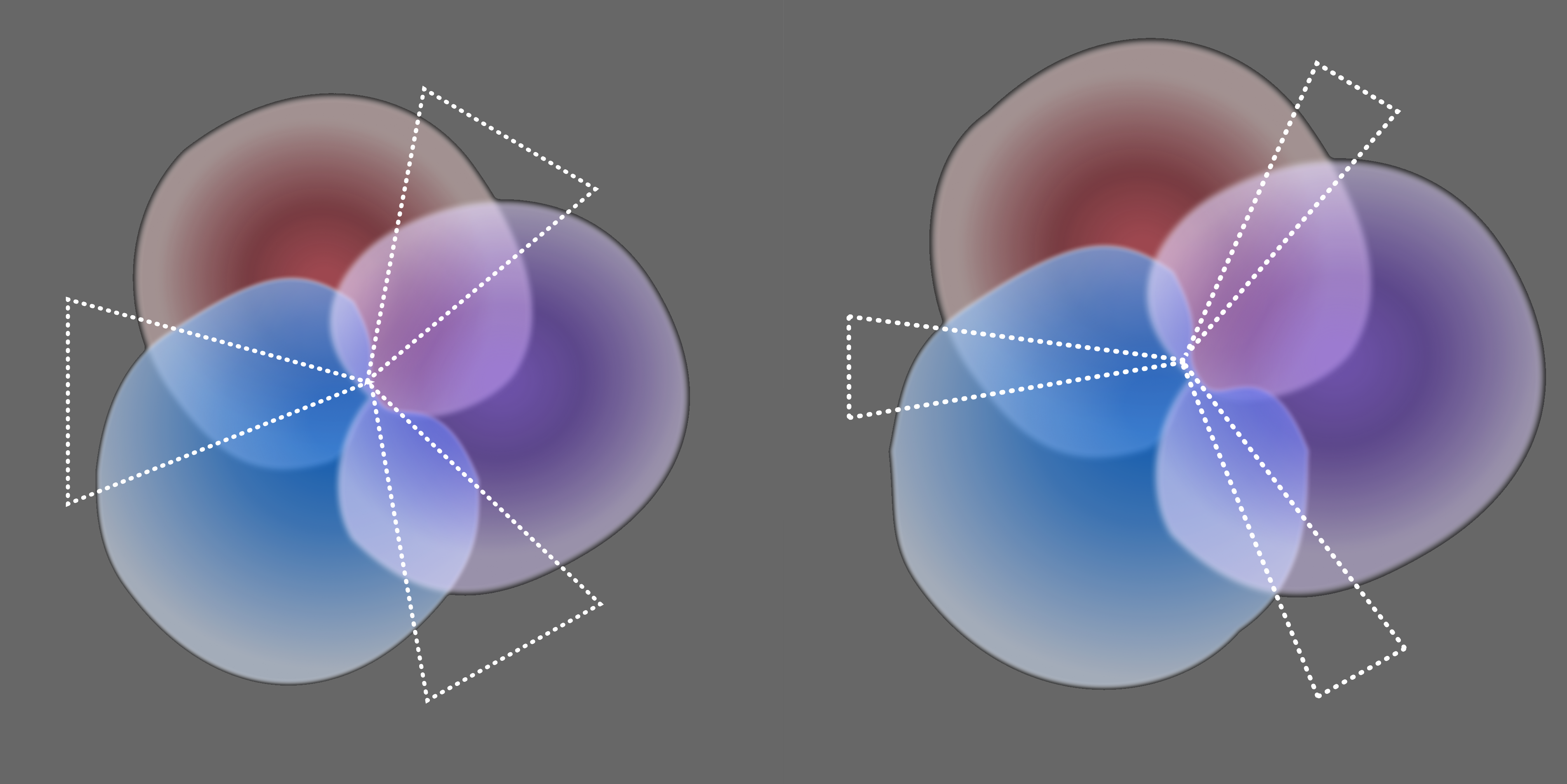
Left: Industry standard beam efficiency with 70% | Right: Higher beam efficiency by compact trio net solutions with up to 85%
The idea caught the operator’s interest, and their response was simple: “If beam efficiency makes that big of a difference, we want to test it in our network.”
The context: a benchmark controlled by the operator
This case is fundamentally different from most antenna cases:
- The network in which the trial was done was 100% non-Ericsson RAN, operated by our main competitor, based on live network statistics from that network
- The entire trial was designed, executed, and evaluated by the operator
The operator ensured equal conditions and maintained continuous communication throughout the trial. To carry out the benchmark, they selected one urban site and one dense-urban site with heavy traffic. The goal was to measure these key KPIs against their incumbent stacked antennas:
- Real network performance
- Downlink and uplink efficiency
- Potential impact on energy consumption
Ericsson delivered a 2.1-meter Honeycomb-based compact stacked antenna: our Antenna 4206. The competitor delivered their strongest antenna, which on paper had higher gain in both low-band (+1dB in average) and mid-band (+1.5dB in average). In theory, a big datasheet advantage for the competitor.
We faced an antenna from an entirely different league. But we were already on the pitch and had agreed to play – against the odds.
The results: real network performance that beats the datasheet
When the report arrived, it surprised everyone. Despite competing against an antenna that should beat us according to the competitor’s datasheet, in their own RAN network, the Ericsson antenna had delivered:
- Increased uplink traffic by +23.23%, with the strongest gains observed in the urban site
- Increased downlink traffic by +12.32%, confirming improved overall efficiency
- Coverage improved across all frequency bands, with gains of up to +10 percentage points in downlink and up to +7 percentage points in uplink
- +41.91% improvement in uplink user throughput, significantly elevating user experience under high load
- Energy consumption per bit was reduced by –1.88%, demonstrating that higher performance was achieved without increasing power usage.
- –28.03% reduction in wind load versus the incumbent antenna, lowering site stress, accelerating deployments, and reducing long-term TCO
In both urban and dense-urban scenarios, the Ericsson antenna delivered outstanding results. Network efficiency was consistently much higher with EAS, particularly in uplink and downlink efficiency. With the network operating so close to its capacity limits, the operator had identified uplink and downlink efficiency as the most critical KPIs, as higher efficiency directly translates into more usable capacity, without adding spectrum or new sites.
Beyond the datasheet. Towards real performance
This benchmark did more than validate one antenna. It challenged a long-standing industry assumption that datasheets accurately predict real-world performance.
Here, the antenna that appeared weaker on paper:
- Delivered stronger uplink
- Used energy more efficiently
- Proved resilient coverage under heavy congestion
And it did so in a competitor-controlled RAN network, showing that Ericsson antennas are network-agnostic by design. They deliver value right where they are deployed, helping the operators get more out of what they already have, whether that’s our own networks or a competitor’s.
As the customer summarized the experience:
“This was like a football game. The favorite entered the field confident they would win, but they were shocked and never recovered.”
Instead of staring blindly at the datasheet, we confirmed a critical insight we have been championing for some time now: datasheets may describe individual parameters, but networks reward how those parameters work together. Once again, precisely engineered antennas for beam efficiency and PIM stability, proved more decisive for real network performance than headline gain figures.
The takeaway: get more with less
This trial proved that:
- Smart antenna engineering beats datasheet specs
- Beam efficiency and PIM stability translate into real network impact
- Conservative datasheets can outperform optimistic ones in real network conditions
- Antenna performance matters — regardless of RAN vendor
Sometimes the benchmark you didn’t expect to win is the one that tells you the most. And sometimes, against all odds, the underdog will win.
Read more
- Latest portfolio release during Mobile World Congress 2026
- Blog "AI is raising the stakes on antenna performance – here’s how to get ready"
- Latest technology paper about "The power of antenna systems in the 5G Standalone evolution"
- Blog "Why the antenna has become 5G Standalone’s real control plane"