










Enabling AI agents: Why unified, real-time inventory is a critical data foundation for autonomous networks
- Closed-loop automation AI agents promise to accelerate service delivery, automate troubleshooting, optimize network performance, and continuously improve customer experience.
- The success of these agents depends on a critical factor that is often overlooked: the quality of the service and resource inventory information they consume.

Technical and Solution Sales Support

Strategic Product Manager, Data and AI, Business Area Cloud Software and Services, Ericsson
Technical and Solution Sales Support
Strategic Product Manager, Data and AI, Business Area Cloud Software and Services, Ericsson
Technical and Solution Sales Support
Strategic Product Manager, Data and AI, Business Area Cloud Software and Services, Ericsson
An AI agent can only make decisions based on the information it understands. If service and resource inventory is inaccurate, stale or fragmented across silos, “autonomous” decisions are limited because issues can arise:
- Provisioning services on resources that do not exist or are already allocated.
- Closed loops healing the wrong root cause and creating new faults.
- Digital twins simulating a network that no longer matches reality.
- Incorrect capacity planning and expansion based on obsolete utilization data.
- SLA breaches because topology is computed on outdated views.
- Reduced trust in AI-driven operations, slowing enterprise adoption.
To enable AI agents to deliver safe, repeatable business outcomes, three prerequisites must be in place in the service and resource inventory domain: accuracy of the data, real time updates and vendor agnostic, normalized models.
Unified, real-time inventory as a data foundation for AI agents
Autonomous networks are data driven systems. Their ability to perceive, analyze, decide and act depends entirely on the quality of the data and knowledge available to them. The inventory management system is not a peripheral database—it is the source of service and resource inventory information that tells AI agents what exists, how it connects and how services and resources are structurally connected.
A unified, real time inventory holds:
- A normalized record of services and resources including sites, nodes, links, spectrum, network functions, slices and services, configurations, state and relationships.
- A vendor agnostic, cross domain model maintained through continuous, real-time discovery and reconciliation, so designed and deployed states stay aligned by the minute.
Open APIs expose this unified, real-time inventory to orchestrators, assurance, analytics and AI agents.
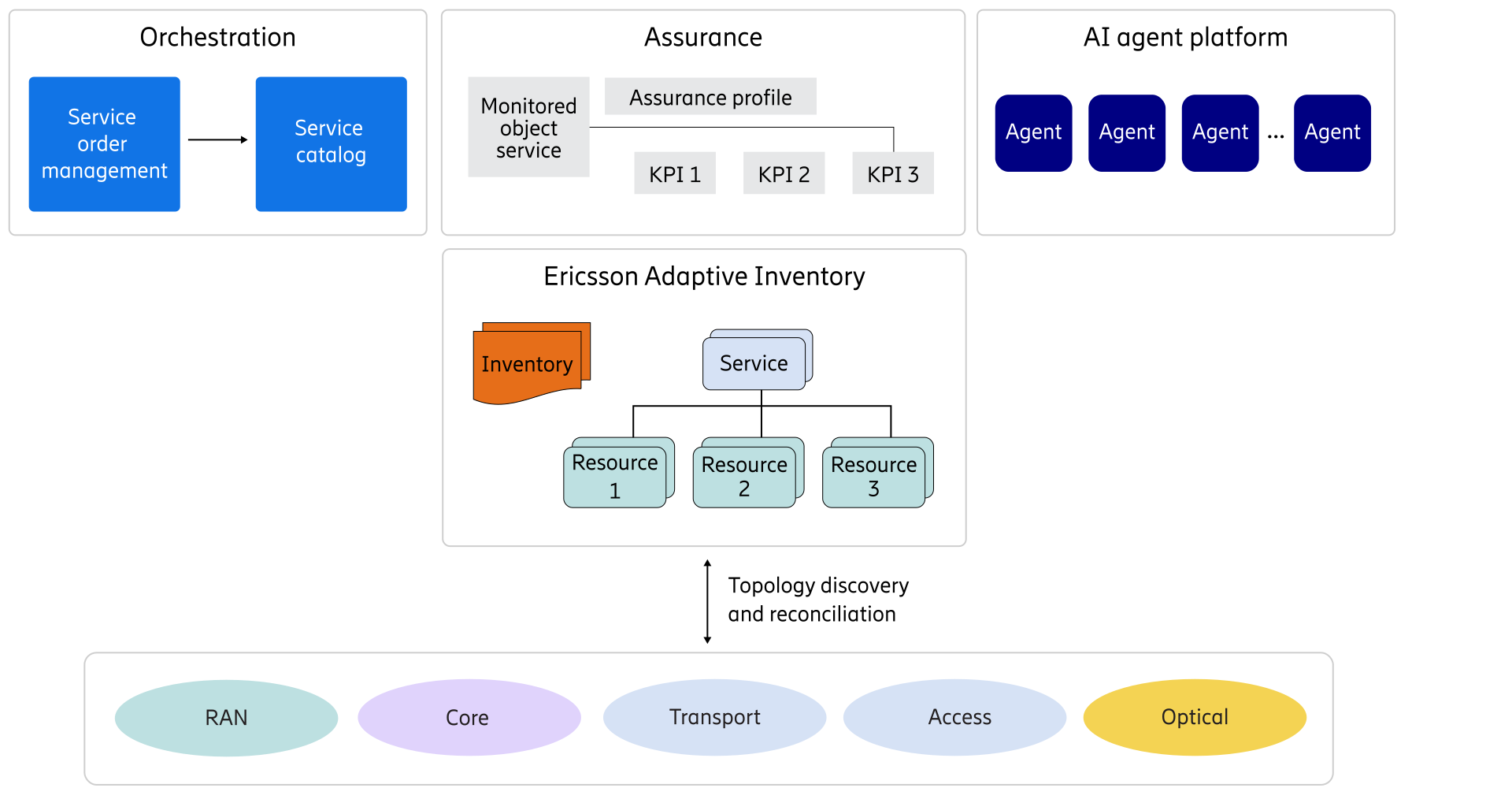
This makes inventory a trusted operational map for service and resource information, to drive closed loop automation and to provide digital twin and advanced planning capabilities.
Success factor #1: Accurate service and resource information
Accuracy is the cornerstone of every successful AI deployment. Every operational decision—from provisioning a service to rerouting traffic during an outage—depends on understanding what resources exist, how they are configured, and how services depend upon them. This is particularly important for network topology.
Network topology describes how physical, logical, and virtual resources connect and interact. It provides the context AI agents need to understand dependencies, resilience, and service impact. Without accurate topology, AI cannot reliably answer questions such as:
- Which customers are affected by a failed transport link?
- Which services depend on this network function?
- Where does redundant capacity exist?
- What is the downstream impact of this maintenance activity?
Incorrect topology creates a distorted view of the network, causing AI agents to optimize toward the wrong objectives and potentially introduce instability instead of resilience.
Unified service and resource inventory maintain this topology as a continuously governed, normalized model that accurately represents the operational network, enabling AI to reason with confidence.
Success factor #2: Real-time, continuously updated inventory
As CSPs move toward higher levels of autonomy, the cadence of change in the network accelerates. Closed loop assurance, intent management and agentic AI all rely on a continuously updated view of service and resource state, including topology, performance KPIs and configuration. If inventory is updated in batch or fragmented across silos, AI agents operate on yesterday’s network
Continuous discovery and reconciliation ensure that service and resource inventory always reflects the live operational state of the network. Information is continuously collected from network management systems, controllers, orchestration systems, and assurance platforms before being reconciled into a single, trusted operational model.
This provides AI agents with an always-current understanding of:
- Resource availability
- Service state
- Network topology
- Configuration changes
- Capacity utilization
- Operational relationships
Without continuous synchronization, topology gradually drifts away from reality. Even small inconsistencies accumulate over time, causing automation failures, incorrect recommendations, and a degraded customer experience.
Real-time inventory ensures AI always operates using the same operational truth as the network itself.
Success factor #3: Normalized, vendor-agnostic information models
Modern CSP networks are inherently multi-vendor and multi-domain. Radio access networks, transport, IP, optical, wave-division multiplexing, cloud infrastructure, core networks, and IT platforms each expose information differently. If each domain or vendor uses its own proprietary model, AI agents must learn a variety of schemas and semantics, and cross domain intents require fragile, complex translations. Without normalization, AI must learn dozens of different representations for what is fundamentally the same operational concept.
Unified service and resource inventory eliminates this complexity through normalized information models that abstract vendor implementations into a consistent representation. This provides several advantages:
- Consistent topology across all network domains
- Standardized service and resource relationships
- Cross-domain visibility
- Simplified AI reasoning
- Reduced integration complexity
- Greater interoperability with orchestration, assurance, and analytics platforms
Normalized inventory models give AI agents a consistent representation of service and resource information, significantly reducing vendor-specific translation. When connected through a shared ontology, this operational model can participate in a broader semantic understanding across domains. This dramatically improves reasoning quality while reducing implementation effort.
From prerequisites to a trusted operational foundation for AI agents
Unified inventory establishes trusted operational truth: what services and resources exist, their configuration, and current state. Inventory becomes an enabling platform for AI agents rather than a constraint. Inventory should embody this role as a cloud native transformation product central to CSPs’ autonomous networks proposition and provide:
- A unified, real time view of the network as a trusted operational foundation for automation and AI.
- Strict data governance and discovery/reconciliation to enforce accuracy over time.
- Vendor neutral, multi domain coverage spanning physical, logical and virtual resources.
- Digital twin capabilities layered above unified inventory, enabling AI powered planning and simulation grounded in operational reality.
- Integration with AI enabled service orchestration, assurance and OSS/BSS solutions to support intent driven, closed loop operations.
For autonomous decision-making, however, this operational truth must be combined with other knowledge—intent, policies, constraints, service and customer context, historical evidence and domain rules. This is where the Knowledge Plane complements inventory. Using shared semantics and ontologies, it connects inventory information with knowledge from other domains and makes it available for consistent reasoning. AI agents can then operate over this governed knowledge rather than rebuilding topology, policies, and domain logic individually. Inventory keeps the operational map accurate; the Knowledge Plane makes that map part of a broader, machine-understandable context for autonomous decisions.
Conclusion: Unified, real-time inventory as a critical data foundation for AI agent deployment
As CSPs transition from automation to autonomy, AI agents will become central to service planning, orchestration, assurance, customer operations, and network optimization. But AI agents must have access to trusted, operational inventory information. Unified, real-time service and resource inventory provides accurate topology, continuously synchronized network state, normalized multi-vendor information models, and an authoritative source of service and resource inventory information across network domains.
With accurate inventory providing trusted operational truth, and semantic knowledge, analytics and governance providing the context for reasoning, AI agents can make better-grounded decisions and participate in safe, intent-driven closed loops.
Appledore Research’s solution profile notes, “AI not only increases the value of good inventory; it makes the cost of poor inventory harder to hide”, and that “Ericsson Adaptive Inventory is central to Ericsson's autonomous networks proposition”.
Read more
- Download: Ericsson Adaptive Inventory - Appledore Research Profile
- Blog post: Autonomous networks use real-time inventory to unravel the challenge
- Blog post: How passive infrastructure will be managed in the era of autonomous networks
- OSS/BSS solutions - Continuous evolution for continuous innovation
- Ericsson Adaptive Inventory
- AI-enabled service orchestration solutions
- Download: “From automation to autonomy” - Industry perspective: From automation to autonomy
- Make agentic-AI driven telco operations a reality