











5G and private networks transforming enterprises
- English
- 繁體中文
5G connectivity and edge compute are fundamental to enterprise transformation programs already underway, and to the related use cases for digitalization, automation and worker augmentation.
- Allocation of industry spectrum for enterprise use has increased demand for private networks. Industry spectrum also brings new opportunities for resellers, yet service providers remain relevant and deploy many private networks.
- For a service provider or reseller, monetizing private networks starts with establishing credibility in new industries. This can be fast-tracked by building ecosystem partnerships in target segments, adapting sales models for resell of connectivity networks, and offering more than connectivity.
- As enterprise transformation programs get underway, the resulting use cases demand the performance of 5G and private networks.
Drivers of transformation vary. They include macroeconomic outlook; new technology capabilities; remote working in COVID-19 times; supply chain volatility; or simply to scale up.
While motivations may differ, many enterprises are implementing high-value digitalization and transformation programs. These tap into the vast data their business generates to gain new insights and capabilities, and enable automation or remote operations, empower workers and promote their safety.
Industry spectrum drives momentum for 5G and private networks
Where industry spectrum has been allocated for enterprise use,1 demand for private networks has gained momentum – over 60 percent of the enterprises deploying private networks by Q3 2022 were located in the US, Germany, France, the UK and Japan, according to the latest GSA report on private networks.2 It is no coincidence that these are leading manufacturing markets. Governments and regulators keen to promote national manufacturing competitiveness have taken allocated spectrum for industry and funded 5G projects. While this brings new opportunities for distributors, resellers and system integrators, service providers remain relevant and provide many of the networks deployed in these markets. Service providers’ licensed spectrum is a valuable asset for 5G use cases. Spectrum is the primary parameter of network capability, so service providers can support the advanced 5G use cases by dedicating spectrum capacity for enterprise use. As most industrial sites are located outside densely populated areas there will be sufficient spectrum capacity.
How service providers add value to enterprises with private networks
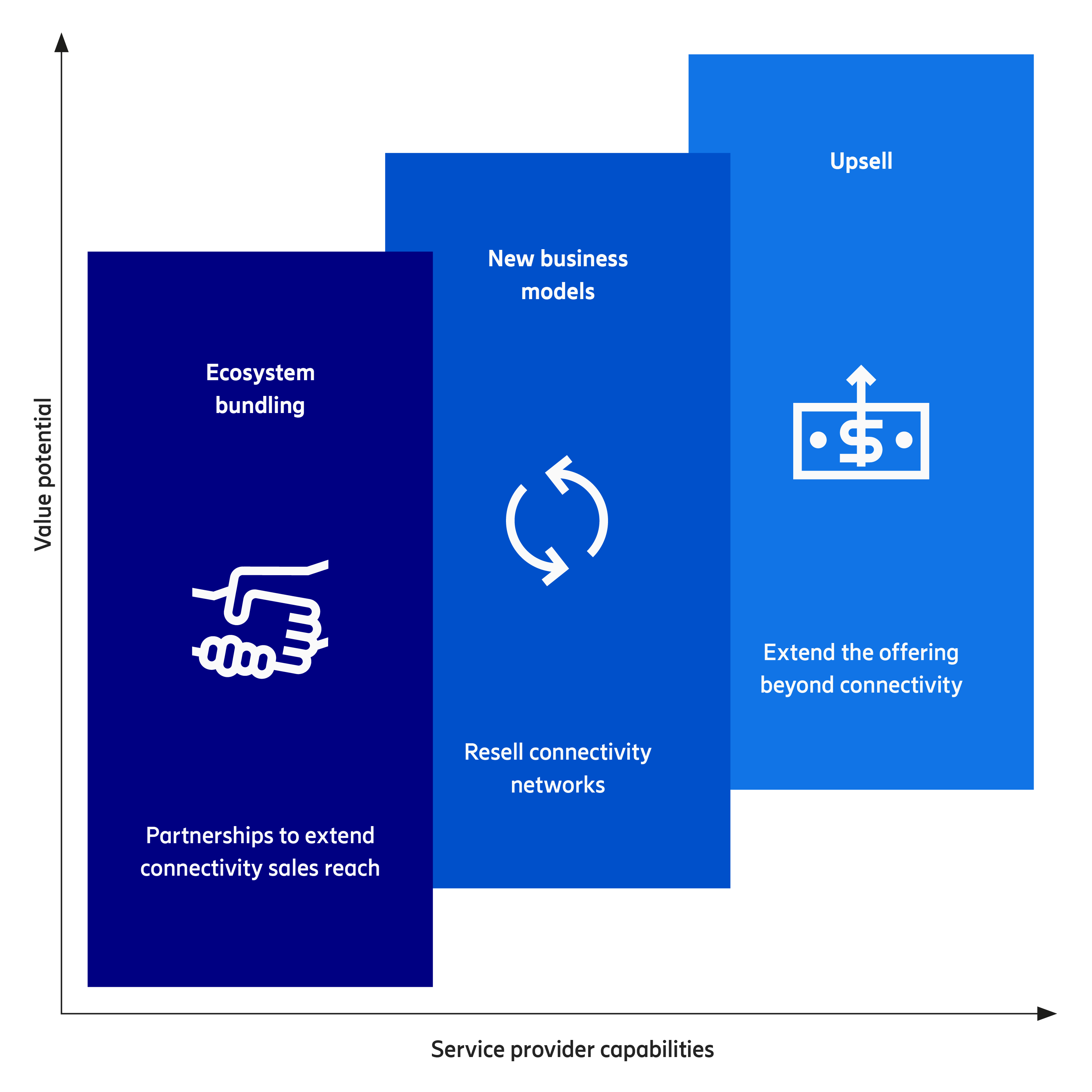
For service providers introducing 5G private networks, monetization paths are depicted in Figure 17. Value potential grows as the offering expands in content and commitment, requiring more capabilities. Monetizing private networks effectively will mean:
- building partnerships and ecosystems in target segments
- adapting the sales, delivery and support models for resell, for example of private networks
- extending the offering beyond connectivity for upsell, and developing credible expertise
- engaging a wider set of enterprise customer stakeholders, beyond IT
- applying a consultative sales approach, with value calculators
Figure 17: Monetization paths
The stakes are high for enterprises and so is the value
This is a compelling, and demanding, sales engagement for service providers, resellers and system integrators. It reaches new enterprise stakeholders and covers strategy, technology and business case, touching ecosystems outside of ICT.
Some enterprises are building the foundations by putting in place 5G connectivity platforms and edge compute capability that will support their ambitions. Others may be experimenting with pilot use cases, many of which require the capabilities of 5G.
Ecosystem bundling: Partnerships to extend connectivity sales reach
Partnering and ecosystem engagement can improve brand recognition in new industries or new areas of expertise. It can bring exposure to new customer stakeholders and decision makers, for example within the Operational Technology (OT) field where service providers are less familiar. Advantages include:
- Becoming intrinsic to ecosystems: Engaging with key industry ecosystems builds relevance and leverages the credibility and sales reach of others. This may be co-selling, in which partners sell alongside one another.
- Strengthening commercial relationships: Leveraging partners who may embed or reference service provider offerings in their solutions, monetized by, for example, reselling the service or generating sales fees.
New business models: Resell connectivity networks
Telecom services are often provided as a shared network where the service provider retains asset ownership. With private networks, the asset ownership is often transferred to the enterprise as a resell, with purchases made through distributors and resellers. Those who resell will expect networks to be pre-integrated as a complete end-to-end offering, for an efficient sales process.
An alternative monetization approach is to offer nomadic private networks as-a-service, for broadcasters‘ use with 5G cameras at sports or entertainment events on-demand, utilizing spectrum which does not conflict with the visitor smartphone traffic. For the service provider, this new offering generates recurrent revenue.
Upsell: Extend the offering beyond connectivity
As an enterprise expands, a customer request for more coverage can evolve to a review of future traffic profiles and use cases, a dialogue with a wider set of stakeholders, and a potential upsell of private networks, devices, system integration services and more.
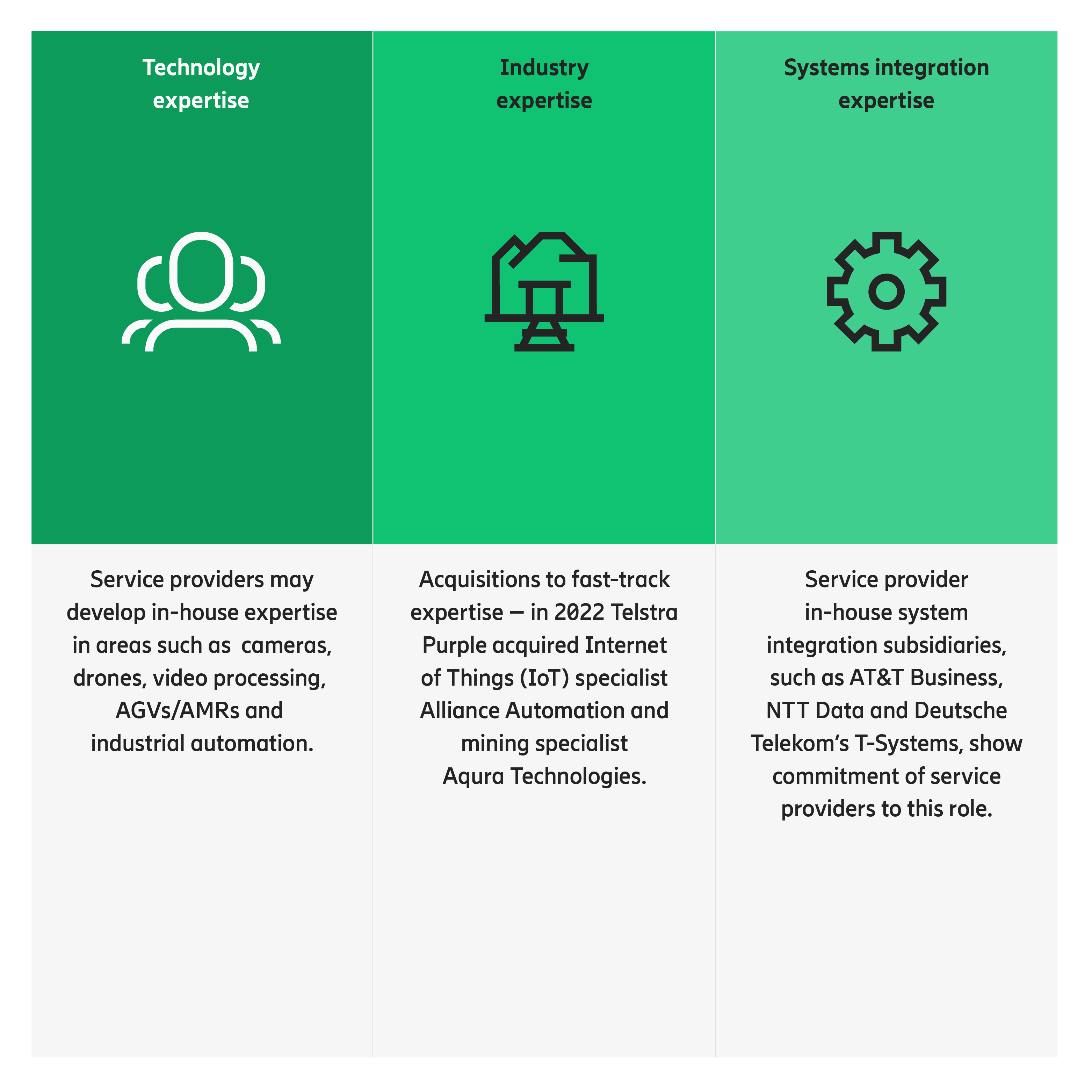
Taking on new roles can extend the offering beyond connectivity; the target value chain position depends on the service provider strategy and existing capabilities. For the service provider upselling beyond connectivity, gaining early credibility is key – in technology, in industry verticals or in systems integration. Examples are provided in Figure 18.
Figure 18: Three areas in which to gain credibility when upselling beyond connectivity
Manufacturers already deploy sensors across the factory site, so when it comes to 5G the focus is often on automation use cases. These enable, for example, AGVs/AMRs to function as mobile transporters within the factory, fork-lift trucks to be remotely controlled and torque tools to become wireless for the safety and agility of workers.
For critical infrastructure industries (such as power plants, mines, steel mills, recycling plants and wind farms) good reliable coverage, often in remote locations, is essential. Predictive maintenance is a leading use case, with sensors introduced to detect equipment problems early and rectify proactively, pre-empting expensive outages. This use case alone may be sufficient motivation for introducing 5G and private networks. Another use case augments field workers with new tablets or AR-based applications, to enable real-time access to specialists in shared centers of excellence. This can greatly empower workers in remote and isolated locations.
For these use cases and more, 5G brings essential new capabilities to the enterprise communications landscape:
- Coverage and economics: While enterprises may have Wi-Fi, cables and land mobile radio, they turn to cellular first for “must-have“ reliable coverage and capacity throughout the site. Furthermore, Wi-Fi hotspots may not scale economically compared with the power output and wider coverage of cellular radio base stations, especially for outdoors.
- Mobility and security: 5G will naturally support the need for high speed and cell handovers which come with AGVs/AMRs, drones and unmanned haulage vehicles. For some, security is the prime need when going wireless.
- Consistent latency: For equipment running industrial automation protocols (for example a port crane using the Profinet protocol) which now adds wireless mobility, it is essential the network provides consistent low latency, without the spikes that Wi-Fi may bring. A remote-control operator requires the controls to respond in less than 75 ms (round-trip) for a credible user experience. Longer than this can cause frustration, operator nausea and service disruption.

“No Ordinary Port”: Port of Tyne and BT’s surveillance and smart solutions
BT has developed expertise and offerings for surveillance and smart solutions, leveraging its 30-year track record supporting UK national security and critical infrastructure.
The offerings leverage smart camera technologies, IoT sensors and video analytics, for situation awareness in tracking and management of things. This covers physical security, identification, inspection and integrity checking, safety zones and rapid and redeployable response capability, for example drones and vehicles.
BT sources best-of-breed technology with open standards, with the right network, and develops additional functionality with in-house BT Research teams and ecosystem partners such as Cradlepoint. BT delivers business outcomes to customers, with a collaborative partnership engagement, such as Port of Tyne.
Port of Tyne is one of the most innovative, progressive and efficient deep-sea ports in the UK, linking the north of the country to the rest of the world. The vibrant and sustainable Port of Tyne contributes to the growth of the economy, with a focus on renewables including the Tyne Clean Energy Park.
To evolve its port capabilities Port of Tyne engaged BT, which introduced its smart surveillance offerings and private networks.
5G works begin at the Port of Tyne3
The Port deploys cameras across the site for various use cases, such as:
- container inspection from ship-to-shore cranes, recording the condition of cargo containers as unloaded from inbound ships, for example to retain a record for any damage/insurance claims
- ship turnaround is a key performance parameter, and cameras together with analytics insights identify improvement areas, as well as track and optimize operations across the site
- development of command and control for remote operations of vehicles, such as drones
Throughout the engagement a joint partnership approach has been taken to ensure that innovation, collaboration and digitalization comes to life for the Port of Tyne: ”No Ordinary Port”.
An agreement was announced between BT and Port of Tyne in June 2022, for a 5G private network.

A 5G private network agreement between Port of Tyne and BT is evolving port capabilities. Photo: Image courtesy of BT
1 Ericsson, 5G spectrum for local industrial networks (April 2022).
2 GSA, Private Mobile Networks Summary Report (December 2022).
3 Port of Tyne blog, "5G works begin at the Port of Tyne" (July 18 2022).