











5G opportunities in the cloud gaming market
- English
- 繁體中文
Cloud gaming has been around for a number of years but only started to gain popularity among consumers in 2019–2020.
- Meeting latency requirements in a loaded network is only possible with 5G.
- Advanced 5G features will be key to unlocking cloud gaming on-the-go.
- Targeted gaming packs will tie together connectivity usage and revenue.
- Market adoption is the most important challenge and becoming associated with gaming is one of the ways service providers can drive growth.
The growth rate of the cloud gaming market is now very high. According to Newzoo, it was estimated to be worth around USD 2.4 billion at the end of 2022. This number is expected to reach in excess of USD 8.2 billion by 2025. There are currently an estimated 32 million users, which is expected to grow to 87 million in 2 years’ time.1 Cloud gaming is one of the more obvious consumer cases for 5G, as it takes advantage of key characteristics like throughput and latency.
The customer group is expected to respond positively to messages around gaming experiences free from “lag” (the gaming equivalent to high latency). Research conducted by Ericsson during the first half of 2022 showed that 35 service providers had launched cloud gaming together with a platform partner. As part of the research, interviews were conducted with 10 of these service providers to understand the challenges and opportunities of introducing cloud gaming to the market.2
Figure 8: Launches of cloud gaming by service providers with platform partners

Source: Summarized from public information.
Insights into the cloud gaming market from service providers
Interviews with service providers have given some interesting insights into the challenges and opportunities that they see in this space. Their comments were grouped into five different categories, and each scored according to weight, or number of mentions. Of the five areas, two are related to the platform or network. These two seem to be of least concern for service providers, which is likely due to the fact that the network is the one area they have most control over. Furthermore, the cloud gaming platform and its ecosystem are also largely under the control of service providers via their selected partners.
The platforms available for cloud gaming have been maturing in terms of both devices they work on and the number of games available in gaming libraries. Unless it is an original equipment manufacturer (OEM) type of setup, there is not much that service providers can do with regards to features and functionality. For the most part, this is a strategic concern when selecting a platform partner.
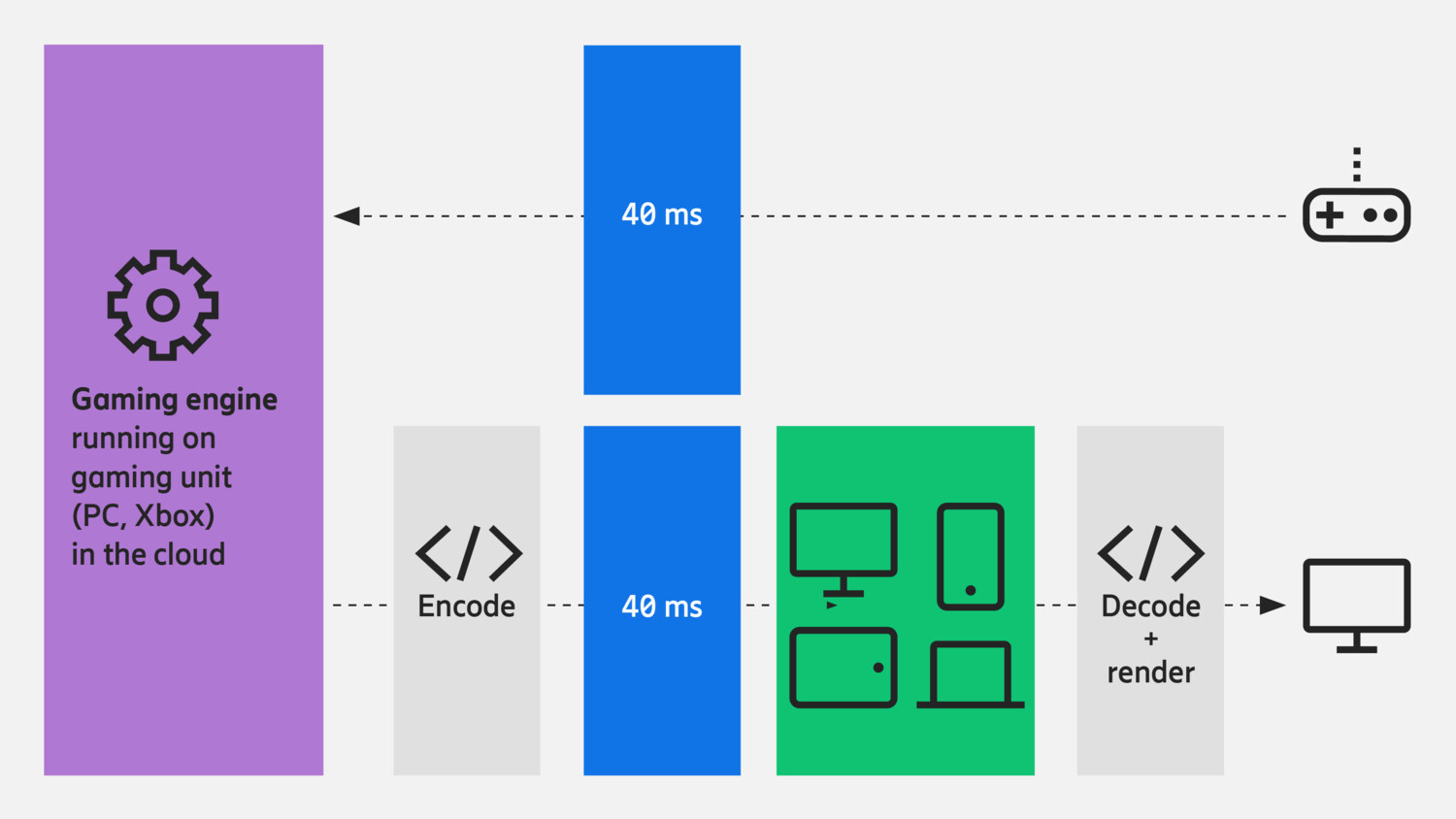
When playing a game locally on a PC, there is some latency between moving the mouse and seeing the resulting movement on screen. This relates to the types of mouse, game engine and screen being used, and is called “system latency”. Generally it is considered to be low enough to give an experience without any perceptible lag. Cloud gaming, however, replaces the mouse connection and the HDMI cable with an internet connection and cloud platform software, each of which increases latency. Network latency is the component which will make the greatest impact on the mobile cloud gaming experience. According to the platform providers, requirements on the network range from 40 to 80 ms or better. Although the lowest possible latency is desirable, stable latency with as little variation as possible can sometimes be even more important. Sudden motion freeze, or jumpy and jerky motion, is nearly impossible to manage as a player and will be very frustrating. Besides latency, there is also a significant requirement regarding throughput, where cloud gaming on a smartphone may start out requiring 15 Mbps (for 720 p and 60 fps).
As pointed out by several service providers, 15 Mbps is often achieved in a mature 4G network, serving at least one or a few concurrent users. Capacity to serve multiple players may not be there, however, and meeting latency requirements in a loaded network is only possible with 5G.
In the end, all these challenges can be addressed in various ways. Network latency is affected by the distance between the end user and the server location and can be resolved by siting distributed servers closer to the users. Moving servers inside a service provider’s network provides as much control over traffic as possible. Upgrading the mobile network with 5G and higher frequency bands improves on latency and moving on with 5G SA and network slicing will further enhance the experience. Advanced features like Low Latency Low Loss Scalable Throughput (L4S)3 will improve management of the data flow and provide an optimal user experience with the lowest possible latency, and without disturbing variations. Some of the service providers interviewed identified these steps as key to unlocking cloud gaming on-the-go.
Figure 9: Cloud gaming: Top challenges highlighted in interviews with service providers
Cloud gaming comes with numerous advantages over conventional gaming. Some of the most attractive features of cloud gaming include:
- No storage required for games
Many new and popular titles require around a 100 GB of storage, if not more. In addition, updates can often be as large as the first install, which requires either a very high bandwidth or waiting an hour or more before being able to play. As gamers increase their game libraries, they may also need to spend money on upgrading their storage. - No waiting for games to load
Cloud gaming services remove the need to store game files on devices, as they are already loaded and ready on a server. - No waiting for updates
The servers used for cloud gaming are always updated with all the patches and latest drivers. - No need for high-end hardware
Gamers do not need high-end devices to play their favorite games on cloud gaming services. It will be possible to play the latest and most demanding games on nearly any device without the need for costly hardware upgrades. - Play anywhere, at any time
A console or desktop PC is not very portable, and a gaming laptop cannot be pulled out on the subway or a bus. Cloud gaming services give gamers the independence to play on their most portable device, namely the smartphone. - Gaming on all devices
Games designed to run on a PC can typically only be played on a PC. With cloud gaming it is possible to use any device and operating system for which the service is available. Most of these services support cross-platform gaming, and the progress is synced with the account, not the device. This means a gamer can start playing on their smartphone on their way home, and then continue playing where they left off on a PC or console. There is one clear downside to mobile cloud gaming, however, and that is increased latency compared to running a game locally on a device. 5G is a solution to this problem.
Overcoming cloud gaming monetization challenges
The top three challenges highlighted by service providers in the interviews are the most difficult to address, as they are perceived to be further away from their control.
The two challenges that nearly all mentioned are related to the fact that cloud gaming is a relatively new phenomenon and therefore not yet well known amongst consumers. While there are many players looking into the possibilities, there is no clear “winner” or “best practice” to show how it should be done.
The challenges mentioned by service providers in relation to the ability to monetize cloud gaming were not about lack of business models or that any of the models used would not work. The challenges were mainly associated with the risks and costs of setting up a cloud gaming solution. Platform providers have designed the complete solution to work on a well-performing network, independently of the service provider. As a result, the partnerships they shape are somewhat generic and inflexible.
In a shared marketing and sales effort where the service provider usually acts as a retailer of the cloud gaming subscriptions, a smaller (typically 10 to 30 percent) share of the monthly fee can be gained. Additionally, the service provider can benefit from being associated with the cloud gaming provider, increasing its reach into the target customer group. Similarly, the platform provider will benefit from the broader reach of the service provider.
The distance between server and gamer plays an important role in the experience. If the server is placed inside the service provider’s network, it can create a near-optimal situation. However, this would typically mean investing in and owning the servers built by the platform provider. In a balanced partnership, the platform provider and the service provider would share the associated risks and costs. Based on what the interviewed service providers are saying, this does not seem to be the case at all. In fact the general view is that the platform providers charge far too much for the servers, moving nearly all of the risk over to the service provider. To resolve this, one service provider decided to build the servers itself, based on specifications from the platform provider. This had a clear and positive impact on its business case which made the decision a much easier one.
Besides receiving revenue from retailing the platform solution, one key element which some pointed towards was related to connectivity. They all spoke about finding a model which would allow them to get some return from the usage of the connectivity, whilst still allowing gamers to play as much as they want. Looking at the 35 service providers which have launched cloud gaming, 1 in 5 have some form of targeted connectivity package for gaming, whether it is a game pass, selling hours of gaming connectivity or complete zero rating of all gaming traffic.
On top of basic connectivity, the next step mentioned by some service providers will come with 5G SA and is expected to involve more experience-based pricing. This makes it possible to deliver a much higher quality of experience to those who really require it, for a price.
The fragmented cloud gaming market
Cloud gaming is growing and interest in the concept is extremely high with investments being made by several large players like Microsoft, Nvidia and Amazon, as well as numerous smaller players. The most common business model is based on a subscription giving users access to a library of games, for as long as they keep paying. There may be multiple tiers which differentiate with regards to performance (resolution and frame rates) or via the game library itself where only the most expensive subscription provides access to all the top titles.
Most of the service providers have selected to partner with one of the market leaders (Nvidia, Microsoft or Blacknut). Others have chosen one of the smaller players, often allowing for significant adaptation with regards to branding, price models, tools and even game selection.
Nvidia and Microsoft target somewhat different customer segments and use different business models. All in all, this results in a rather scattered market and several service providers feel there is a lack of direction.
Figure 10: How streamed cloud gaming works
Driving behavioral change
The most important challenge, which everyone points towards, is the issue of limited cloud gaming awareness. The interviews clearly show that the challenges most, or all, service providers agree upon are related to getting consumers to accept, adopt and even discover this new way of playing games.
Both casual and more hardcore gamers need to be educated about the possibilities. However, unlike selling physical gaming hardware like a PC or a console, the proposition of hardware in the cloud, or a “virtual PC”, is difficult to understand and therefore communicate.
Several indicated that the business model involving access to games through a monthly subscription represents another challenge. Considering the success of video streaming services, this might seem counterintuitive. But, unlike a movie you watch once or twice, games are typically played over extended periods, sometimes for years. Being forced into paying a subscription “forever” in order to be able to retain ownership of a game is therefore seen as a drawback. The possible benefit to be communicated is access to a library of hundreds or even thousands of games, although most gamers typically only play a handful of games, even over an extended period of time.
Although cloud gaming has been growing rapidly, creating awareness takes time and effort and here service providers together with their platform partners will have to work together.
The web pages of a service provider are an obvious go-to place when looking for any type of connectivity for a smartphone or a home. For gaming, however, there is no clear association and without making the proposition very visible, most consumers will likely miss the fact that it even exists. One service provider in the Netherlands market has successfully integrated the proposition into the customer journey, which is proving to be very effective. It offers consumers a selection of entertainment alternatives, including cloud gaming, together with the SIM card subscription. Bundling of cloud gaming with premium packages is another tool that some are using. In addition, the inclusion of free trial periods is something many mention as an effective way of creating awareness and driving change, almost regardless of the service in question.
Becoming associated with gaming is yet another way service providers can drive market adoption. A few of them have created a separate gaming or esport brand to address the most active gamers. Being an active sponsor at esport events or even being the host for them can be part of this.
According to some service providers, between 15 and 20 percent of cloud gaming usage is in the mobile network. Simplifying and speeding up access when playing can have a huge impact on usage. As one service provider explained, their simple “click to play” setup resulted in literally turning usage upside down, resulting in up to a 4:1 ratio in, mobile vs. home use. This proves one of the key benefits of cloud gaming in which the game is already loaded and ready to run, with all the latest patches and drivers working.

1 Newzoo, "Cloud Gaming Revenues to Hit $2.4 Billion in 2022" (October 2022).
2 Ericsson desktop research covering 200+ service providers with 5G. Ericsson research covering interviews with 10 service providers with cloud gaming offerings.
3 Ericsson, "Ericsson and DT demo 5G low latency feature" (October 2021).