










A 5G value proposition that’s easy to memorize

Head of Thought Leadership
Head of Thought Leadership
Head of Thought Leadership
This is episode 4 in the blog series A Practitioner's Guide to 5G for Business. Sign up here to receive an email notification once the full guide is published in October.
Existing wireless value propositions
The positioning of 5G values needs to consider the existing value propositions for both 4G and Wi-Fi.
The 4G value proposition is clear and well understood by consumers and businesses. Network coverage is universally available outdoors as well as indoors. The concept of mobile broadband services to smartphones is universally adopted. Over-the-top apps based on freemium models are at the same level of understanding.
The monetization of 4G values happens in eight different ways. Two involve original traffic-based models with unlimited data plans or predefined buckets of mobile data. Six additional monetization models are widely adopted: service- and device-based, family plans, fixed wireless, service-bundles, and 5G upgrade plans.
The Wi-Fi value proposition prospers on simplicity and complements 4G for mobile data offload. There is a widespread acceptance that basic network availability, reliability, security, and performance are sufficient when offered as a free service. Low device technology costs allow for integration in a broad range of devices. Public Wi-Fi network deployments rely on cross-subsidies from adjacent businesses or ad-supported models, often coupled with a disclosure of an individual’s email address.
To make it easy to understand the 5G value proposition, here we look at how it relates to both 4G and Wi-Fi for consumers and businesses.

Business and network architecture values
Before jumping into the unique values associated with 5G standards, it’s important to articulate the business model and architecture foundation further.
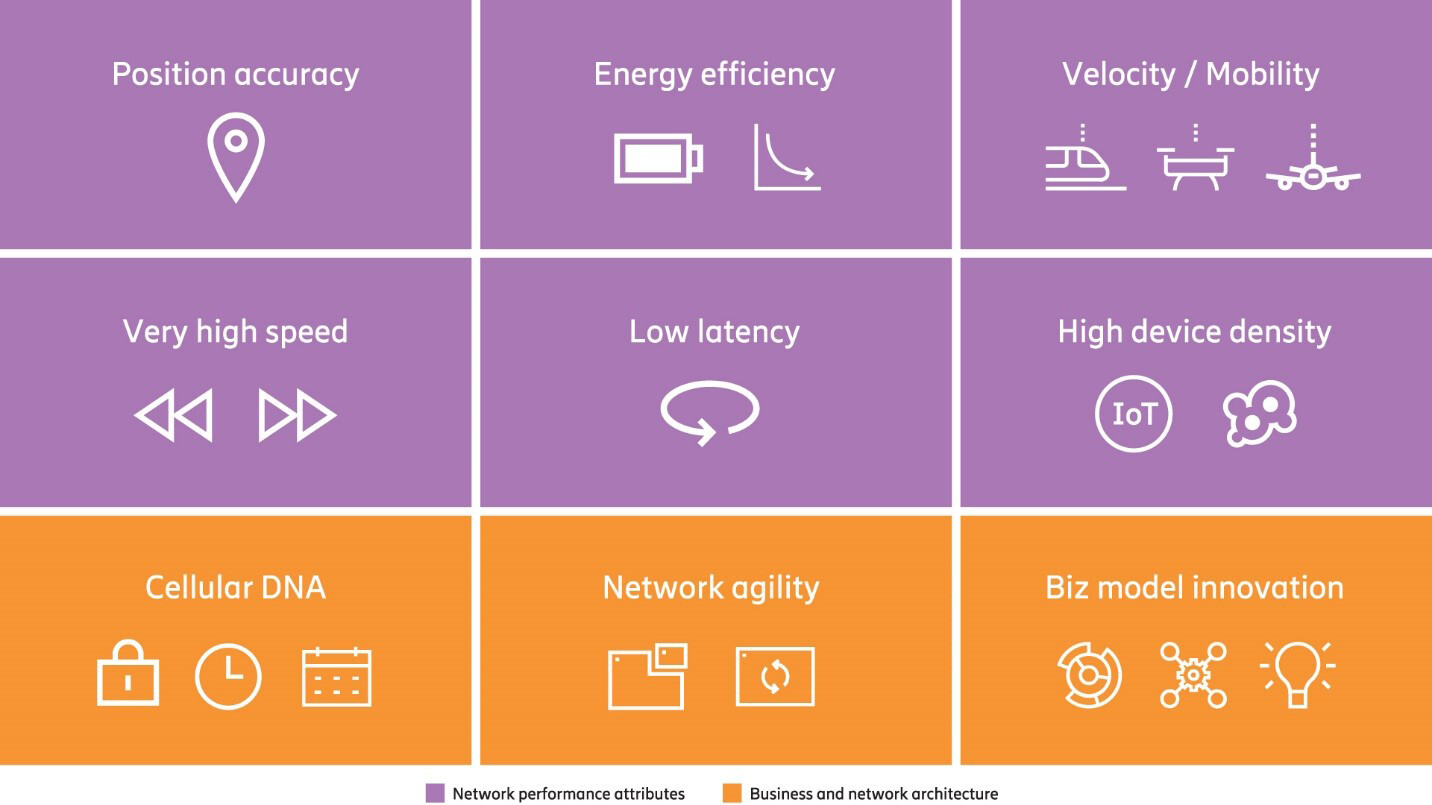
First, there is a robust cellular DNA and brand we can continue to leverage. Cellular networks and services are synonymous with reliability, availability, security, and network performance. 5G improves many of these attributes, meeting or exceeding 4G performance and offering a clear edge toward other wireless alternatives. The cellular DNA is of extra high importance when cellular network technologies are used for business- and mission-critical connectivity.
Secondly, the network agility in wireless networks has already gone through a transformation on multiple fronts. Today we operate with software-defined networks, executing on cloud-based infrastructure. A high degree of automation allows for continuous delivery and integration of new software capabilities. Network capability upgrades that used to take place yearly now occur monthly or weekly. This agility is essential when evolving networks to support a broad spectrum of IoT applications, and not only for yearly software upgrades aligned with major smartphone releases.
Thirdly, we have created a framework for business model innovations to align values with the monetization of services. A dedicated slice of a public network is a powerful alternative to building dedicated networks for one or only a few users or use cases. The ability to deploy cellular technologies in private networks for business-critical applications is a connectivity game-changer positioned in between wired and Wi-Fi at business premises. 5G represents improvement on a range of capabilities that can be used as a base for new business models. The six categories explained below can all be exploited for introducing new parameters, beyond peak rates and data traffic volume-based models. We are in the early stages of business model innovation where services charges are tied to new parameters.

Flagship capability values
5G is known to be significantly faster than 4G. Most point to low latency values when discussing the topic, which gets almost as much attention as its higher speed. Few, however, reflect on the performance differences between different spectrum bands, increases in upstream data capabilities, and the limitations for device densities of previous generations.
The fourth value is about peak data rates. Data rates vary with the type of spectrum used. Low-band spectrum brings a coverage foundation, mid-band spectrum results in material peak-rate improvements, and high-band spectrum creates a performance revolution! The maximum peak rates, 20Gbps downstream and 10Gbps upstream, are coupled to high-band and carrier-aggregation across all three band types. 5Gbps downstream is the current state of the art demonstrated in commercial networks. The upstream improvements target applications with large data volumes generated in devices. The data rate improvements provided by 5G are 10 to 100 times higher than 4G. High-band or millimeter wave has the highest potential for service differentiation, based on peak rates. The peak rates for 5G in mid-and high-band spectrum can be boosted further in fixed wireless access models where terminals are stationary.
If speed or peak rate is considered king, the fifth value, latency reduction, is queen. The latency improvements are visible across all types of 5G spectrum. Low latency makes a significant difference for real time applications. Low latency also improves how businesses and consumers interact with cloud-based applications. Ultra-low latency and increased reliability and availability enable large categories of new use cases. When moving from 4G to 5G, the latency is reduced, pushing network latency into single-digit milliseconds. This topic is less about finding the lowest possible latency, and more about consistent low latency to support time-critical communication.
Connected devices and the ability to increase the density of devices in an area are foundational for IoT. This sixth value eliminates limitations for IoT applications in densely populated or frequently visited places and locations where we can envision large numbers and types of IoT devices. It unlocks the potential for cellular IoT beyond what is possible today. The demand for this value will be vital in zones of the networks, rather than across the whole wide area network. The 5G standards call for a tenfold increase in connected devices for a given geographical footprint.
High peak rates, low latency, and high densities of connected devices are three flagship values we’ll use when marketing 5G services. We expect these to have high visibility and association to 5G across both consumer and business users. There’s also potential to leverage some of these values for new ways of 5G monetization. It’s possible to foresee a future with premium service offerings based on upstream peak rates and low latency as the base in new business models.

Icing on the cake values
Beyond the initial market, we can exploit additional values of the 5G value proposition. These three new values rely on the six values outlined above as a foundation and represent the icing on the 5G cake. Although they’re not used to receiving the same level of attention as those above, they have huge potential in unlocking new and innovative use cases.
The seventh value provides increased position accuracy. Today smartphones are good at defining their position through a triangulation of cellular, GPS, and Wi-Fi data points. The network's ability to position a device accurately is determined by emergency call regulations. More accurate positioning is relevant for IoT applications where devices are not stationary. We can prevent moving devices from colliding when comparing their precise positioning data. The navigation of airborne devices is of high interest. It requires three-dimensional positioning data that relies on simultaneous location and mapping. 5G introduces hundredfold improvements in the accuracy in determining positioning of devices, by the network.
The eighth value, energy efficiency, is multifaceted and targets both devices and networks. Increasing battery life in mobile phones has been a hot topic since pocket sized mobile phones were introduced. Applications based on sensors, which experience tiny traffic volumes enjoy material improvements in battery life. The goal is to enable applications where the battery life matches the device's life to support a “fit and forget” deployment model. The network side of the energy-efficiency equation is about breaking the increased energy consumption, not just per bit transported but for the network as a whole. Previous mobile generations have resulted in an increase in power consumption, as we have added more and more spectrum, with every generation shift. A tenfold increase in battery life for devices and reduced growth or flat energy consumption in networks are both essential game-changers.
Mobility and velocity represent the exciting final category of values. Cellular networks have supported devices moving at the speed of cars and trucks since the first generation. Support for devices moving at even faster speeds opens up new opportunities. We can increase the margins for autonomous and communicating vehicles on our roads. The increasing velocity of rapid trains requires cellular networks to evolve to support passengers. Higher velocity is also important for air traffic while serving unmanned aerial vehicles, as well as supporting data offload from commercial aircraft when approaching airports. 5G provides a 50 percent increase in the maximum device velocity when compared to 4G.
Marketers play a crucial role in positioning the 5G value proposition to consumers and businesses. This challenge, where multiple spectrum types and new values are in play, goes beyond classic values of peak rate speeds and data bucket volumes. This 3x3 matrix of values provides a framework for the design of new innovative business models. It’s important to be creative here as 5G allows service providers to align the new capabilities with values and experiences that consumers and businesses will pay for.
Practitioner’s Guide to 5G for Business - Five episodes during the fall 2021
If you signed up to the Practitioner's Guide in 2020, you’ll receive email when new episodes are published.
If you’re new to the Practitioner’s Guide to 5G for Business, you’re welcome to sign up here for an exciting series. In addition to the blog posts, you can expect one-page cheat sheets that summarize each topic. We’re also keen to support you in how you and your team can leverage this material and take conversations further at the intersection of service providers and enterprises.
Read previous blogs in the series:
Introduction to A Practitioner’s Guide to 5G for Business
Episode 1: Five reasons why 5G makes a difference
Episode 2: Five tech inflections
Episode 3: Six experience continents are defining the world of 5G