










Expanding the 5G ecosystem to unlock its full innovation potential

Head of Thought Leadership

Head of Thought Leadership
Head of Thought Leadership
Read this blog post if you are as excited as we are about understanding what this new innovative ecosystem looks like and who the key stakeholder groups are.
The ecosystem created around 4G
4G has fueled the phenomenal development of interdependent industries. The 4G journey is centered around three main pillars. The first pillar focuses on there being a smartphone in every human hand, with consumers managing their lives through a five-inch screen. The second concerns the reinvention of mobile service providers, transforming their networks from voice to data-centric connectivity services, with universal coverage and capacity, which has enabled pace to keep up with growing traffic demand. Finally, centralized hyperscale data centers host the apps and content consumed on our smartphones.
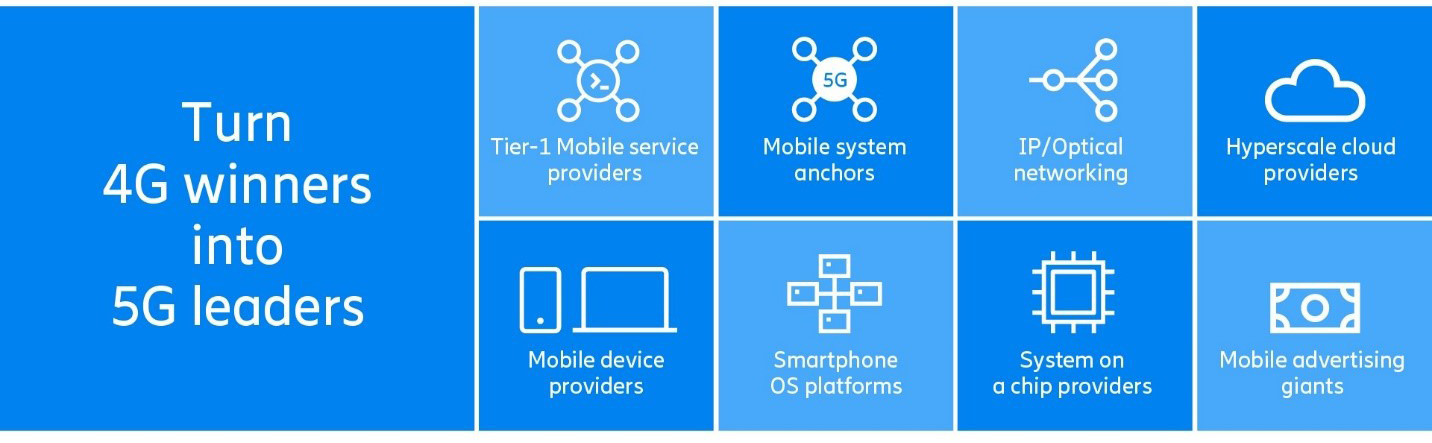
If we go beyond the smartphone-network-cloud level, the following stakeholder groups forming the ecosystem created around 4G are:
- mobile communication service providers with hundreds of different players providing nationwide data connectivity services in low- and mid-band spectrum
- smartphone platform providers and associated application stores, which are dominated by a few global players
- providers of hyperscale cloud data centers, hosting their own and all third-party apps in centralized data centers, with a few players operating at a global scale
- system-on-a-chip (SoC) providers, enabling technology at both the device and cloud-ends of the ecosystem
- smartphone providers, focusing on device innovations using standard SoC and operating systems for the most significant mass-market product on earth
- app unicorns, introducing digital disruptions for a spectrum of industries such as taxis, hotels, retail, real estate, and creating new industries such as social networking
- mobile advertising platforms, the enabler for freemium apps where consumers are the product sold to advertisers
- network technology providers, mobile radio and core networks, IP routing and optical transport, and associated business and operations support systems.
The 4G ecosystem has created a set of global winners in these eight stakeholder categories. These players are now reinventing themselves for similar success in the 5G ecosystem. This is a challenge that demonstrates we are moving from a very homogenous market to one with far more strategic options.
Rapid 5G network build-out and consumer conversion
Now that we’re in the third year of 5G, service providers are focusing on a few key priorities. The first is the land grab for consumer smartphone market shares in 5G. With 5G-powered smartphones available from all major providers, it is seen as vital to obtain a substantial percentage of the 122 million 5G subscriptions expected by the end of 2022 in North America alone. The second is the maximization of existing spectrum assets where new mid-band spectrum additions complementing low- and high-band spectrum are universally available. And finally, the third priority is business model innovation. 5G in low- and mid-band spectrum for mobile broadband can leverage existing models. The innovation potential comes from a combination of high-band spectrum, network slicing, fixed wireless access, and experience-centric offerings.
Transforming 4G winners into 5G leaders
The 4G ecosystem has created a set of global winners. US stakeholders stand out among the winners, having leveraged early access to network infrastructure, and with consumers quickly embracing smartphones and investments beyond the network.
A few megatrends define the transformation of 4G winners into global 5G leaders:
- five major expansions when it comes to target users, service offerings, connectivity types, infrastructure models, and coverage ambitions
- all communication service providers targeting first-mover advantages—low interest for fast-follower strategies—a trend that is uniform across the globe, with gaps erased to laggards
- the introduction of edge computing as a complement to centralized clouds, located at the network edge in major metropolitan areas and business premises
Unlocking new 5G growth engines
Beyond transforming 4G winners, there is also a significant opportunity to unlock new 5G growth engines. This opportunity is coming from areas representing the broader scope of 5G as served by an expanded ecosystem.
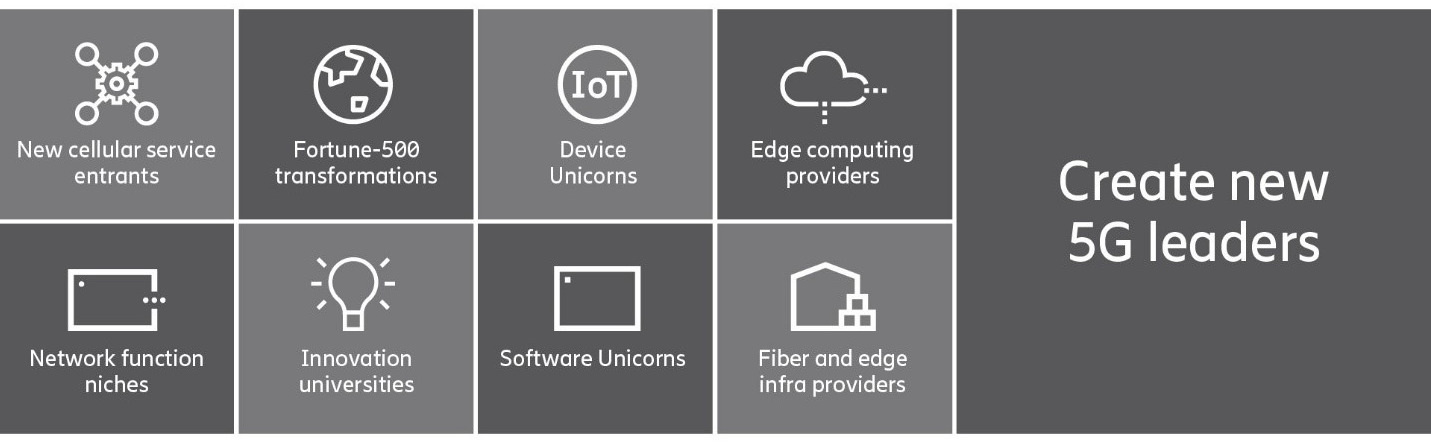
New communication service providers are emerging on multiple fronts. Some players are betting on providing nationwide 5G services with greenfield networks. Mobile virtual network operators are building their own 5G networks in areas with high potential to offload traffic from leased capacity. Geographically limited providers are offering fixed wireless services by converting legacy networks or entering areas with insufficient broadband options. Citizens Broadband Radio Service license holders are leveraging their new spectrum assets. And last but not least, service providers are offering to outsource asset ownership or network operations for private networks.
An essential part of the 5G agenda is the digital transformation of large corporations. 5G can develop innovations integrated into customer offerings for streamlining business operations to reduce costs. 5G is of high interest to Fortune 500 companies wanting to create in-house 5G innovation capabilities, with 5G campus networks at headquarters and major innovation hubs. Corporations with ambitions to move production from low-cost countries closer to their primary markets look to 5G as a critical ingredient in their smart manufacturing strategies. On the Global Fortune-500 list 2021, more than half of the enterprises are headquartered in China (135) and the US (122). Followed by Japan (53), France (31), Germany (27), United Kingdom (22), South Korea (15), Switzerland (13), Canada (12) and the Netherlands (11) among top-10.Early and successful adoption of 5G can be an important factor in determining if a company remains on the Fortune-500 list by the end of the decade.
At the time of publishing this article, 1,060 5G devices in 22 different categories had been announced. Both the variety and early timing stand out compared to previous mobile generations. Smartphones will remain the initial growth vehicle for 5G, the category representing half of all launched devices. Another quarter are fixed wireless terminals for indoor and outdoor deployment, and battery-powered pocket routers. In the last quarter we find 18 different devices types, in early stages of the 5G innovation cycle. It’s expected that devices won’t just be smart, but they’ll be smart and connected.
Mobile edge computing opportunities are of two primary types, network edges in major metropolitan areas, and at business premises. The evolution of the network edge, changes in radio network topologies, and the decentralization of mobile core capabilities are all part of the agenda of creating superior user experiences. The combination of distributed cloud capabilities and low latency networks is a door opener for new innovations.
The opening up of new interfaces is resulting in 4G networks being turned into 5G innovation platforms. The ability for software providers to develop network functions or microservices on cloud-based infrastructure is a completely new opportunity. The border lines between networks and applications are becoming more blurred and new software opportunities are being created as a result.
5G is equally essential to the digital transformation of small and medium companies. Here, universities can play a crucial role as regional and local innovation hubs, providing access to 5G infrastructure and a skilled 5G talent pool. Campus-wide access to 5G networks allows for the new learning models to be introduced, providing a platform for validation of new use cases, and access to a pool of digital pioneers for early testing of innovations. Of high interest are the universities classified as the 100 most innovative globally (46 of these are based in the US) and those classified as research universities (with 266 classified in the R1 and R2 category in the US).
The pandemic has shown the value of a society that is capable of working and studying from home. When the pandemic is over, we will use some of the learnings to create a more flexible hybrid future for work and education. We need to make sure that the capabilities we have at home and in remote workplaces are like those we have in our regular workplaces. 5G can become the go-to connectivity option for personal productivity in smartphones, tablets, and laptops to bridge gaps in fiber-based fixed broadband, which will enable us to work from wherever we want.
5G is driving new demand for fiber to 5G sites and edge computing close to end-customers. The focus is on securing fiber to 5G macro and small cell sites on black fiber to complement managed Ethernet services. Network edge computing is attractive for collocating with mobile core functionality.
5G has the potential to shape a new generation of unicorns in the same way 4G did. Of high interest are innovations at the intersection of 5G, and adjacent and correlated technology shifts. Venture capital invested in combining one or several of 5G, edge computing, Internet of Things, artificial intelligence, and augmented/mixed/virtual reality has strong potential.
Conclusion
5G offers an opportunity to turn the ecosystem into a powerful economic system, one where 4G winners reinvent themselves to become 5G leaders. The rapid and nationwide build-out of 5G networks is the foundation for development across leading markets and a key to global success. With the broader reach of the 5G ecosystem, we can look forward to unlocking a comprehensive set of new opportunities. 5G is, without doubt, the economic system battle to watch this decade.
The topics covered in this second season of the practitioner’s guide to 5G for businesses represent a subset of the topics being discussed right now. If you have further questions or suggestions for new topics to be addressed, you can contact the author here.
Thank you for investing your time in reading the five episodes and good luck in applying them to improve your 5G strategies and plans!
Read previous blogs in the series:
Introduction to A Practitioner’s Guide to 5G for Business
Episode 1: Five reasons why 5G makes a difference
Episode 2: Five tech inflections
Episode 3: Six experience continents are defining the world of 5G