










CTO Focus: How edge is creating massive cloud innovation opportunities in India and beyond

CTO Ericsson

Chief Technology Officer, Bharti Airtel
CTO Ericsson
Chief Technology Officer, Bharti Airtel
CTO Ericsson
Chief Technology Officer, Bharti Airtel

The rollout of 5G across the globe is bringing with it a unique transformation. Of course, as in previous generations, it introduces greater speed and performance – this time with ultra-low latency and a more resilient connectivity. But 5G also represents a disruptive shift in the location of compute power – moving away from devices to the network edge, unlocking a whole new world of opportunities through cloud innovation.
5G services in high demand
In India, one of the world's largest telecoms markets, 4G data usage currently sits at around 15 gigabytes per month – a figure expected to grow exponentially, reaching around 40 gigabytes in the next five years.
In addition, the latest EMR data points to 18.4GB per month per smartphone user in India, which is set to increase to 50 GB per month per smartphone user by 2027.Demand is growing. Ericsson's ConsumerLab report Harnessing the 5G consumer potential shows that consumers around the world not only have a strong interest in 5G – but that they are willing to pay extra for it, with one in three early adopters willing to pay a 20-30 percent premium for 5G services. In India, that number reaches as high as 50 percent, where 40 million five-year subscriptions are expected in the first year of 5G alone.
But consumers also expect more, with 70 percent of early adopters dissatisfied with the availability of innovative services and new 5G applications, as the Ericsson ConsumerLab report Five ways to a better 5G uncovers.
By 2023, 25 percent of 5G use cases are forecast to be reliant on edge computing – making a wide range of technology applications more affordable, accessible and efficient. Knowing demand is already strong from consumers, let’s explore some of the unique cloud innovations and use cases that 5G is enabling, both in India and throughout the wider technology world.
New business opportunities – from Bollywood to better surveillance
Integrating service orchestration with 5G will allow communications service providers (CSPs) to dynamically expose and monetize the network based on performance, efficiency gains, pricing and more – firmly establishing a value proposition in the edge cloud ecosystem. For example, providers can use their edge to host content or to provide services on demand, monetizing one-off subscriptions or access as opposed to bundled video services.
Entertainment is one area with truly breathtaking new possibilities, with consumers willing to pay for augmented reality (AR) and virtual reality (VR) 5G immersive experiences both at home and at live events. This poses a lucrative opportunity for the Indian market, where large-scale entertainment staples such as Bollywood and cricket receive enormous popularity and success.
5G gaming is also likely to be one of the biggest 5G use cases, with cloud gaming allowing games to be played in real time - even on smartphones - without having to download them or invest in gaming hardware. In September 2021, Bharti Airtel successfully held India’s first 5G cloud gaming demonstration, partnering with two of India’s most popular gamers – Mortal (Naman Mathur) and Mamba (Salman Ahmad). With its large youth population and increased smartphone penetration, the cloud gaming ecosystem in India is expected to grow rapidly.

Caption: Top Indian gamers Mamba (Salman Ahmad) and Mortal (Naman Mathur) test out their gaming skills as part of Bharti Airtel’s 5G cloud gaming demonstration, the first of its kind in India. The full demo video is available here.
5G gaming, enabled by edge cloud technologies and end-to-end network slicing, will also offer new business models. With network slicing, consumers wanting to play in a gaming or e-sports competition could subscribe to a low-latency slice for a certain length of time, delivered through a cloud application. This flexibility opens up new services and mobile cloud gaming opportunities for business support systems (BSS) that are simply not possible today.
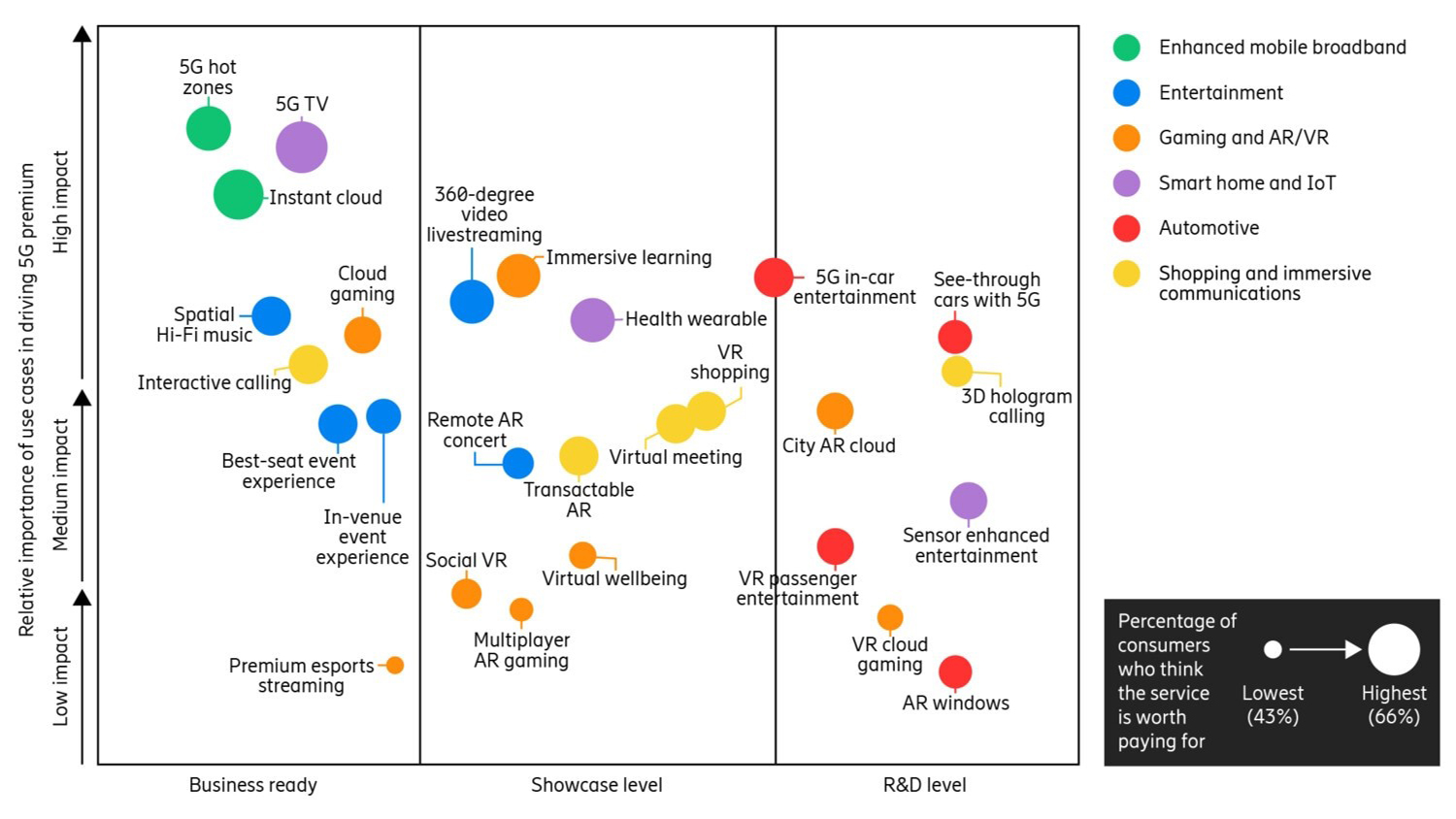
A consumer use case development roadmap for 5G from the Ericsson ConsumerLab Report Five ways to a better 5G.
The benefits of 5G edge for industry and organizations are also enormous, and equally broad. Groundbreaking new opportunities are opening up for Industry 4.0 and smart factories utilizing the Internet of Things (IoT) and automation. We also have simpler real-world situations where cloud and edge technology can help with systems that rely on processing on the fly, making them more cost-effective and efficient.
In security surveillance systems, for example, surveillance equipment is currently very expensive as it must process all the images within the equipment and system itself. But if the footage was processed at the edge, in a secure cloud-based application, the cameras and equipment would be much more affordable and the systems more easily maintained.
Networks as a platform
The transition to a more service-based approach is driving a movement toward networks as a platform, with different levels of processing taking place in different slices and different locations based on demand. This will, of course, have a drastic impact on the telecoms landscape and ecosystem.
To make this shift, we need to re-architect the network, moving from closed and inward-looking, to more open, flexible architectures which offer interaction and accessibility for a range of service providers. We will see an increasing decoupling of hardware and software components, and it will be the responsibility of all stakeholders and players in the telecoms ecosystem to work together and realize the full potential of this new landscape.
To deliver optimal 5G network ecosystems, it’s crucial that solution providers, including Ericsson, continue to build secure open platforms where application programming interfaces (APIs) can be exposed to content providers. CSPs also have a responsibility to make sure that they are building the network architecture needed to enable new 5G services and innovations for connected enterprises. This will include more exposure services, with access to network information about their IoT which companies can process and use – while ensuring privacy and security for sensitive data.
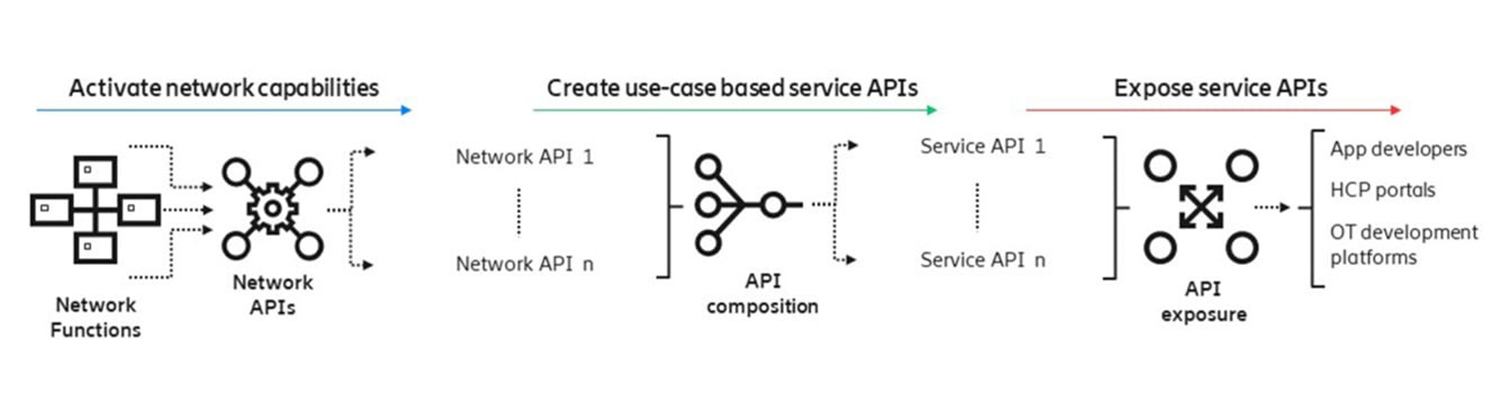
The network exposure journey
We need to ensure network automation and cloud journeys are more standardized, and platforms are more integrable and universal to enable developers and applications to function unhindered in a global context.
There is much to be done to achieve this transition, but – like with 3G and 4G – the early movers who invest in and offer new services first will be the winners long term, capturing a larger market share. According to the Ericsson ConsumerLab Report Harnessing the 5G consumer potential, CSPs can generate USD 131 billion by 2030 from digital service revenues by proactively developing and marketing 5G use cases. By being proactive in driving their 5G differentiation, providers could gain a 34 percent higher average revenue per user (ARPU) by 2030, growing their consumer revenues at a compound annual growth revenue rate of 2.7 percent.
Driving the future of cloud innovation
Many of the most exciting or impactful future 5G and edge use cases and applications are likely to be born, not from large companies, but from a small idea – perhaps by an individual, an employee, a small business or a startup. Telecom industry- and technology leaders such as Ericsson and Bharti Airtel also have an important role to play as innovation incubators, nurturing new ideas and ensuring opportunities for new 5G services are not missed.
Disruptive new ideas require identification, proper testing and, if successful, scaling up. Larger telecom players need to support this process, to bring these ideas to a larger audience through technology hubs such as the 5G labs Bharti Airtel is setting up in India, or the Ericsson D15 innovation center in Silicon Valley. If we do not co-create solutions and give them exposure many game-changing 5G innovations will be left on the ground untested and potentially lost forever.

Helping others imagine possible: business building and demand creation
Finally, we need to leverage our positions as industry leaders for business building and demand creation – these are, after all, new capabilities and services that aren't known to the broader ecosystem yet. 5G has so much to offer enterprise - creating value, new services, new business models, increased efficiency and competitive advantage. In industries such as manufacturing or mining, businesses no doubt have extensive knowledge about their industry and operations, but often no in-depth expertise when it comes to the latest technology and capabilities.
For successful connected enterprises and industries, telecom must have a seat at the table. We need to present solutions to their business problems, introduce them to the opportunities of the connected world, and the efficiencies of machine learning algorithms – really communicate what this technology can do for them.
5G and edge technology offer a wide horizon of fantastic opportunity, both in India and around the globe. The technology is in our hands - now the onus is on us to shape and create its true value – and its success.
Learn more
Discover more about edge computing, and the world of new revenue opportunities it’s opening up across manufacturing, transport, gaming and more.
Explore more 5G use cases in transport, healthcare, production, football and more.
Read more about 5G and cloud: How telecom can architect the next cloud era.
Learn how network slicing enables customized connectivity with assured performance for enterprise, consumer and industry-specific services.
Learn how service orchestration enables automated, end-to-end coordination of services across network domains and technologies.