









How to build high-performing Massive MIMO systems
- English
- 日本語

Principal Developer Advanced Antenna Systems technology strategies

Senior Expert in Multi Antenna Systems & Architectures

Strategic Product Manager, Massive MIMO software solutions

Head of Product Line 5G Radio Access Network
Principal Developer Advanced Antenna Systems technology strategies
Senior Expert in Multi Antenna Systems & Architectures
Strategic Product Manager, Massive MIMO software solutions
Head of Product Line 5G Radio Access Network
Principal Developer Advanced Antenna Systems technology strategies
Senior Expert in Multi Antenna Systems & Architectures
Strategic Product Manager, Massive MIMO software solutions
Head of Product Line 5G Radio Access Network

To cater to the ever-increasing data traffic demand expected in 5G, as well as to the higher speeds, mid- and high-band spectrum availability are key.
However, we have a few key challenges to solve:
- First, we need to overcome coverage issues associated with high-frequencies - the higher the frequency, the lower the reach.
- Secondly, we need to secure the best spectrum efficiency to maximize the value of the spectrum investment.
Finally, while we are addressing those challenges, we also need to minimize the radio size, weight and power consumption of radios, so that we can enable faster and affordable roll-out for communication service providers (CSP).
Join us and discover the key ingredients of Ericsson high-performing Massive MIMO systems and how it helps CSPs overcome those challenges, using our secret sauce.
The 101 of radio physics
It takes more than one key ingredient to cope with the increasing volume of data bits that are expected with 5G and as we will explain, Ericsson´s Massive MIMO solution is one of them.
Let´s start with the spectrum – the information superhighway of telecom systems. Simply put, the more spectrum or bandwidth you have, the more information you can deliver. However, you also need good enough signal strength for the information to reach the intended receiver as efficiently as possible.
The great engineer Claude Shannon described the fundamentals of this in his famous equation from 1948 (we promise that this is the only equation in this blog):
C=W log2(1+S/N)
Shannon showed that the channel capacity (C) - the achievable data rate in bits/s - is proportional to the channel bandwidth (W) and logarithmically dependent on the Signal to Noise ratio (S/N). Incidentally, the Shannon happens to be the name of the largest river in Ireland and has always been an important channel of communication, with the flow of water similar to the streams of bits passing through a radio propagation channel.
So, do we just need to add more spectrum to get more capacity?
As the frequency gets higher, the wavelength of the radio waves becomes shorter. Antenna sizes naturally become smaller to match the radio wave size. However, a drawback is smaller antennas have less reach. Luckily, we have clever ways to compensate for this with Massive MIMO.
As a simple analogy, let us imagine listening to music playing from a speaker at a distance. The higher frequencies from small treble speakers carry a fast-moving melody, while the lower frequencies from the larger bass speakers carry the slower beat of the backing bass. Of course, the large bass speakers provide extra energy that carries the bass sounds far through the air and walls, and to hear the melody at a distance we need it amplified somehow.
Fortunately, we have a great solution to these coverage and efficiency challenges of radio wave physics, that also has numerous other benefits – Ericsson Massive MIMO and Beamforming!
“Outsmarting” physics with Massive MIMO and Beamforming
Of course, physics can’t be outsmarted. But there are clever ways to circumvent the challenges described in the previous chapter by building advanced antenna systems (AAS), also often called Massive MIMO solutions (the terms can used interchangeably).
Massive MIMO and its beamforming features are key to solve the coverage and efficiency challenges posed by higher frequencies in the 5G spectrum. Let´s see why and how.
Firstly, an AAS system comprises, as explained in our white paper:
- An AAS radio – an integrated hardware unit with an antenna array, closely integrated with many radio chains (generally 16 or more) and often part of the lower layer RAN functionality.
- Massive MIMO (or AAS) features such as beamforming, which can be executed by algorithms in the AAS radio, a RAN Compute connected to the AAS radio or both.
AAS may also stand for anabolic androgenic steroids. So, if you have a casual conversation at the gym about how you are working a lot with AAS and you really need them for performance, people will not think you are talking about radio antennas – you may get weird looks (true story!)! So, context is important! But in a sense, it´s a good analogy. AAS is like 5G on steroids!
To make an AAS, we add many more antenna elements to the antenna array of the radio. This increases the total antenna area and so the overall gain of the antenna can be increased without increasing overall size of the antenna panel compared to lower frequencies. This increases coverage in both the transmit and receive directions.
Of course, just being able to focus energy in a fixed direction is not very useful as people typically move around. So, to be able to control the direction and shape of the beams in any way we want in space, we also make the antennas individually controllable with their own radio chains, so we can change the amplitude and phase of their signals separately.
This gives us numerous coverage and capacity abilities, including:
- To create multiple beams at the same time
- To send and receive radio signals extremely quickly – on a fraction of a millisecond basis – where we want to, while reducing interference in directions where we don´t want that energy to go or come from. All of this, for multiple users simultaneously!
But - this is no easy task. How do we “form” the right beams to get the most signal energy to the user that we want? People usually think of a beam as a simple concentration of energy that looks like the figure below. You just point it in the direction that you want and that´s all that you need. It is true that you can form beams like that, and they will often work quite well, but they are not always optimal.
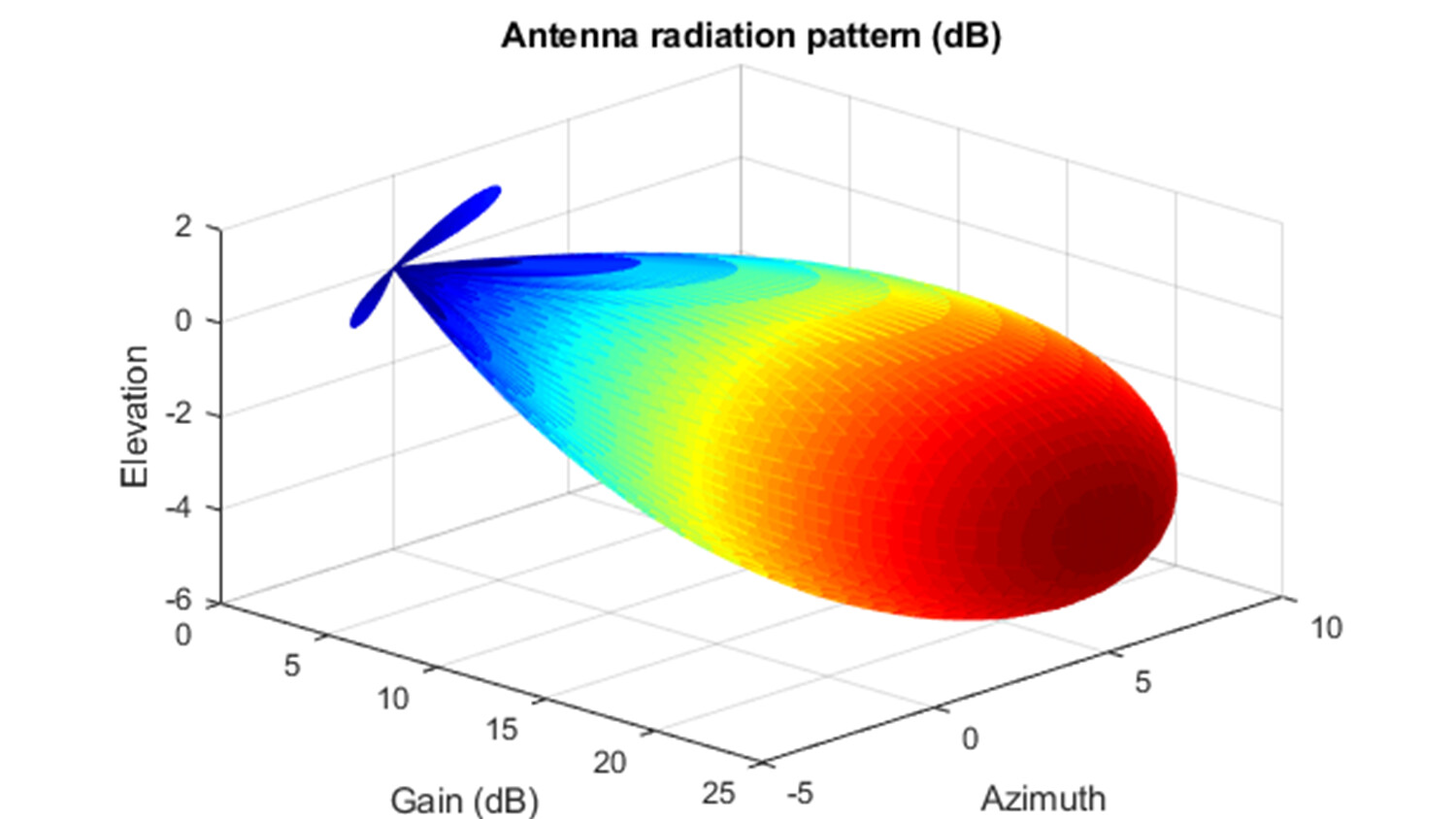
The reason we can do better than a simple beam is that the “radio channel” is a highly complicated environment, since the signal path that travels between the base station and each device reflects off numerous objects causing standing waves and dips that change in time and in frequency at sub millisecond level, as multiple paths arrive at the receiver from all directions, as illustrated in the picture below.
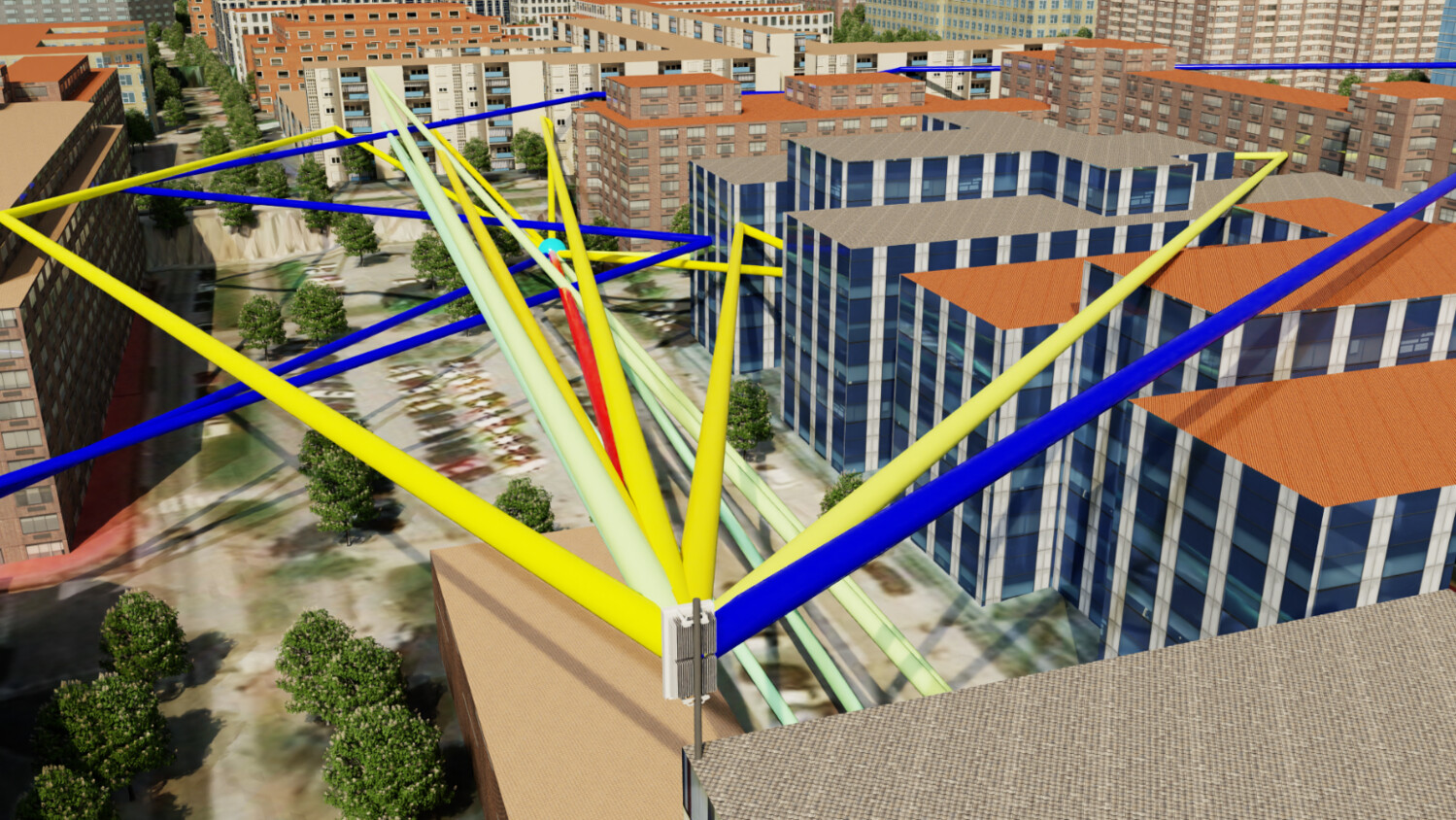
Think of a choppy ocean… what should the ideal beams look like to navigate this environment with the best performance? To add to the complexity, this channel is different for each of the hundreds of moving devices that are connected within a cell so they each need precisely created beams of their own and of course when we send a beam to one user we don’t want to interfere with others.
So, the beams must be highly precise, individual, and continually reshaped every fraction of a millisecond both in time and frequency, based on instant measurements of the radio channel across the spectrum together with large scale calculations to work out and apply the beams to the data we want to send or receive. The gigabits of data that are sent and received over the air interface are practically surfing the radio channel and just as in wave surfing, precise timing is essential to catch the radio waves. If you let your view of the channel information get too old, which happens extremely quickly, you will fall off the wave, and miss the chance to optimize your beamforming performance. The instantaneous beam that works best can look quite arbitrary as illustrated below but best achieves the goal of getting the energy exactly where we want until we change it for a new beam a fraction a millisecond later.
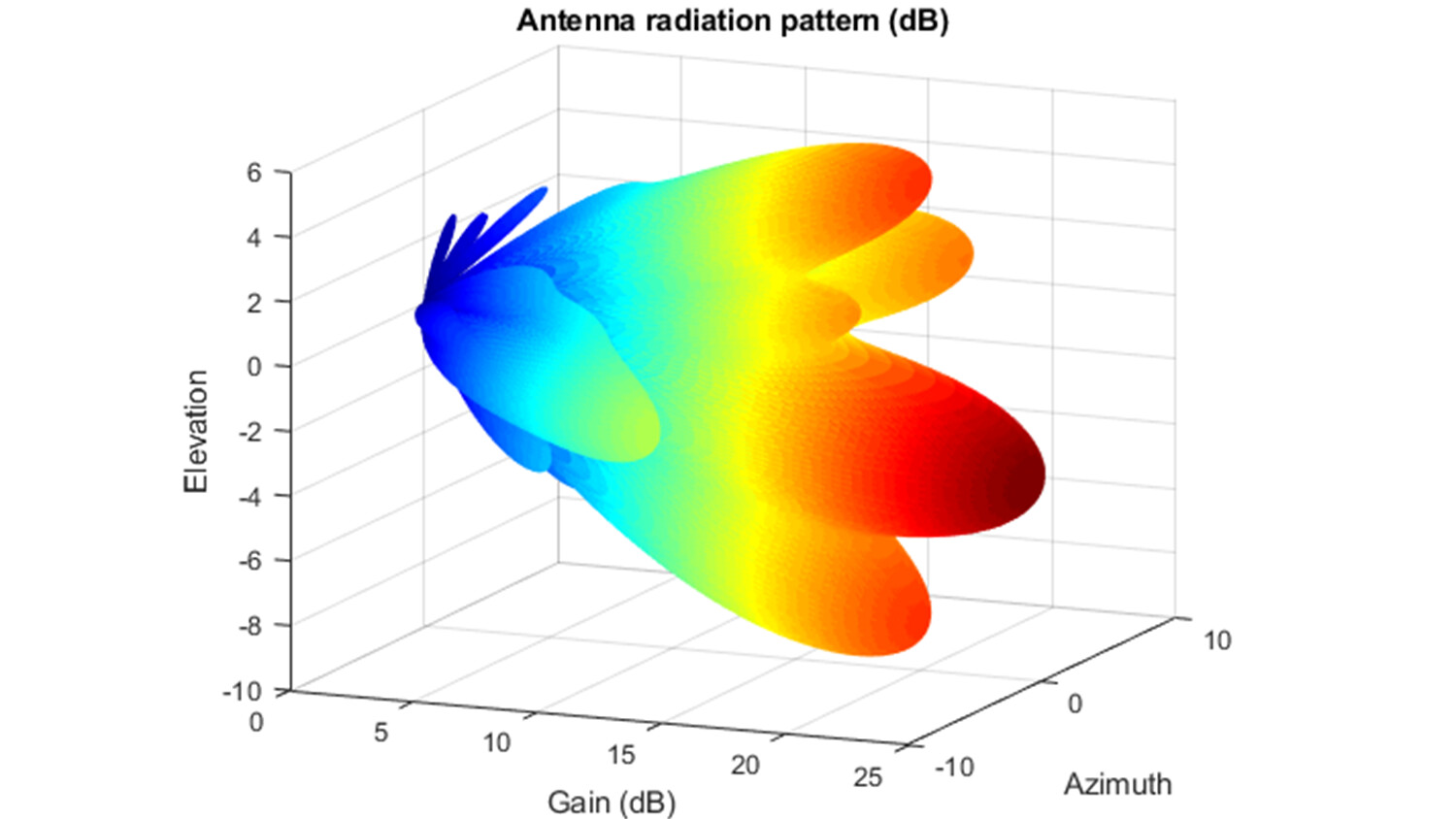
For CSPs, the result is much greater coverage, much greater network capacity and high end-user speeds over a wider area compared to remote radio unit solutions. The CSP can exploit their valuable spectrum resources to the utmost without vastly increasing the number of sites. This has the benefit of reducing the cost per gigabit per area while preparing CSPs for future traffic growth - they can continue providing outstanding speeds and great coverage as the data traffic load gets heavier.
The art and science behind Ericsson Advanced Antenna Systems
We can clearly see the benefits of AAS. However, there are also challenges to realize its full potential:
- Radio challenges: Larger bandwidth and more antenna branches drive the need for increased processing capacity, which drives higher power consumption, size and weight at the base station.
- Beamforming challenges:
- The radio environment changes on sub-millisecond timeframes as the smartphone moves. Adding to this complexity is of course the hundreds of other devices that connect within the cell.
- The beams must be continually reshaped every fraction of a millisecond, based on instant snapshots of the channel, both in time and frequency.
- To adapt the beams in a complex radio environment for many users simultaneously when using multiple antennas, requires millions of mathematical calculations per second
To address these challenges, Ericsson adds three key components: access to information about the instantaneous radio channel, clever algorithms which utilize this information, and the processing power of the Ericsson silicon. Fortunately, Ericsson’s long experience in the AAS field has ensured that both our hardware design and beamforming algorithms are prepared for this.
The Ericsson Massive MIMO architecture has been designed to put as much as possible of the beamforming and MIMO processing in the AAS radio itself, close to the antennas and radio channel, where we have access to real-time and fine granular information about the radio channel. Therefore, Ericsson is able to do channel estimation and beamforming weight calculations that follow the extremely rapid changes that occur on the radio channel almost instantaneously. You could say that Ericsson Massive MIMO antennas have a fingertip feel of the radio channel and can react to the real-time channel situation with the best possible beams.
Putting this processing in the radio where it belongs also has other advantages. The fronthaul bit rate from the radio to the RAN Compute is reduced, thus saving costs, and the RAN Compute can concentrate on its own tasks,- for example to schedule users over many cells, and to encode and decode the data bits on the user plane, which must be well protected before they are sent over the air.
Secondly, we need clever beamforming algorithms to act on the channel data. In fact, the way to do the beamforming in 5G is not defined by any 3GPP standard and is completely up to implementation, which means there is a lot of room for innovation and artistic freedom.
To solve the complex challenge of adapting to time-varying radio channel, we need to generate ultra-precise beamforming by applying different precoder weights to the antenna elements of our array so that after passing through the wireless channel to the target user, the signals from the multiple antennas add up coherently to boost the signal. This is analogous to creating a harmony in music by playing several tones on the piano at certain specific intervals so that when added up they form a pleasant-sounding chord.
But we simultaneously want to reduce interference to other users by having the signals from the different antenna elements add up destructively, akin to creating a dissonant-sounding chord in music by playing tones with other intervals (like a diminished fifth). The problem to generate optimal beamforming performance to achieve these goals simultaneously then becomes similar to composing a musical arrangement with complex harmonies and passages, while handling multiple instruments simultaneously, both an art and a science! And as we know, it takes both skill and dedication to become a Mozart as it does to master the art of Massive MIMO.
To generate ultra-precise beamforming, a massive set of complex calculations needs to be performed in real-time, scaling with the number of antennas, the bandwidth and number of users. This adds up to millions of mathematical calculations per second, which requires an extreme processing capability. In addition, it also requires our sophisticated software features and algorithms to make sure that we leverage that hardware in the best way. This can only be achieved with Ericsson silicon, system on a chip (SoC) solution, as outlined in the previous blog. It can not only handle all that processing capacity inside the Massive MIMO radio, but also creates much tighter integration of components inside the radio. This way, we can build a high-performing radio without adding size, weight or energy consumption.
How Ericsson provides true 5G experience with unmatched coverage and capacity
Ericsson has decades of R&D experience under its belt. We are currently the major contributor and a key driver of 5G standardization, having co-authored 37 percent of specification texts. Additionally, based on learnings from Massive MIMO with LTE, Ericsson ensured that the 5G New Radio was designed to fully support Massive MIMO already from day one to become the first Massive MIMO native standard.
Our key features include:
- Ericsson´s Massive MIMO radio solutions, with joint hardware and software co-design, enable CSPs to deliver the high speed, high performance 5G experience demanded by consumers and enterprises.
- The added antennas increase coverage, while the beamforming and its algorithms enable maximum spectrum efficiency through real-time data, directing coverage where it is needed, minimizing destructive interference.
- Lastly, our secret sauce – Ericsson silicon delivers the processing needed for beamforming without adding size, weight and energy consumption, in conjunction with our innovative software solutions.
All these together enable Ericsson´s Massive MIMO radio solutions to provide coverage and capacity that will remain unmatched.
Our customers can be sure that they can get the best value from their precious spectrum assets while re-using existing sites as much as possible. They can in turn, deliver enormous benefits to their customers with super-fast and reliable 5G service, achieving the highest quality and best 5G user experience possible.
We believe that Claude Shannon himself would be impressed at the results we achieve with Ericsson 5G Massive MIMO!
Learn more
Explore the Tech Unveiled blogs and videos
Explore our 5G RAN key offerings
White paper: Advanced antenna systems for 5G networks