










Intelligent Automation: The evolution from SON to centralized automation

Solution Marketing Manager OSS

Solution Marketing Manager OSS
Solution Marketing Manager OSS
Invisible SON?
The SON concept was introduced in the 3GPP Release 8 as part of long-term evolution (LTE) standardization. SON focuses on three key areas of radio access network management: self-configuration, self-healing and self-optimization and is driven by the need to reduce complexity in network management by automating repetitive processes and improving the run time of operations and network performance.
Some CSPs are wholeheartedly embracing the technology, with it forming part of their core network strategy. It’s, however, fair to say this technology hasn’t been universally adopted. There are a number of reasons for this, not least the diverse number of SON providers, the close linkage between SON applications and the underlying application platform and the challenges of deploying SON applications across multiple RAN vendors.
There’s been a consolidation of the SON vendor landscape from more than twenty vendors down to around ten key vendors. LightCounting1 estimate global SON market to be around USD 1 billion per annum but it’s predicted that if every operator deploys SON technologies this would grow to around USD 8 billion per annum. The question is: "What, if anything, can re-energize the SON market?”
House of the rising SON
Fortunately, at Ericsson we believe that there is an answer – a simple answer – that will not only re-energize the SON market but also has the potential to extend the boundaries of SON beyond the three original precepts of 3GPP Release 8.
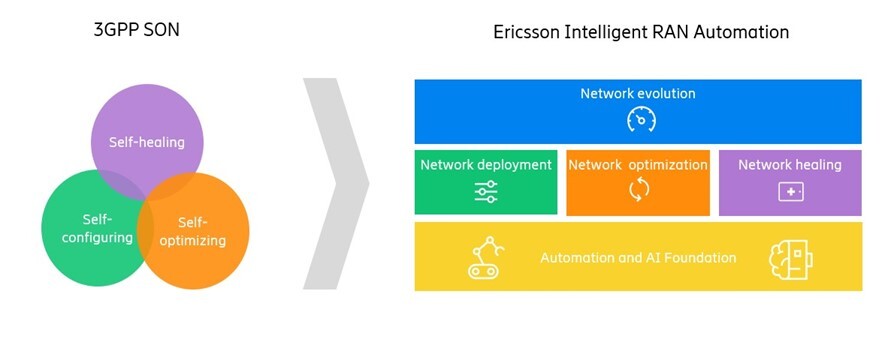
This evolution forms an important part of the Ericsson Intelligent RAN Automation vision and is closely linked to the introduction of Ericsson’s new Open RAN service management and orchestration (SMO) platform the Ericsson Intelligent Automation Platform (EIAP). This platform consists of a Non-Real-Time RAN intelligent controller (Non-RT-RIC) capable of running radio access network automation applications called rApps. Some observers see rApps as simply the evolution of SON at Ericsson we see these new architectures enabling much more than a simple translation of 3GPP SON capabilities. The reason that we believe the Intelligent RAN Automation approach is more than simple translation of SON is because these new generations of rApps will leverage artificial intelligence (AI) and machine-learning (ML) technologies to extend the capabilities of rApps far beyond what was originally envisaged.
Waiting for the SON
Ericsson is a thought leader in the development of SMO and is one of the major contributors to the O-RAN Alliance working groups focused on the O-RAN architecture, open R1 interfaces and the non-real-time RIC. In addition, Ericsson was the first organization to recognize the importance to the industry of being able to extend the powerful RAN automation capability of the SMO, Non-RT-RIC and rApps beyond open RAN and cloud RAN to automate the existing, purpose-built 4G and 5G networks deployed today. The reason that this is an important development is because these existing commercial networks often must deal with complex environmental and user environments that benefit the most from SON.
The ability to deploy this type of multi-technology (open RAN, cloud RAN and purpose-built RAN) and multi-vendor automation in networks today is a real game changer. In addition, the current energy crisis with massive energy price rises is really accelerating interest in a new generation of optimization and healing rApps focused on improving network sustainability and energy management.
Sustainability-focused rApps are accelerating interest where it's possible to see immediate business impact from deploying applications that can deliver a 15 to20 percent reduction in power usage without materially impacting customer experience.
Set controls for the heart of the SON
It's easy to think that the evolution to SMO, Non-RT-RIC and SON rApps will be easy, but as with anything in the mobile communications domain, the devil is in the detail. Deploying SON across multi-vendor, multi-technology networks is complex and CSPs need a partner that understands that complexity. The O-RAN Alliance SMO architecture is hugely innovative, but the proposed open interfaces are not fully specified or standardized, although Ericsson is working hard within the O-RAN Alliance to drive forward the specification of the key interfaces. Finally, there are some challenges for automation of multi-vendor RAN particularly where the RAN vendors are not active participants in the operational support system interoperability initiative (OSSii) which seeks to make multi-vendor management easier.
The good news is that Ericsson’s EIAP has been designed to manage complexity, support all of the key open interfaces and is designed to support multi-vendor existing 4G and 5G RAN.
The future’s so bright, I gotta wear shades
The SMO architecture solves a number of the issues that’s preventing ubiquitous adoption of SON. SMO provides a single, common, open-standards based platform for running [SON] rApps and a number of CSPs are already recognizing that this architecture offers the opportunity of wide-scale platform consolidation.
The open R1 interface will enable a degree of portability of rApps between different vendor platforms. SON rApps decouple the application layer from the underlying platform and potentially enable an rApp to run on any R1 interface compliant SMO.
Finally, market-leaders, like Ericsson, see the need for a high-functionality software development kit (SDK) that allows CSPs and third parties to rapidly and cheaply develop new rApps, which can then be monetized globally.
The final thing to say about the evolution of SON to SON rApps is that the benefits of this technology are not just limited to SON. We expect some of the earliest rApps and use cases to be ‘reimaginings’ of existing SON capabilities, often powered by artificial intelligence (AI) and machine learning (ML) but the innovation doesn’t stop there. We expect to see a rapid rise in new ‘sustainability rApps’ which are designed to reduce the carbon footprint and energy usage of the network. We also expect to see some very advanced automation capabilities linked to the evolution of 5G networks, leveraging new capabilities not envisaged in 4G/LTE, that utilize some of the new capabilities of 5G networks, such as ultra-low latency, ultra-reliable networks and scalability, as well as supporting dynamically sliced public and private networks and enterprises.
The evolution will start with SON, but we expect that Intelligent RAN Automation will go above and beyond SON in terms of capability and impact.
Sun song references:
For those of you confused by some of the chapter titles they are variations on songs with the word sun in them. Apologies for the confusion and apologies to the original artists for misappropriating their titles:
- Invisible Sun – Police
- House of the Rising Sun – The Animals
- Set Controls for the Heart of the sun – Pink Floyd
- Waiting for the Sun – The Doors
- The future’s So Bright, I Gotta Wear Shades – Timbuk 3
Want to know more?
Read the guide Intelligent Optimization and subscribe to the new Intelligent Automation Guide series
Watch our new Intelligent Automation Platform video
Related blog posts:
- Why intelligent RAN automation is going to rock your world
- Intelligent ecosystems: driving the development of RAN automation applications
- How open development ecosystems drive rApp innovation
Explore 5G
1 LightCounting Network Automation-SON-RIC Report October 2020