











Network management
Telecom is an increasingly complex landscape of high expectations, evolving security threats and unprecedented levels of data and traffic generated by billions of connected devices. Intelligent network management makes handling day-to-day operations simpler, so you can focus on the big picture – securing, serving and scaling business opportunities.
Network management explained
Network management is a broad topic, covering a wide range of activities and operations, from deploying and activating a secure network to upgrading and ensuring everything is running smoothly and efficiently.
This process of administrating, managing and operating a public or private network involves using a network management system (NMS) to monitor performance, maintain reliability, control security and manage access to data or parts of the network. These systems manage network configurations, automate tasks, perform software upgrades, track usage and bandwidth and help identify and troubleshoot issues. The ultimate goal? A network that’s always up and delivering at its best.


Key principles in managing networks
Effective mobile network management involves managing and overseeing a number of primary functions and areas.
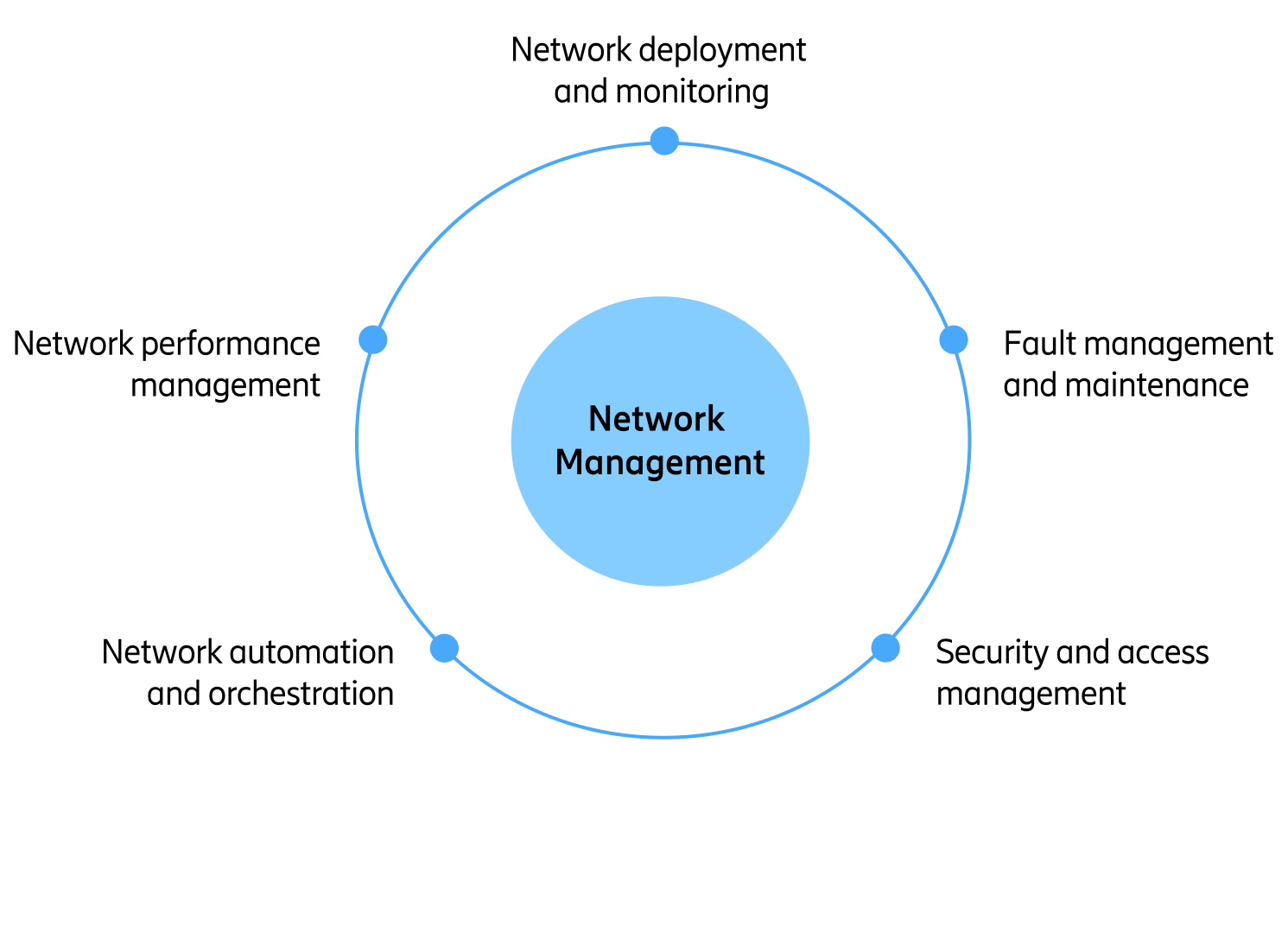
Challenges and opportunities of network management
What are the trials facing CSPs?
1. Increased complexity on the road to future networks
We’ve already mentioned the complexity of managing large and diverse networks as a central concern when it comes to network management. Overseeing so many devices, components and applications efficiently is no easy task, and things are only expected to grow more complex as 5G Advanced rolls out and we continue the journey toward Open Radio Access Networks (Open RAN).
2. Countering evolving cybersecurity risks
With increasing openness, network exposure and greater integration with ICT systems in the telecom security landscape, the number of threat vectors for attacks also grow. To counter the ever-present threat of attacks and minimize cybersecurity risks, a range of network management capabilities need to be engaged - data, monitoring, access control and authentication plus automation and real-time responsiveness.
3. Energy management
For CSPs, energy costs have traditionally represented up to forty percent of total operating expenditure – their largest cost factor. Simultaneously, environmental sustainability goals and efforts to reduce carbon footprints are increasingly prioritized. With the arrival of 5G, it is business-critical that service providers reduce energy costs and carbon emissions, without compromising on network performance.
4. Scalability and flexibility
Networks, industry digitalization and consumer needs are all evolving rapidly, making scalability and flexibility key factors. Network management systems need to not only support legacy systems and components, but also be flexible and future-proof, taking a continuous improvement approach so they can be easily upgraded and expanded to meet future needs – including Open RAN and multi-vendor environments.
On-premise vs cloud-based network management
Benefits of intelligent network management
Technology transformation
AI and automation enable CSPs to continuously optimize end-to-end processes of both legacy- and new infrastructures, driving continuous technological transformation of the network and connecting enterprise.
Accelerate new service creation
Through automated agile resourcing, intelligent network management balances time-to-market with enhanced security, performance and reliability of new applications – allowing service providers to be first to roll out new services.
Grow revenue
Strategic and technological agility will be key to driving growth of existing business and new revenue streams on the network. This is underpinned by an ability to integrate faster with new applications, as well as managing new business-customized network slicing technologies.
Real-time, closed-loop automation
Always-on optimization technologies are intelligently engineered to adapt network performance and evolution based on business goals, delivering true balance between new traffic demands and total cost of ownership.
Improve customer experience
Through advanced machine learning capabilities on live networks, together with aggregated insights, service providers can be first to anticipate future customer needs and already begin to deliver tomorrow’s personalized experience today.
Manage threats in real time
Based on intelligent and automated technologies, complete end-to-end solutions are critical for detecting, monitoring, and managing threats using real-time risk visibility and automated resolutions – delivering robust security from device to cloud.
Reduce energy consumption
By leveraging real-time and automated intelligent site management for their energy infrastructure operations, service providers can optimize energy use and ensure the highest levels of energy efficiency and availability, while improving network up-time and saving on operational expenditure.

See what’s possible when cutting-edge technology is employed for energy management.
Harnessing AI and automation
Today’s network management solutions leverage AI and automation to handle the increasing complexity of network infrastructures and deliver new enterprise and consumer opportunities from Industry 4.0. But this isn’t a one-way relationship. These same solutions are key for collecting and collating all the network data, configurations and components required to enable the training and use of such intelligent technologies.
When large volumes of network data are brought together in real-time, AI can analyze them to monitor patterns, detect and predict events that require action, and provide a suitable solution automatically. The technology then learns and adapts over time, ensuring robust automated network operations with significantly lower operational costs and less chance of human error.
Learn more about network automation | Explore the use of AI in networks

Network management solutions: the components for success

Effective network management requires various components and technologies to work together to ensure efficient network operations. The most important element is a network management system (NMS), which provides centralized control and monitoring of the network and systems.
This often integrates or is complemented by tools to:
- track performance
- detect faults
- offer real-time insights
- conduct analytics or utilize AI and machine learning for decision-making
- control specific automation like the streamlining of repetitive tasks such as provisioning and updates
- introduce cloud integration for seamless management of both cloud-based and on-premise infrastructure.
A powerful, unified foundation for managing networks
Advanced functionality for intelligent automation






Why choose Ericsson?
Market leading technology
In the telecom industry, network management generally falls under network resource orchestration, where GlobalData listed Ericsson as a global leader according to their recent Competitive Landscape Assessment. The Ericsson Automation Portfolio (including EIAP components such as Ericsson Network Manager and Ericsson Orchestrator) was rated market leader in functional capabilities, lifecycle automation and production experience – a reflection of our years of innovation and experience in improving these solutions.
Innovation and industry leadership
To realize our vision of fully open and zero touch future networks, we are always innovating ways to improve efficiency and performance and support new use cases – whether through technology or partnership within the wider telecom and ICT ecosystems. We also utilize a Continuous Integration/Continuous Deployment (CI/CD) model for our software development, all of which is fully aligned with industry standards such as 3GPP and O-RAN which we’ve been actively involved in developing as part of our telecom standardization leadership.
Simplified end-to-end solutions
While our solutions are ready for multi-vendor environments and openness, there are significant advantages to a one-vendor stack. Benefit from greater efficiency and simpler lifecycle management, plus systems that are ready to go, with industry standard processes and solutions that enable seamless integration. Plus, if you should encounter a problem, you can enjoy the convenience of a single point of contact for support.