








Realizing the 5G FWA growth opportunity
- English
- 繁體中文
There is a very large unserved market in broadband for both households and enterprises worldwide, with more than a billion addressable connections.
- With 5G efficiencies, FWA has an expanding addressable market worldwide, with great potential to deliver broadband in unserved and underserved areas.
- FWA is currently the largest 5G use case after mobile broadband in terms of uptake.
- The growing volumes of FWA connections worldwide are helping to reduce the cost of customer premises equipment (CPE), which in turn further drives uptake.
As one of the largest 5G use cases, monetization of FWA has already begun, and attention has shifted to momentum, opportunities, positioning and profitability.
FWA global momentum
Estimated service provider revenues from Fixed Wireless Access (FWA) worldwide of USD 27 billion in 2022 are projected to reach USD 67 billion by 2028, a CAGR of 16 percent. The growth potential from FWA is especially attractive as it leverages mobile broadband assets to a large degree.
High-speed mobile broadband coverage of 4G and 5G has opened up opportunities for service providers to deliver broadband services to homes and small and medium-sized enterprises (SMEs) via FWA. Research data from 139 countries show that more than three-quarters of service providers are now offering FWA services. Nearly one-third are offering it over 5G, compared to one-fifth a year ago. 5G FWA has been launched on all continents.
Key findings are as follows:
- The uptake in North America is particularly strong, with accelerating connection growth over 2022.
- Many service providers are launching 5G FWA in Europe, with strong market uptake in Italy, Austria and the Nordic countries.
- There is strong momentum in the Middle East, particularly in Kuwait, Oman and Saudi Arabia.
- In Australia and Japan, strong connection growth is being captured by all service providers.
- Emerging market launches have begun following spectrum awards, including several populous markets such as Mexico, Nigeria and South Africa.
FWA opportunities
The potential revenue growth from FWA is from a combination of six typical market opportunities, broadly divided into the unserved and the underserved.
The unserved:
- Connecting unconnected homes (~1 billion households without fixed broadband globally) and businesses in emerging markets as well as rural areas of more developed markets.
- Secondary homes, as many people want broadband connectivity for leisure and/or work. As an example, Norway has some 400,000 cottages and Sweden just over 600,000 secondary homes (around 12 percent of permanent homes).
The underserved:
FWA is in many cases an alternative to wired broadband.
- Cable: FWA is an alternative for cable subscribers when there is no other choice of fixed broadband provider, with lower cost and/or higher speeds.
- Fiber: FWA can be viable where there is only one fiber provider and consumers want choice.
- DSL replacement for service providers delivering broadband over copper-based local loops to provide higher speeds and reduced network operation costs.
- The SME opportunity is typically for connectivity solutions, primarily addressing premises with fewer than 100 employees. Some service providers include value-added services on top of connectivity solutions, including security, SD-WAN and IT services (such as Microsoft 365). For larger enterprises, Wireless WAN solutions offer even more complementary opportunities.1
Speed-based tariff plans offer enhanced FWA monetization
FWA is typically offered with either a volume-based or a speed-based tariff structure.
In a volume-based case, the household customer premises equipment (CPE) is usually an indoor wireless device with 4G or 5G connectivity, and a Wi-Fi router (or LAN cabling) within the home. The device and subscription may be nomadic, meaning the subscriber can move the device to a different location, and as long as the subscription is valid, it will continue to work. The subscription normally reuses mobile broadband paradigms, possibly with higher data allowances to cater for a household’s needs.
For a speed-based offering, the household CPE is ideally a 4G/5G device mounted on the exterior of the home. Typically, it includes an advanced antenna arrangement to improve performance, connected to a Wi-Fi router within the home. It is normally managed according to the fixed broadband paradigm, enabling remote configuration and fault management from a customer service center over standard protocols.
The price plan is in line with fixed broadband offerings. In terms of positioning, speed-based offerings can have higher prices than volume-based offerings, with price levels in line with fixed broadband offerings available in the market.
Moreover, speed-based FWA connections are usually marketed to verified locations, where the network capacity and performance are dimensioned to deliver on the agreed service levels. Finally, subscription agreements are generally only valid in the subscribed location.
Monetization strategies
As with fixed broadband, segmentation of the FWA market is critical to target a broad variety of market opportunities. As a result, service providers use a mix of offerings with different price and speed tiers to target different segments. Such speed-based tiers are achieved primarily by using a combination of technologies (including 4G and 5G) and CPE alternatives (including indoor and outdoor).
Figure 11 depicts offerings from service providers in four different countries, categorized by relative ARPU and speed. Relative ARPU is based on the ratio of FWA tariffs to the equivalent mobile broadband ARPU to adjust for local market conditions and exchange rates. Entry-level offers are based on 4G using indoor CPE, where speeds in these examples are between 5 and 20 Mbps and prices range from 1 to 2.3 times mobile broadband ARPU levels. High-end offerings are based on 5G using outdoor CPE, with speed tiers from 100 to 500 Mbps and tariffs ranging from 3 to 5 times the mobile broadband ARPU levels.
Figure 11: FWA solutions addressing a variety of speed and price tiers

Price positioning
Price positioning is driven primarily by the local broadband market dynamics and the home broadband pricing itself is mainly related to advertised download speeds. Higher speeds command higher prices across all available technologies, whether fiber, cable, xDSL or FWA. The variety of speed-based tariff plans enables service providers to address different customer needs and segments, at a variety of price points. Service providers generally use xDSL and 4G FWA to target download speeds below 100 Mbps, while fiber and 5G FWA are used to target speed tiers of 100 Mbps and above.
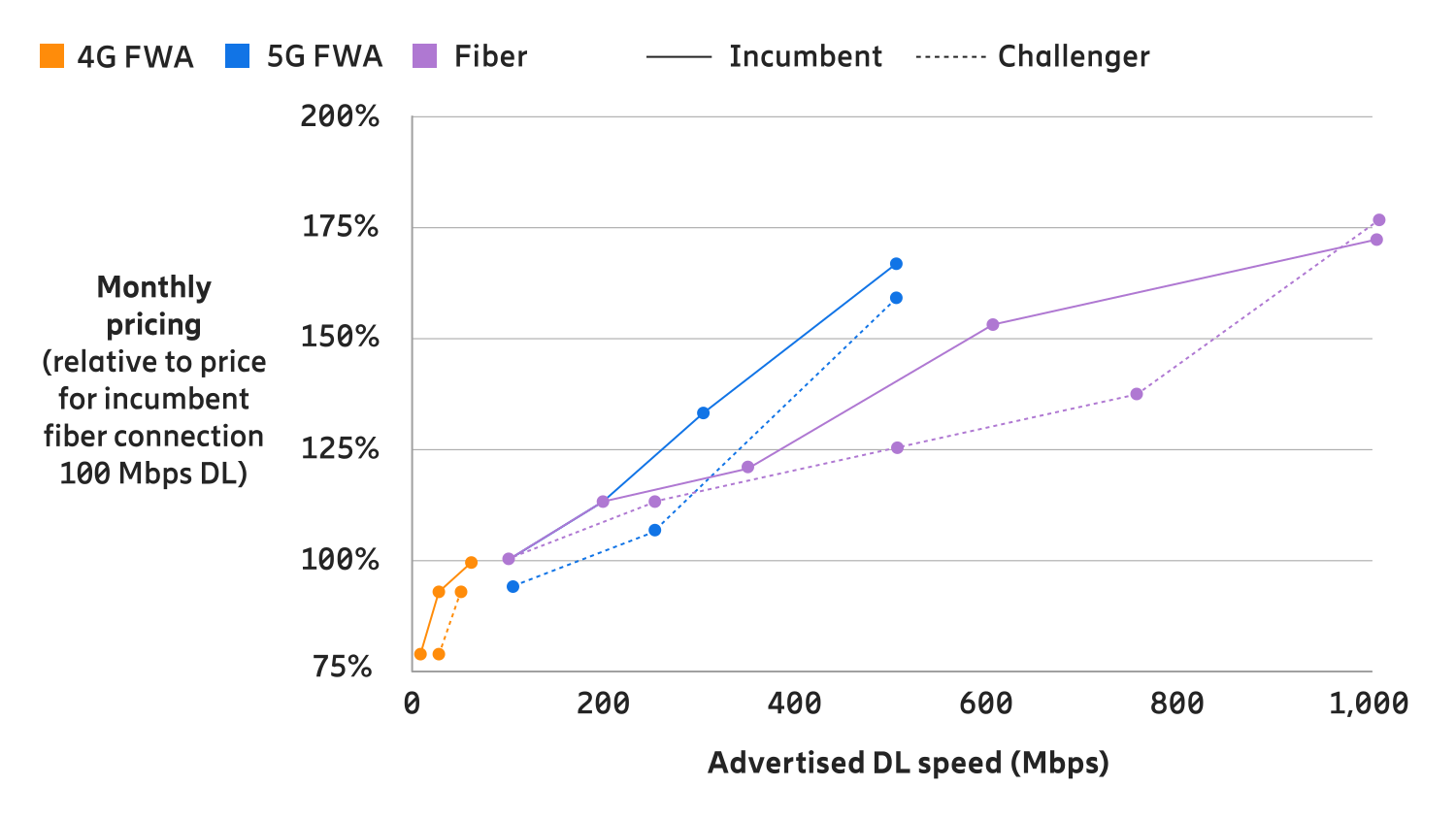
Service providers’ market positioning also influences home broadband pricing. Service providers that are market leaders or hold a strong incumbent position typically command a price premium over new entrants and challengers – driven by brand perception and market performance. As a result, challengers’ pricing tends to be pitched at a lower level (for example, with a lower tariff or more data for the same price), and this applies across technologies and speed tiers.
Home broadband pricing is also affected by competition at local level, in contrast to mobile broadband, where prices are set at a regional or national level. Home broadband competition is set at the address level, which defines the availability of speed tiers and alternatives. As a result, national list prices can be adjusted to the local competitive environment through discounts (such as tariff reductions) and incentives (such as free installation or a period of free service).
Figure 12 illustrates these competitive dynamics in a European market, comparing 4G FWA, 5G FWA and fiber tariff plans across various speed levels. Both the incumbent and the challenger are converged service providers, and the incumbent holds the price premium position. Figure 12 clearly shows that the challenger’s services are priced lower than those of the incumbent. It also shows how 4G FWA and 5G FWA complement each other to address multiple segments. 5G FWA pricing follows fiber pricing between 100 and 200 Mbps, with 5G FWA priced above fiber in higher-speed tiers to monetize high-speed tariff plans in locations that do not have fiber available.
Figure 12: Price positioning in the fixed broadband market – example
Optimizing profitability through choice of CPE
FWA profitability is affected by CPE choices determining premises and network costs as well as revenue drivers.
Premises costs relate to the direct costs of connecting a home or other type of premises. They include the cost for the CPE, where indoor CPE tends to cost less than outdoor CPE as it includes less expensive antenna components. Installation cost is another parameter, with indoor CPE having an advantage as there are no associated costs, or only minor ones such as eventual call center support for self-installation. While outdoor CPE often comes with a self-installation app, users might prefer professional installation.
Network cost includes all costs related to FWA for a RAN site (and proportion of other elements such as packet core). Outdoor CPE, with its higher spectral efficiency compared to indoor CPE, enables two to three times more FWA connections per site. As a result, unitary network cost per CPE can be two to three times lower for outdoor CPE than indoor CPE. Some service providers mitigate the drawbacks of indoor CPE by adding external antennas, including upgrades to external antennas at a later stage for high-end and cell edge users.
Time to market (TTM) is the first revenue driver, as it impacts uptake of customers. Speed of deployment is a key differentiator for FWA, with CPE choices also affecting that parameter. Indoor CPE would generally enable a faster TTM as there is no need for onsite installation. Another parameter is related to customer lifetime value, where outdoor CPE is generally correlated with longer customer contracts and lower churn compared to indoor CPE. Finally, outdoor CPE is associated with larger cells reaching more households, providing faster and more predictable broadband speeds than indoor CPE and therefore commanding higher prices.
Finding the right mix of indoor and outdoor CPE
Outdoor CPE allows better spectral efficiency compared to indoor CPE. While it may be an absolute necessity to have outdoor CPE for homes in some locations, there are other places, such as those close to a base station, where indoor CPE can be quite sufficient.
In cost-sensitive cases (like low-ARPU areas) or where TTM is crucial, it makes sense to deploy indoor units, which are typically cheaper and faster to deploy. For example, if the available spectrum is large, a first approach could be to provide indoor CPE to most homes, with an option to replace them later with outdoor units as required.
On the other hand, if the number of potential customers in an area is large relative to the available spectrum, it might be worth identifying customers who would benefit the most from outdoor CPE during the sales process. The improved spectral efficiency of outdoor CPE typically boosts range, which in turn increases coverage and the potential customer base, and drives up the proportion of outdoor CPE.
In one case study, when the 20 percent worst-located connections from a radio signal strength perspective were assigned outdoor CPE, the average number of connections per cell could be increased by around 60 percent, while the capacity doubled when only outdoor CPE was used. Even though results are dependent on individual case parameters, this example indicates the effects of mixing indoor and outdoor units.
FWA – a future-proof technology
FWA has emerged as the most popular 5G use case after mobile broadband, with leading service providers scaling and monetizing the 5G connectivity opportunity. Its competitiveness is based on three scale advantages:
- FWA leverages 5G’s multi-use case network scale, enabling service providers to make shared investments to monetize multiple use cases, spreading risks and lowering initial upfront investments to new use cases.
- FWA leverages the scale of the global 5G device ecosystem, reaching 1 billion connections in 2022 (2 years faster than 4G measured from its launch), enabling affordable devices and a broad device ecosystem.
- 5G FWA leverages the scale of the 3GPP innovation ecosystem, bringing billions of dollars of R&D investment and new spectrum to higher capacity and performance of devices and networks.
To highlight the third point, one of the latest 3GPP innovations has been the millimeter wave extended range functionality, enabling FWA connectivity at gigabit speeds over 11 km.
In summary, 5G service providers are well positioned to serve the more than 1 billion premises that currently lack fast and reliable broadband, closing the digital divide and empowering consumers and enterprises.
Figure 13: CPE choices impacting profitability in three areas

1 Please check The value of 5G WWAN lies in layers report to find out more about Wireless WAN.