



Skip navigation
Previous searches
    Suggested searches

      Unlocking uplink opportunities with next generation video codecs

      As uplink video traffic grows, more efficient video coding can help networks keep pace. This white paper explores how VVC can reduce the resources needed for video uploads, increase network capacity and improve cell-edge performance. It also examines why wider support for VVC encoding in devices will be key to meeting the growing demands of upload-centric applications.

      Video Codecs: Unlocking more uplink in 5G and 6G networks

      Rising uplink traffic and video-intensive use cases are reshaping requirements on mobile networks. Discover how next-generation codecs such as VVC/H.266 can reduce bitrate, improve user experience and device efficiency, and help network operators maximize their investments as 5G evolves toward 6G.

      Introduction

      This white paper examines how video codec efficiency shapes uplink performance and why transitioning to more capable compression standards such as Versatile Video Coding/H.266 (VVC) is both technically justified and operationally urgent. It establishes the role codecs play in determining achievable data rates and quality within real-world uplink constraints.

      The analysis goes beyond the user-centric view of video coding performance to examine system-level impacts. It reveals that the capacity gains enabled by codec efficiency are disproportionately large relative to the bitrate savings alone. This becomes clear when reduced resource utilization on the shared uplink is traced through to cell capacity and cell-edge performance. As a result, the system-level case for codec modernization is significantly stronger than the user-level case suggests. Furthermore, codec efficiency and uplink capability are complementary: combined with improvements through new spectrum, network densification, or 5G enhancements, more efficient video coding can amplify the return on those investments.

      The paper concludes with a call for coordinated industry action. VVC is a standardized solution, ready for deployment at scale, and increasingly supported on devices for video consumption through hardware and software decoding. However, realizing its full potential for rising uplink traffic over the next decade will require equal attention to the encoding side, ensuring that devices are equipped to support VVC not only for playback but also for upload-centric applications.

      (Un)-expected rise of uplink video traffic

      Uplink traffic is growing, and the trend is set to accelerate. For most of the mobile network deployment history, this would have seemed unremarkable: networks were built around downlink, and rightly so. Video streaming, social media, and file sharing made downlink traffic an overwhelming priority, with up to 90 percent of data traffic today still flowing toward the user[1]. Network investments, infrastructure optimizations, and capacity planning have followed that same logic, treating the uplink as a secondary dimension.

      That balance is beginning to shift. Video is already the dominant driver of uplink traffic, with file uploads and video calls continuing to grow across cloud storage, communication, and social media platforms[1]. But a more significant inflection point lies ahead. Emerging AI-driven applications such as AI/AR smart glasses relying on cloud inference from continuous video input, autonomous vehicles transmitting large datasets for training and remote operation, always-on AI companions, robots, and drones, are set to dramatically increase uplink volumes [2][3]. These applications share a common characteristic: they require a constant stream of data from the user and their surroundings to function. The role of the mobile user is changing from primarily a consumer of data delivered by the network to simultaneously a contributor of data that the network must carry upstream, at scale, in real time.

      End-user investigations[4] also indicate a change in user behavior: AI/AR glasses enable hands-free experiences and easy content creation that users may want to share instantly. They generate more uplink data and expect the services to always be available, irrespective of location and time of day. To meet these expectations, improvements in uplink coverage and capacity may be needed in many locations.

      The increasing uplink traffic volumes will significantly narrow the current asymmetry between downlink and uplink. Yet these services may require performance beyond current capabilities of best-effort mobile broadband. This need for higher-performing uplinks is addressed in the Ericsson Technology Review article [5], which examines in detail a range of capacity and coverage improvements required to scale up network uplink performance. The recommended improvements include new radio access network software features, spectrum strategy, hardware upgrades for radios and antennas, and site densification.

      Role of video codecs in shaping data rates
      All wireless video is compressed with video codecs

      Video is one of the most data-intensive media formats. A single 45-minute 4K TV episode in raw, uncompressed form requires just under 2 TB of storage. This is more than four times the capacity of a typical consumer laptop or smartphone, while sports or gaming content at equivalent quality would demand at least twice that. As a result, virtually every video, from capture to display, relies on compression through video codecs.

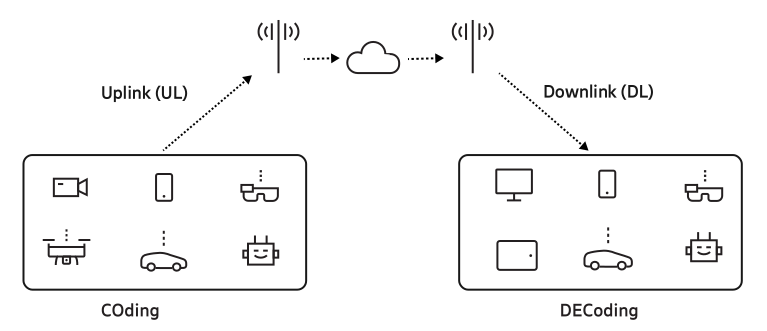
      Figure 1. Video coding deployment in a mobile data transmission system.

      Figure 1. Video coding deployment in a mobile data transmission system.

      A video codec consists of an encoder, which compresses raw video into a bitstream, and a decoder, which reconstructs back to uncompressed format, for example for playback. Compression is typically lossy, enabling significant bitrate reductions while maintaining acceptable perceptual quality. In mobile data transmission systems, the encoder operates on the transmitting side and is associated with the uplink, while the decoder operates on the receiving side and is associated with the downlink (see Figure 1). Thanks to video codecs such as High Efficiency Video Coding/H.265 (HEVC), streaming of 4K video is possible today with bitrates between 15-30 Mbps instead of the 6-12 Gbps otherwise required for the uncompressed video achieving a high compression ratio of about 400:1[6].

      Not every video codec is the same

      Advanced Video Coding/H.264 (AVC), standardized in the early 2000s, remains the most widely used video codec today. Its introduction was a pivotal moment for the video ecosystem, enabling mobile video streaming and widespread high definition (HD) videodeployment at scale. Its successor, HEVC, standardized in 2013, halved the bitrate required for equivalent quality and is now ubiquitous across mobile platforms and streaming services, with the additional benefit of enabling efficient 4K ultra-high definition (UHD) and high dynamic range (HDR) video capture and delivery [7].

      VVC, standardized in 2020, is the latest generation in this codec family. It delivers a further 50 percent bitrate reduction compared to HEVC and extends built-in flexibility to support a broader range of applications, including low-latency streaming, immersive video, and gaming [8].

      All three codecs were developed as open international standards through worldwide collaboration of industry and academia under a joint standardization framework of International Organization for Standardization (ISO), International Electrotechnical Commission (IEC), and International Telecommunication Union (ITU). Outside this framework, notable codecs in deployment include Google's VP9 (2013), the Alliance for Open Media's AV1 (2018), and China's AVS-3 (2021).

      Video codec performance is not fixed

      A common oversimplification in discussions regarding video delivery is that codec technology alone determines the bitrate required to deliver a given quality level. In real life deployments, achievable bitrates result from several interacting factors. The most critical are the complexity of the codec technology and its implementation, the complexity of the underlying video content, and operational constraints (see Table 1).

      Factor Relative bitrate impact
      Codec generation
      (decoder complexity)
      Newer codecs => lower bitrate
      (~75% bitrate reduction from AVC to VVC)
      Encoder computational complexity High complexity and high power (server) => lower bitrate
      Small form factor and low power (mobile/Internet of Things (IoT) chipset) => higher bitrate
      Content format High resolution => bitrate increase
      (sublinear relationship between pixel count and bitrate)
      Content complexity Static video (e.g., talking head) => lower bitrate
      Complex and rich video (e.g., high motion sports) => higher bitrate
      Latency and operational requirements Buffered or non-real-time video => lower bitrates
      Low-latency or real-time video => higher bitrates

      Table 1. Factors influencing video delivery bitrates.

      Beyond these technical constraints, the operating point across these elements is also shaped by commercial deployment considerations. The cost of sophisticated, compute-intensive encoding can typically be justified for one-to-many video streaming services, where a single high-quality encode is distributed to millions of viewers. Conversely, for long-tail (less popular) content and single-session use cases such as user-generated and AI video uploads or video conferencing, the economics of encoding shift toward the use of less complex implementations.

      This is especially relevant for uplink-centric applications, where the video encoder typically does not reside in a powerful server farm but inside a small-form-factor device: smartphone, wearable, or drone, where silicon area, power envelope, and thermal headroom are the binding constraints. This creates a practical paradox: equivalent-quality video requires more bandwidth on the uplink, due to constrained encoder complexity, precisely where the network provides less of it. This is why codec performance and implementation-friendly codec design is particularly important for the uplink part of the video chain.

      Addressing uplink video requirements with VVC
      VVC addresses both dimensions: compression performance and hardware-friendly design. It was developed and standardized with broad industry participation, including hardware vendors, content and service providers, and implementers. VVC's compression-efficiency gains are underpinned by a broad set of features that enhance both coding performance and encoder flexibility, enabling those gains to be realized across a wide range of use cases and operational conditions, such as low-latency and real-time scenarios. Its key capabilities include:

      • native wide color gamut and HDR support for modern mobile camera content
      • purpose-built screen-content coding tools suited to the growing share of screen-sharing and video-conferencing traffic
      • subpicture and tile-based architecture enabling region of interest encoding and on-the-fly bitstream composition and personalization
      • built-in low-latency support, including gradual decoding refresh, which ensures stable quality even under tight bandwidth constraints
      • dynamic video-resolution adaptation that allows effective bitrate adaption to varying bandwidth and congestion, for example through integration with low-latency, low-loss, scalable throughput architectures

      In the following sections, we investigate the impacts of improved compression performance both from a user-level and a system-level perspective.

      User-level impacts

      For users uploading video over cellular networks, more efficient codecs deliver direct gains in both upload speed and quality. A 4K HDR video shared on a social media platform typically requires at least 35 Mbps with AVC. HEVC halves that requirement to 15–25 Mbps at equivalent quality, while VVC reduces it further to 8–15 Mbps. For a 10-minute 4K HDR video clip, this translates to a file size reduction from around 3 GB with AVC to approximately 1.5 GB with HEVC and under 1 GB with VVC, cutting upload time and data consumption proportionally.

      If faster upload time or video size reduction are not the primary goals, a more efficient codec can instead be used to improve visual quality. This is especially important for uplink video, because for content shared on social media platforms, for example, the quality achieved during uplink stage sets the quality ceiling for all downstream uses of that source: transcoding, storage, redistribution, playback, and AI or machine-vision inference. Any unwanted quality drop during the uplink would affect every subsequent reuse of the content.

      For extended or always-on video sessions, compression efficiency has a compounding impact. A one-hour HD video call at 1.5 Mbps with AVC consumes approximately 675 MB. VVC reduces that to around 250 MB at equivalent quality, which is a substantial difference for users on capped data plans. This matters even more in continuous video use cases such as AI-enabled smart glasses, where video is persistently streamed to on-device or cloud inference pipelines.

      Finally, the compression-efficiency gains speak directly to one of the key 2030 ambitions of International Mobile Telecommunications: bridging the digital divide and extending meaningful internet access to all [9]. Where basic connectivity exists but bandwidth is scarce, VVC enables essential public services such as online medical consultations and remote education to be delivered cost-effectively over constrained links.

      System-level impacts

      While the benefits of video compression are evident at the individual user level, understanding their full impact requires a closer look at how coding efficiency propagates through mobile network operations. User data rates in mobile networks are primarily governed by three main factors: available bandwidth, location within the cell, and network loading. Spectrum reuse across neighboring cells creates a significant signal-to-interference-plus-noise ratio (SINR) variation depending on where a user is located, while dynamic resource sharing means each user receives a smaller share of available bandwidth as network utilization increases. These factors compound one another: higher load raises interference from neighboring cells, further degrading SINR, reducing data rates, and increasing utilization and interference. Together, they can cause user data rates to vary by more than an order of magnitude across different locations and loading conditions [10].

      A critical consideration in network planning is understanding user satisfaction, which is shaped by the experience of cell-edge users. Cell-edge is defined as the fifth percentile of user distribution, meaning 95 percent of users achieve better performance. For cell-edge users, the weak serving signal forces link adaptation to select lower-throughput transmission modes, cutting achievable data rates. Under high load, this is further aggravated by stronger interference from neighboring cells and greater competition for the cell's own resources.

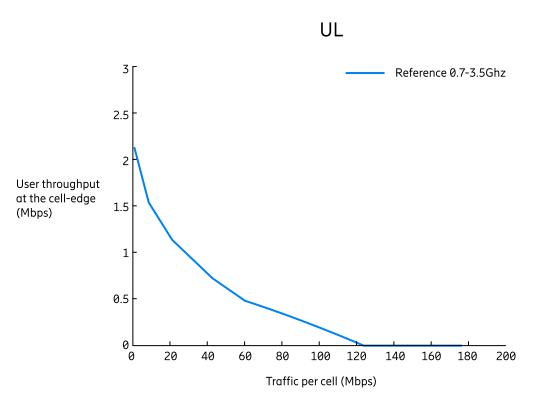
      Figure 2 Cell-edge user throughput as a function of traffic load for uplink traffic.
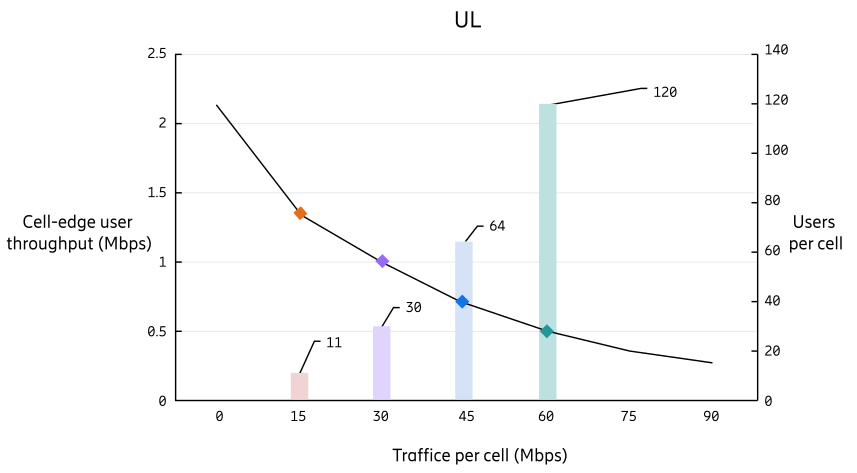
      Figure 2 Cell-edge user throughput as a function of traffic load for uplink traffic.

      As cell load increases in a dense urban macro scenario with 1 km inter-site distance and frequency bands in the range 0.7–3.5 GHz, cell-edge user uplink throughput decreases (see Figure 2) [11]. While the simulation results are representative of a modern wireless system, such as a 5G system, the uplink throughput observed in real networks may differ between cells or operators, but the overall trend will be the same. With a higher traffic load in the cell, the probability that users must queue behind other users in their own cell, as well as the probability of interference from users in neighboring cells, increases, and user throughput decreases.

      Relevant questions for communications service providers (CSPs) considering the impact of reduced codec bitrate are at the system level: How many additional uplink video flows can be supported simultaneously? How does lower video bitrate relieve congestion on shared radio resources, particularly at the cell-edge?

      Figure 3. Relationship between total traffic per cell and limit on use throughput (zoomed in version curve in Figure 2) for uplink traffic.

      Figure 3. Relationship between total traffic per cell and limit on use throughput (zoomed in version curve in Figure 2) for uplink traffic.

      Figure 3 shows four operating points for an uplink video service, marked as colored diamonds at cell-edge user throughput of 1.35 Mbps (orange), 1.0 Mbps (magenta), 0.7 Mbps (blue), and 0.5 Mbps (green). These operating points correspond to a video service delivered at different bitrates, which can be associated with the performance of different codec generations at the same service quality. At each point, the uplink data consists of the bitrate for the video service and a small protocol overhead. The vertical bars and the right-hand axis show how many uplink video flows per cell can be supported at each operating point.

      A bitrate of 1.35 Mbps could be associated with a real-time video upload at standard definition (SD) quality using the AVC video codec. When the video service requires at least 1.35 Mbps, the total uplink traffic in the cell must not exceed 15 Mbps. In this situation, 95 percent of users in the cell have at least 1.35 Mbps uplink throughput and receive satisfactory service. A total cell traffic of 15 Mbps corresponds to about 11 simultaneous uplink video flows per cell.

      The lower operating points, 1 Mbps and 0.7 Mbps, represent effective bitrate reductions of 25 percent and 50 percent, respectively, and could be associated with the same-quality real-time video upload using the HEVC codec. Similarly, 0.7 Mbps and 0.5 Mbps represent bitrate savings of 50 percent and 65 percent using the VVC codec.

      The bitrate-saving range between 25 percent and 50 percent results in approximately 2.7 to 5.8 times more uplink video flows that can be supported in the cell, while the bitrate-saving range between 50 percent and 65 percent results in approximately 5.8 to 10.9 times more supported flows (see Table 2). In absolute terms, this corresponds to an increase from about 11 flows per cell for SD video with the AVC codec to around 120 flows per cell with the VVC codec, without sacrificing resulting video quality, in the same cellular infrastructure. Such a dramatic increase signifies a capacity boost significantly exceeding what could be expected from analyzing video-coding gains for a single user alone.

        New operating point
      ↓ Old operating point   1.0 Mbps   0.7 Mbps   0.5 Mbps
        1.35 Mbps 2.7x users
      (25% lower bitrate)
      5.8x users
      (50% lower bitrate)
      10.9x users
      (65% lower bitrate)
        1.0 Mbps 1x 2.1x users
      (30% lower bitrate)
      4x users
      (50% lower bitrate)
        0.7 Mbps - 1x 1.9x users
      (30% lower bitrate)

      Table 2. Increase in cell-edge users for different operating points corresponding to video compression gains.

      Translating video compression impacts into benefits

      The cell-edge analysis reveals a compounding effect: the users who benefit most from improved video-compression efficiency are those whose traffic places the greatest strain on network resources. This creates a rare alignment where a single technology improvement simultaneously advances the interests of end users, service providers, and network operators.

      End-user benefits:

      • Increased video usage without extra data: VVC's ability to deliver the same quality at half or less of the bitrate means endpoints can use a wider range of high-quality video services without rapidly exhausting a fixed data allowance.
      • Higher source quality carried end-to-end: Video quality is set at the point of capture. What enters the network at low-quality stays low-quality downstream. VVC allows end-users to transmit high-quality video formats at bitrates previously limited to lower resolutions, raising the quality floor for every viewer and platform that receives the content.
      • Improved access in constrained uplink conditions: Users at the cell edge, indoors, or in rural areas gain access to video-enabled services over constrained uplink channels, narrowing the quality gap between well-served and underserved users.

      Service providers benefits:

      • New services unlocked: Better video compression efficiency makes a range of uplink video services, that were previously too bandwidth-demanding to deliver reliably at scale, viable. This expands the addressable market beyond existing offerings, creating opportunities to launch new services for both consumer and enterprise segments.
      • Expanded addressable market: VVC's ability to deliver viable video quality at bitrates previously insufficient for usable service extends the geographic and demographic reach of video platforms and live-streaming services to users and coverage areas that were previously unreachable.
      • Reduced transport and infrastructure costs: Lower per-stream bitrates mean less bandwidth is needed to upload, transcode, store and distribute video. For service providers handling large volumes of AI or user-generated and professionally contributed content, this helps keep infrastructure investment at a sustainable rate as traffic continues to grow and new uplink services emerge.

      CSP benefits:

      • Amplified returns on network investment: The growth of uplink-intensive video services is driving a fundamental rebalancing of traffic demand, making further investment in uplink capacity critical. By amplifying the capacity effect of every improvement in uplink capability, whether through new spectrum, densification, or 5G enhancements, VVC ensures network investment yields disproportionately larger improvements in the number of supported uplink users and in service quality.
      • Extended coverage for premium uplink services: By making high-quality video transmission viable at lower throughput levels, VVC enables CSPs to offer differentiated uplink video services across a larger share of their coverage footprint, improving both revenue per square kilometer and user-experience metrics in coverage-limited areas.
      • Differentiated premium uplink offerings: CSPs that have invested in 5G new radio, carrier aggregation, enhanced multiple-input, multiple-output antennas, can unlock stronger commercial returns when those capabilities are paired with VVC-capable devices. The combination creates the conditions for credible uplink-video service-level agreements with guaranteed quality levels and prioritized bandwidth for premium tiers. This opens differentiated service offerings for broadcasters, public safety agencies, and enterprise customers, transforming uplink video from a best-effort consumer feature into a managed, monetizable service.

      Conclusions and call for action

      Two decades ago, AVC brought video to the mobile internet: constrained, low-resolution, and one-directional. Today, video is the dominant form of communication and underpins essential services on cellular networks, where it accounts for over 75 percent of all traffic. Traffic is no longer flowing only downstream. Users, creators, and AI-assisted devices are pushing high-quality video over the uplink at a scale that legacy codecs were never designed to support. Efficient uplink video transmission has become a core requirement for enabling new and emerging services. VVC is standardized, proven, ready to be deployed at scale, and well positioned to address these requirements over the next decade. Realizing that potential requires a coordinated industry effort to put the technology already available to work.

      VVC is standardized, proven, and increasingly deployed for playback across consumer devices through growing hardware and software decoding support. It is ready to be deployed at scale and well positioned to address these requirements for the next decade. Realizing that potential requires a coordinated industry effort to put technology that is already available to work, extending the momentum behind decoding to the encoding side, where uplink efficiency matters most.

      Looking ahead, as uplink-centric applications grow in scale and diversity, video codecs must increasingly address uplink traffic requirements. Codec innovation and evolution, in step with the broader rebalancing of network architectures, will ensure readiness for AI video traffic and the applications of the 6G era [12].

      Contributors

      Lukasz Litwic

      Lukasz Litwic is a Senior Research Manager of Visual Technology team responsible for standardization activities in visual media coding at Ericsson. Lukasz represents Ericsson at several standardisation bodies including ITU-T SG21, 3GPP SA4, DVB, JVET and MPEG. He serves as a Vice-chair of ITU-T SG21 and Chair of Interoperability WG at Media Coding Industry Forum. He holds an M.Sc. from Gdansk University of Technology, Poland, and a Ph.D. from the University of Surrey, in Guildford in the UK.

      Anders Furuskär

      Anders Furuskär joined Ericsson Research in 1997 and is currently a senior expert focusing on radio resource management and performance evaluation of wireless networks. He holds an M.Sc. in electrical engineering and a Ph.D. in radio communications systems, both from KTH Royal Institute of Technology.

      Dr. Jonas Kronander

      Jonas Kronander is a Senior Research Manager in RA Networks and has been with Ericsson Research since 2007. He is the manager of a section focusing on research and standardization of radio networks for machine-type communication. He has been engaged in research leading up to 5G and 6G and his current research interests include aspects of augmented reality and its impact on radio networks. Jonas Kronander holds an M.Sc. in Engineering Physics and a Ph.D. in Theoretical Physics from Uppsala University, Sweden.

      Thorsten Lohmar

      Thorsten Lohmar brings extensive expertise in wireless communication and media delivery technologies, with a track record of advancing industry innovation. He holds a diploma from the Technical University of Aachen (1997) and a PhD in Electrical Engineering from the same institution (2011). Since joining Ericsson Germany in 1998, Thorsten has built a distinguished career spanning multiple business units and research divisions, with significant involvement in industry standards development. His work has encompassed a broad range of mobile communication technologies, with particular focus on multimedia innovation and optimization. Thorsten's research interests center around wireless video delivery across both downlink and uplink channels, alongside transmission optimization strategies. In recent years, he has pioneered efforts to integrate 5G network capabilities into professional media production environments, collaborating with industry stakeholders to develop solutions that leverage Network APIs for seamless workflow integration.

      Eric Ericsson

      Eric Ericsson joined Ericsson in 1998 and has held a range of leadership and technology roles throughout his career. He has been responsible for Ericsson’s enterprise voice portfolio and was a key driver in the development and evolution of VoLTE from 2005 to 2015. Between 2013 and 2015, he was based in Japan, working for Ericsson Japan.

      From 2017 to 2020, Eric was responsible for establishing and developing Ericsson’s Telecom Cloud portfolio. Since 2020, he has been part of Ericsson’s Business Area Networks organization (BNEW), where his focus has included differentiated connectivity, connected vehicles, and tactical defence systems.

      Eric is currently part of the BNEW RCE R&D organization, focusing on the evolution of radio system platforms and security.

      He is based in Stockholm, Sweden.