










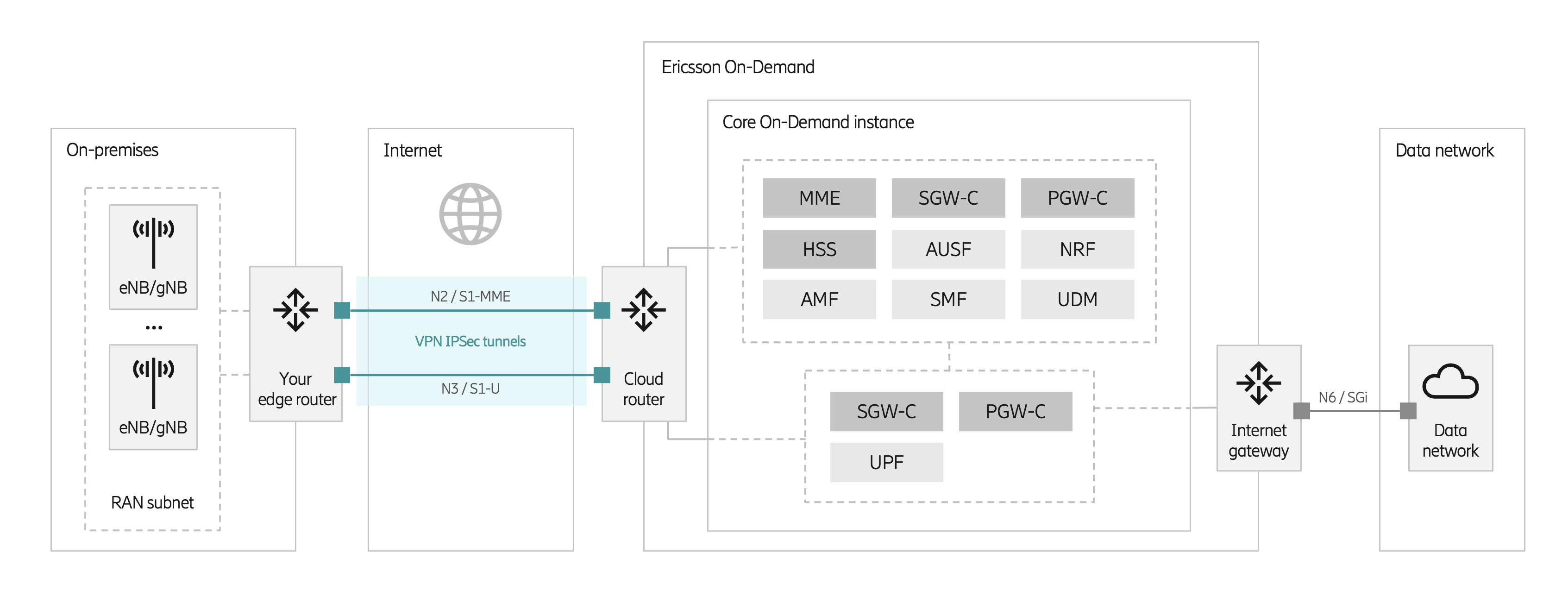
Core On-Demand connectivity support for private wireless access use cases is defined through the exposure of 5G 3GPP interfaces N2, N3, N6 and 4G 3GPP interfaces S1-MME, S1-U, and SGi.
The N2/S1-MME and N3/S1-U interfaces are essential for control plane and user plane traffic, connecting to the communication service provider (CSP) RAN network through secure VPN connections over the public internet. This secure connectivity ensures the integrity and confidentiality of data transmission between the core network and CSP infrastructure.
N6/SGi interfaces are directly exposed to the internet through Google Cloud's Internet Gateway, offering efficient data path routing for end-user traffic.
On-Demand – Network connectivity
3GPP interfaces
N2 / S1-MME
The N2/S1-MME interfaces are essential for managing user equipment (UE) and handling sessions. When a Core On-Demand instance is created, the N2 and S1-MME interface IP addresses are automatically configured and made visible to customers.
N3 / S1-U
N3 and S1-U interfaces carry user data payload between the radio access network and the core network.
The IP address of the UPF's N3 interface endpoint is communicated to the gNB (gNodeB) via the N2 interface within the N2 PDU session request/response messages.
Similarly, the IP address of the gNB's N3 interface endpoint is also part of this negotiation, enabling the UPF to send downlink data to the gNB.
The IP address of the SGW's S1-U interface endpoint is communicated to the eNB (eNodeB) via the S1-MME interface within S1-AP (S1 application protocol) messages like E-RAB setup request/response. The IP address of the eNB's S1-U interface endpoint is also part of this signaling, enabling the SGW to send downlink data to the eNB.
N6 / SGi
The N6 and SGi interfaces serve as the user plane interfaces connecting the core network to external data network. Each Core On-Demand instance is currently assigned a range of public IP addresses for N6/SGi.
Next: Life cycle management