










Cognitive networks – an introduction and outlook for the future

Principal Researcher, Networks

Master Researcher, Artificial Intelligence

Principal Researcher, Artificial Intelligence

Principal Researcher, network automation

Research Leader, Network automation
Principal Researcher, Networks
Master Researcher, Artificial Intelligence
Principal Researcher, Artificial Intelligence
Principal Researcher, network automation
Research Leader, Network automation
Principal Researcher, Networks
Master Researcher, Artificial Intelligence
Principal Researcher, Artificial Intelligence
Principal Researcher, network automation
Research Leader, Network automation

In the Five network trends towards the 6G era, our CTO Erik Ekudden describes that in a 10-year perspective, the network will evolve to support advanced use cases, like the Internet of Senses and communicating intelligent machines. In our 6G vision, we foresee that networks will host many services with diverse, and in many cases, extreme requirements. The resulting scale and diversity of services means that today’s partially automated operations will no longer be possible.
To prepare the network for the challenges ahead, we need to make it more intelligent, and the approach we have taken is what we call the cognitive network.
What is a cognitive network?
Cognition is a term from psychology and means “the action or process of acquiring knowledge, by reasoning or by intuition or through the senses.“ As humans, we perceive what happens around us, we reason around these perceptions, combining new perceptions with previous perceptions, and based on our understanding of the situation at hand, we identify the best line of action, even when we’ve never faced it before. This is exactly what we want a cognitive network to do.
If we can make the network cognitive, it would imply that the network itself can observe and act. Through observations, the network itself can find patterns in resource usage and take actions to optimize this usage. A cognitive network achieves a higher level of automation where the human network operator is relieved from network management and configuration tasks.
Initially, the human will guide the network in learning and taking decisions, but eventually we may achieve an autonomous network where the human is merely supervising and managing the automated operation, but is no longer actively taking part in configuration tasks.
If we want the network to be autonomous, we need to give it a certain level of freedom to choose its actions. One way to do this is to control it through intents. An intent is a “formal specification of all expectations including requirements, goals and constraints given to a technical system.” Intents specify what goal to achieve, contrary to many control interfaces today, where the system is rather instructed what to do and how to do it.
Intents are handled by an intent manager. There may be multiple intent managers distributed across the network, cooperating in a hierarchy (a so-called federated cognitive network). Each intent manager is responsible for a specific part of the network. Top level intents may be sent by humans.
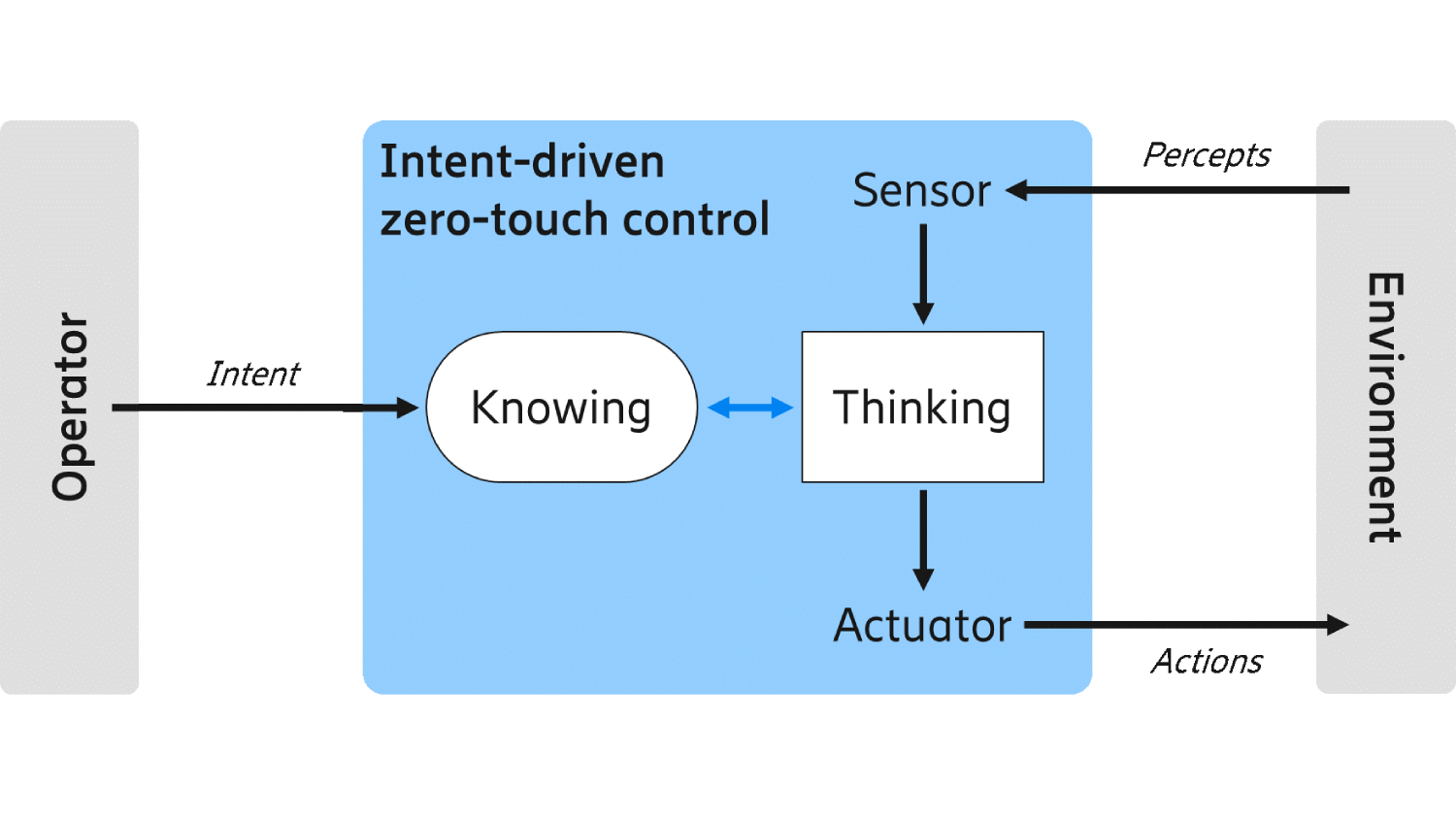
Figure 1: High-level view of an intent manager (dark blue) receiving intents, sending actions towards the controlled environment (light blue), monitoring the environment and the reporting the intent fulfilment to the sender of the intent.
Each intent manager will have cognitive functions that enable it to observe the environment under its control, draw conclusions from the acquired data, evaluate alternatives, and take action to fulfill the intents. The environment under control may be another intent manager or a part of the network infrastructure.
The cognitive functions use artificial intelligence (AI) features to draw conclusions from acquired data and available knowledge. Examples of such features include machine-learning models that can produce insights and machine-reasoning capabilities to reason around insights.
Cognitive network technology journey
The cognitive network technology trend is one of the technology journeys that make up our research agenda towards future technologies and 6G. The cognitive network will enable zero-touch deployment and operation, and continuous real-time performance improvements. It will do this with minimum human intervention by self-learning at scale from its experience and its interactions with the environment. To break it down, we have created six sub-journeys focusing on different components to reach the overall vision, see figure 2 below.
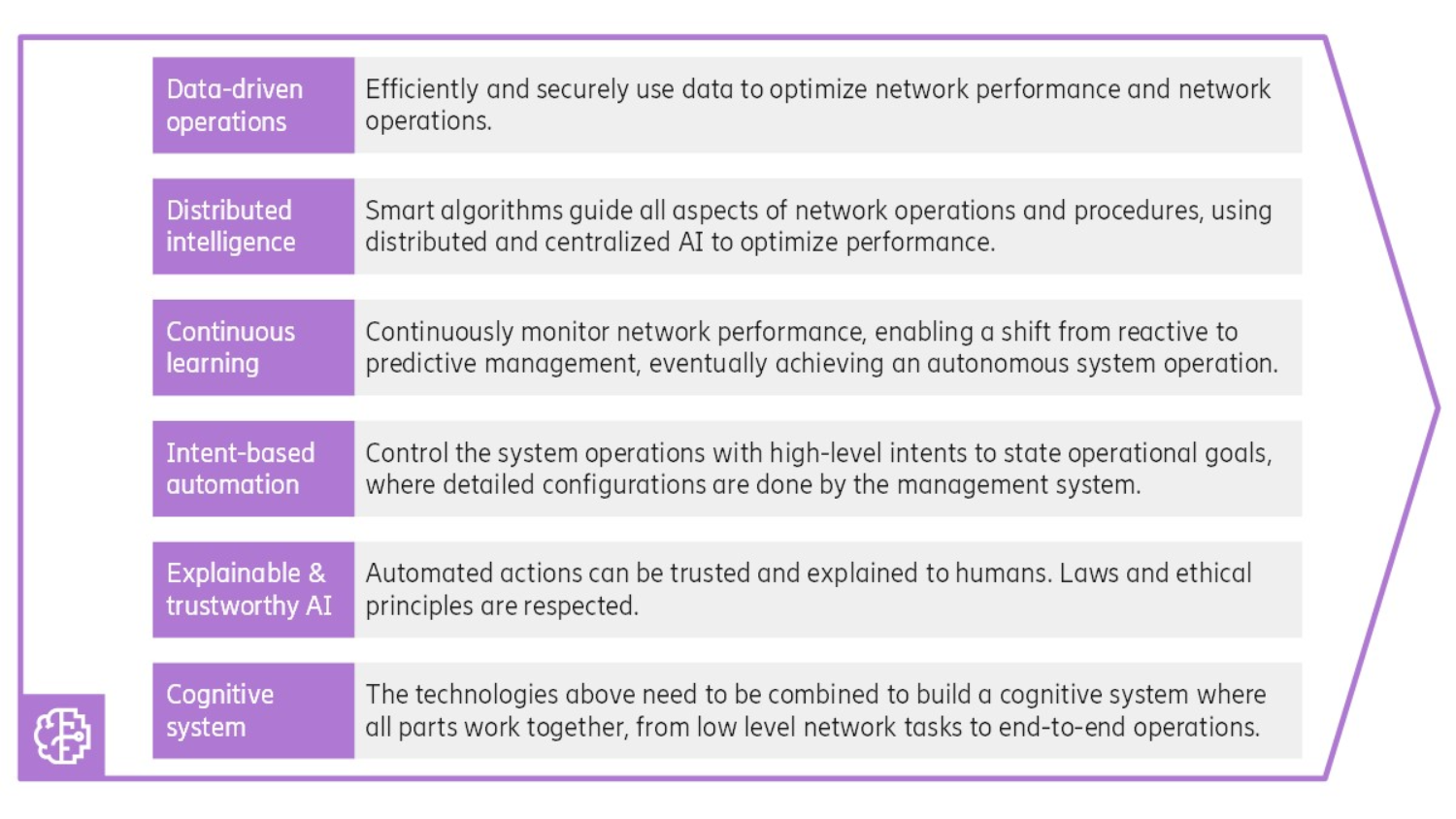
Figure 2: The six sub-journeys of the cognitive network technology journey in the Ericsson Research 6G vision.
Intelligence involves making automatic decisions based on facts or data, and with more data available, better decisions can be made. Data-driven operations and data-driven network architecture provide reliable and useful data in a timely and secure manner. Smart data collection and exposure makes sure it is handled efficiently. Both data itself and resulting models need to be lifecycle managed properly and integrated in training, and development pipelines need to be put in place.
Wireless networks are by nature very distributed and will require distributed intelligence both for learning and decision making. At times, this comes from real-time requirements where a decision-making agent needs to be placed close to the function it steers. In other cases, we need to optimize the placement of data processing and learning functions to available computation resources. Novel AI algorithms optimized for large networks will be deployed in different places.
Continuous learning is an important capability of a cognitive network. Once this is realized, there will no longer be a need to manually update policies and algorithms to reach higher performance levels, as the system itself can continuously optimize its performance towards set intents. Once we automate the system, there will be many control loops for different services and resources. In general, each loop consists of four functional blocks: 1) monitor the environment under control; 2) analyze that data; 3) based on the analysis, decide what to do; 4) perform the decided action on the environment. Many of these closed loops will interact, and the system needs to understand how this happens and how to automatically resolve any resulting conflicts. By learning system and user behaviors, we also move from reactive to proactive management, where we take mitigation actions in advance to avoid future problems.
Humans will control the cognitive network through high-level operational goals in the form of intents, as outlined above. This intent-based automation requires well-defined formal languages for intents, as human natural language is ambiguous and meaning often depends on implicit assumptions. At the heart of this is the intent manager of figure 1, which relies on methods to interpret and analyze many different intents, sometimes with conflicting goals. To realize this, there is a need to understand abstract knowledge and make the right conclusions. Here, knowledge representation and machine reasoning are expected to play an important role. This article about intent-based networking is worth a read.
To be trusted by humans, the cognitive network needs to be based on explainable AI and trustworthy AI. This involves several aspects. Firstly, the system needs to be able to explain its actions, and why it ended up in its current state. Secondly, the intelligent system should act lawfully, respecting all applicable laws and regulations; ethically, respecting the right principles and values; and technically robust while considering its social environment. Thirdly, the system must involve humans to get input and guidance in the decision-making process when needed.
Finally, all individual technologies and building blocks need to work together as a single cognitive system, acting to fulfil its purpose as given by the provided intents. AI-based performance optimizations spanning from the physical layer to the application layer, across today’s technology and operational domains, will have to work together to reach all set operational goals. Network digital twins can be used to support different aspects of operations and development, ranging from evaluation of future scenarios to training of AI algorithms. In general, different approaches will likely need to be evaluated and combined to achieve this overarching goal of autonomous system operation.
Cognitive networks: the outlook
The increased level of autonomy we have described above will allow the network to grow in expected scale and diversity of services, keeping the operator in control able to focus on more strategic challenges. Networks will gradually become cognitive systems with the ability to sense, reason, acquire new knowledge, and act autonomously. They will be fully controlled by intent-based technologies, simplifying the task for humans to define services and operational goals, while becoming the backbone infrastructure for a truly digital society.
The key enablers for this evolution will be data-driven operations, distributed intelligence, continuous learning, intent-based automation, and explainable and trustworthy AI. Moreover, all these technologies will have to be combined to work in synergy across different aspects of functional architecture, deployment scenarios and responsibility areas of different vendors and CSPs. Only then can we achieve the needed capabilities to optimize performance and operational efficiency.
Look out for our second blog post in this series, where we’ll deep dive into the technical side of cognitive networks.
Want to know more?
Read our 6G white paper on ever-present intelligent communication.
Read CTO, Erik Ekudden’s blog post, To deliver cognitive networks, we build human trust in AI.
Read more about Cognitive networks for adaptive intent-based operations.
Explore telecom AI
Explore AI in networks
Learn more about network automation