










A sn6gk peek into what’s next
6G
6G will go far beyond faster network speeds, reshaping industries, economies, and everyday life. As artificial intelligence (AI) and cloud innovation accelerate, networks must evolve into intelligent, adaptive platforms that take connectivity to the next level, creating an intelligent fabric that connects people and machines through mobile, cloud, and AI so they can work together seamlessly in real time. Now is the time to ready networks, rethink business models, and reframe ecosystems for a future defined by pervasive intelligence and limitless connectivity.
Step into the 6G era

Imagine a reality where human, physical and cyber worlds interact in real time
What 6G will unlock









6G timeline
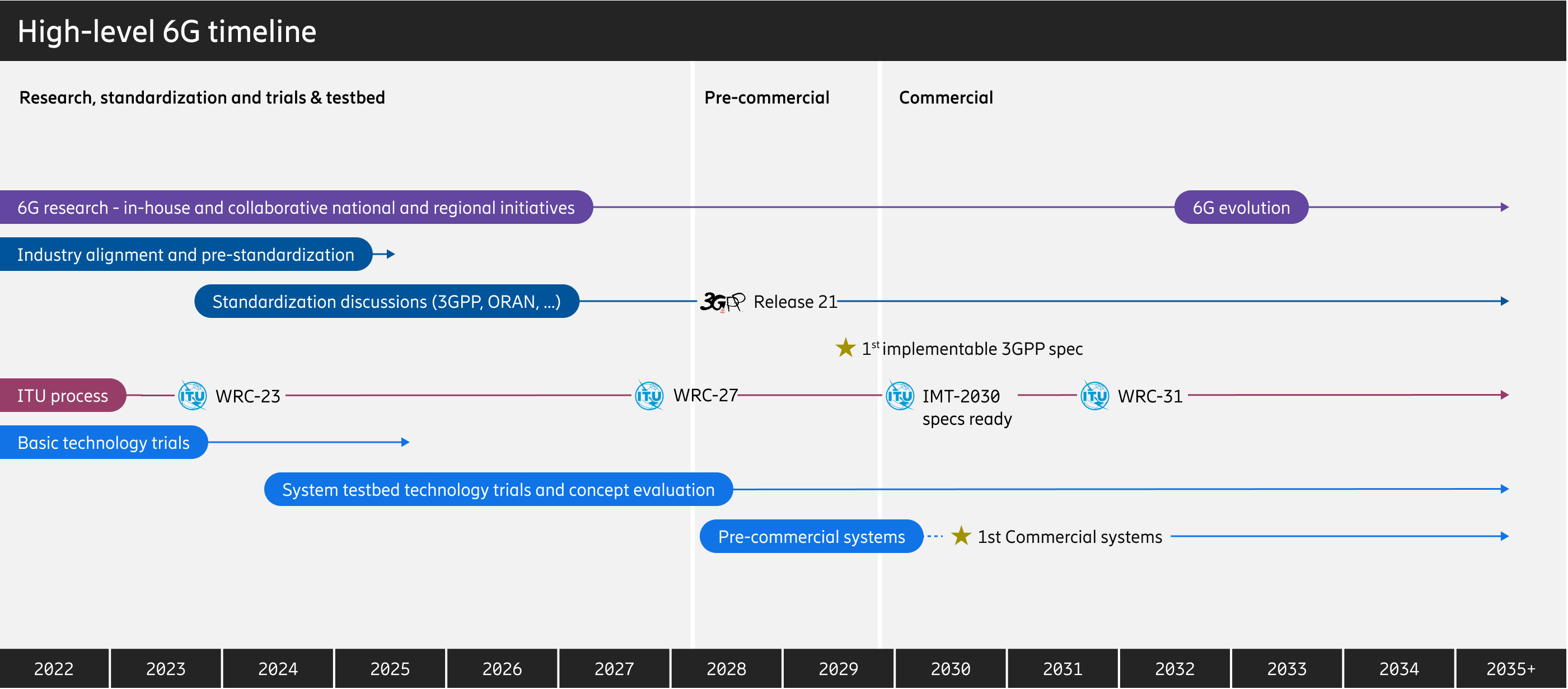
The 6G evolution

5G SA is the foundation of the 6G journey, delivering a cloud-native, programmable network that moves beyond best-effort connectivity. It enables new use cases and business models through differentiated connectivity, network APIs, and automation, spanning enhanced mobile broadband and fixed wireless access to private networks and advanced enterprise services.

By 2030, initial 6G deployments will establish a new baseline for performance and capabilities, building directly on existing 5G SA and 5G Advanced networks. In addition:
- Multi-radio access technology spectrum sharing (MRSS) and a 6G core evolved from 5GC will enable smooth migration.
- New centimeter-wave (cmWave) band spectrum and energy-efficient signaling will boost capacity and coverage.
A scalable, AI-native radio access technology (RAT), designed to support the most relevant use cases and relying on intelligence embedded across all layers, will serve both human users and AI workloads at scale.

After the first deployments, 6G networks will continue to evolve into a truly intelligent fabric, ready to meet accelerated AI needs and enable fully autonomous networks. In this phase:
- Solutions will be enhanced for selected verticals and high-value use cases.
- Spatial services will gain greater precision and coverage.
The system will adapt to new devices and agents, from digital twins to semantic communication and future network topologies, strengthening how mobile, cloud, and AI work together across the cyber-physical world.
Inside the 6G standardization journey
Explore more on 6G standardization




Shaping 6G with smart spectrum choices
An essential enabler of 6G
CmWave bands, primarily in the 7 to 8.5 GHz range, can provide good wide-area coverage with large contiguous bandwidths, unlocking new capacity without rebuilding the existing grid. Deployed adjacent to today’s mid-bands, cmWave can unleash substantial wide-area spectrum to support demanding 6G use cases such as AI-driven services, XR, integrated sensing, and massive digital twinning, while keeping site counts, costs, and power consumption under control.
See why cmWave is the ideal spectrum for 6G coverage and capacity

The transition to 6G in existing bands
Reusing today’s low- and mid-band (FR1) spectrum efficiently enables efficient coexistence between 5G and 6G without building entirely new site grids. Multi-RAT spectrum sharing (MRSS) lets 5G and 6G operate dynamically within the same carrier with very low overhead, so networks can add 6G capacity and performance while continuing to support existing 5G services and long-lived IoT deployments.
A potential future
Low band spectrum is essential for nationwide coverage, including rural areas, and for deep indoor penetration in urban areas. Access to low bands, such as 600 and 700 MHz, can bridge the digital divide and help close the connectivity gap.
Sub-THz spectrum was initially suggested as a potential frequency range for 6G. However, it is not part of current discussions on 6G spectrum in regulatory groups because of, for instance, challenging propagation conditions.

6G architecture
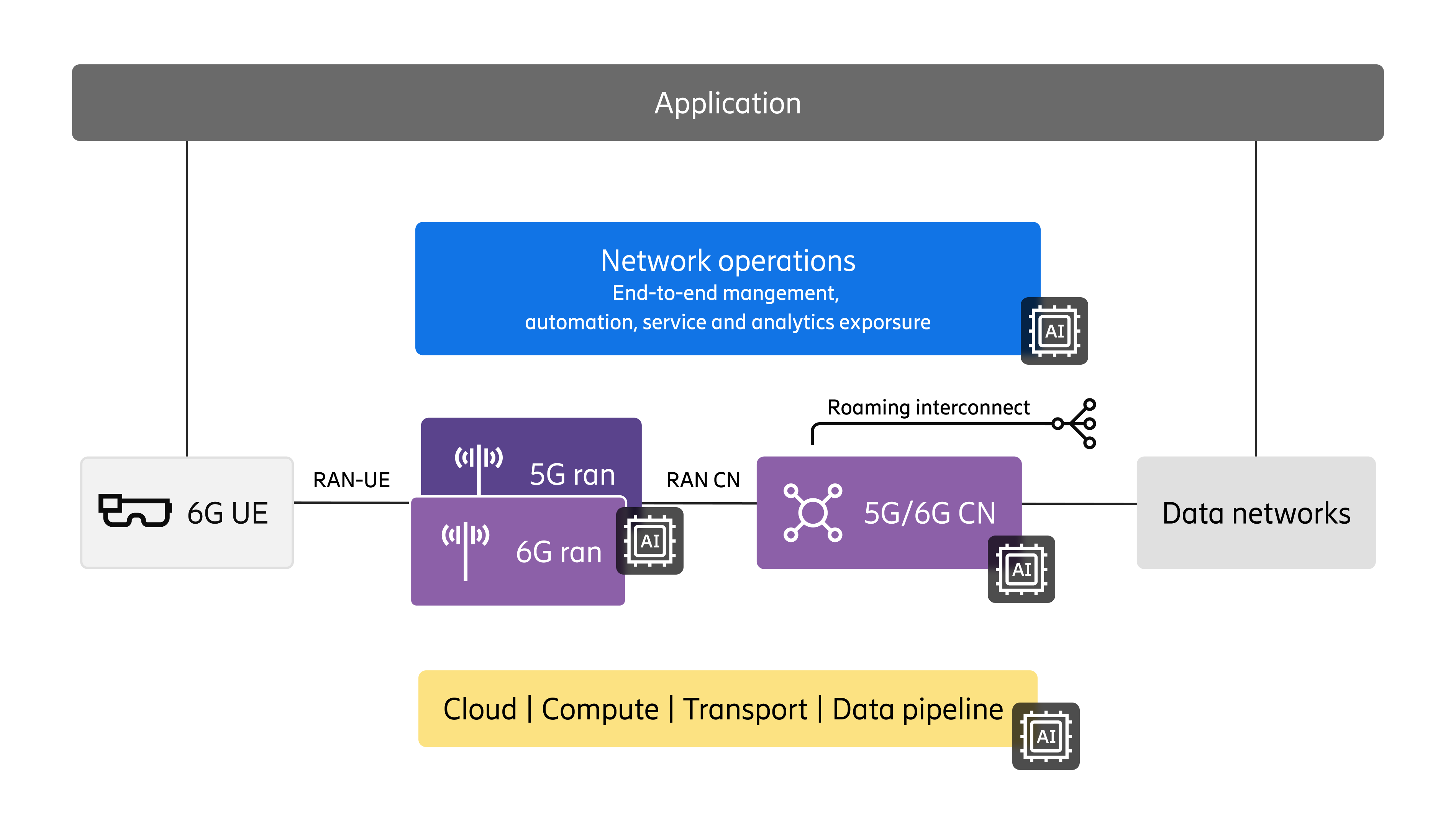
6G architecture with the most important features highlighted below
The core network will have a unified AI framework that governs AI design, deployment, and lifecycle, supported by holistic data collection, observability, and management, as well as requests from user equipment, agents, or application functions supplied to the network as intents.
A 6G core, evolved from 5GC, coexists with 5G, reusing slicing, exposure, and roaming while adding new 6G-specific functions and sharing spectrum with 5G to ensure a smooth migration path to 6G.
Standardized interfaces and network APIs expose network capabilities, such as sensing, allowing applications and AI agents to consume network services beyond basic connectivity.
6G will help share cloud, compute, and data platforms to provide the scale, elasticity, and placement flexibility that support future service evolution, from near-edge processing to AI workloads and energy-efficient deployments.